
Peloni: Having the capability of successfully providing the defense of the homeland is the primary and foremost obligation of any nation’s governing body. Hence, it is unfortunate that so many nations in the world have come to accept that such obligations are either arbitrary or conditional, just as it is unfortunate that those nations who are so inclined to ignore such necessities as border defense will likely pass into the pages of history when they find that their security capabilities, or lack thereof, are someday tested.
Security is not a slogan; it is a capability.
Am Thinker | January 19, 2026
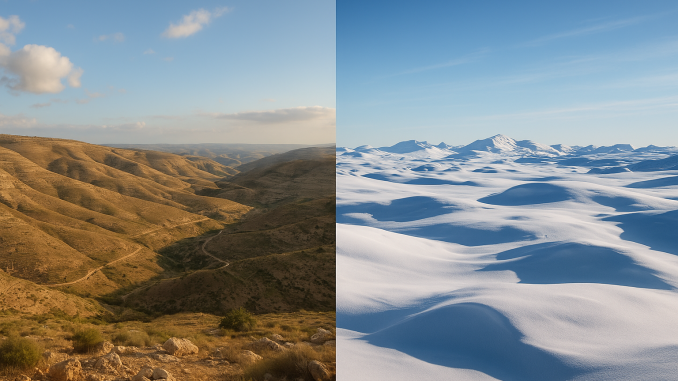 Landscape images of the Judean Hills and Greenland drifts. Image created via AI
President Trump is saying it plainly — and repeatedly — right now: Greenland matters because security matters. Russia’s invasion of Ukraine and China’s near daily threats toward Taiwan, including flying military aircraft near its airspace and rehearsing naval blockades, are just two obvious examples. This much should be obvious: the United States can defend Greenland. Denmark, an extremely small nation of roughly six million people, cannot.
That same hard truth applies to Judea-Samaria — what the New York Times, the United Nations, and the Palestinian Arabs call the West Bank — what October 7 demonstrated is that Israel must retain exclusive security control of the entire region.
Security is not a slogan; it is a capability. It requires intelligence dominance, rapid response, air control, logistics, and the political will to act decisively when threats emerge. Israel possesses those capabilities. The Palestinian Authority does not. It never has.
Even today, it is the Israel Defense Forces — not the Palestinian Authority — that prevent Judea-Samaria from collapsing into the kind of murderer-led enclave seen in Gaza. Israeli forces disrupt terrorist cells, intercept weapons, and prevent mass-casualty attacks not only against Israelis inside the so-called Green Line, but also against Jewish families living in communities in Judea-Samaria itself. Without Israel, those Jews would be defenseless. This is reality.
American conservatives should have no trouble understanding this. Conservatives believe that borders must be defensible. They believe that security precedes diplomacy, and know that pretending weakness is strength only invites aggression. The lesson of Ukraine is clear: when aggressors believe territory is weakly defended, they move. Outsourcing security to entities that lack the means to provide it is not moral — it is reckless.
Geography reinforces the point. Greenland is not merely associated with North America; it is part of its strategic ecosystem. Arctic shipping lanes, missile defense, early-warning systems, and great-power rivalry all run through Greenland. With China pushing into the Arctic and Russia militarizing the polar north, Greenland is no longer a distant ice sheet — it is a frontline. Its future aligns naturally with the United States, not Europe.
So too with Judea-Samaria. The area’s ridgelines dominate Israel’s population centers. Its water aquifers feed Israel’s cities. Its roads, commerce, and labor markets flow westward. The notion that Judea-Samaria “belongs” with the Hashemite Kingdom of Jordan — an entirely separate state east of the Jordan River — ignores every strategic and geographic reality on the ground. Jordan has its own challenges and has neither the desire nor the capacity to absorb or secure the territory.
Equally mistaken is the idea that the Palestinian Authority can be allowed to be a part of the future of the region. Mahmoud Abbas, head of the PA, has also long been given a free pass from the UN and others regarding the PA’s harboring and protecting of terrorists. The PA has one of the largest per-capita security forces in the world (over 60,000 men) and it has largely been armed and trained by the United States. Yet instead of using those forces to arrest and extradite terrorists — as the Oslo Accords require — Abbas and his PA pay salaries to terrorists and their families, and shelter fugitive terrorists so Israel can’t capture them.
Neither Jordan nor the Palestinian Authority can be trusted with the future of Judea-Samaria.
President Trump’s Greenland idea is not about conquest; it is about the future and about responsibility. Power carries obligations, and the first obligation is defense. The same realism that recognizes China’s threat to Taiwan and Russia’s brutality in Ukraine applies in the Middle East. Pretending that security can be subcontracted to weak or fragmented authorities is how regions collapse and wars begin.
Judea-Samaria in hostile hands would not produce peace. It would give birth to one huge terrorist base overlooking Israel’s heartland — just as abandoning strategic territory elsewhere invites adversaries to exploit it.
History does not punish strength; it punishes denial. Nations that survive are the ones that secure what they must, when they must. Those that hesitate learn the lesson later — at far higher cost. Americans who care about the future of Israel should stand with those Israelis that are working to remove the Palestinian Authority from Judea-Samaria and end the limbo in which the area has been trapped for far too long.
Moshe Phillips is national chairman of Americans For A Safe Israel, a leading pro-Israel advocacy and education organization.


The Greenland dispute is all the same a vanity exercise in formalities and Mr Trump’s vanity to be in history books as having added to US territory.
Since 1940 the US has only had to knock and ask – notify – politely for Denmark to let it do as necessary for rmutual defence. This incident, however it ends, will do no good for NATO; and excuses Russia in Ukraine and any mischief China may do in Taiwan.
Incidentally the Danes and other Norse were in Greenland before the 13 colonies were established.
UPDATE: Trump gains Greenland/Arctic Region Deal
What he says rings true. However the missing part is converting into reality. The existing strength must not be wasted. The PA must go.
Israel is capable of policing J&S but the will to do so while ignoring the screams from all sides is still in denial.