
Peloni: This is a very important article, detailing the path of solidifying Israeli support in the region, something which was once Israel’s focus prior to its rising dependency upon the establishment of the US-Israeli alliance. America was not always an ally of Israel, and was initially very supportive of the arms embargo which left Israel’s enemies with a significant advantage over the nascent Jewish state for the first 20yrs following its re-establishment. While Israel should not ignore the support of its relationship with the US, it should not be constrained to exclusively depend upon it either.
Strengthening ties with Somaliland is not detached from the broader picture, which centers on establishing a system of cooperation between Israel and its neighbors, first and foremost Greece and Cyprus.
Prof. Eyal Zisser | Jan 4, 2025
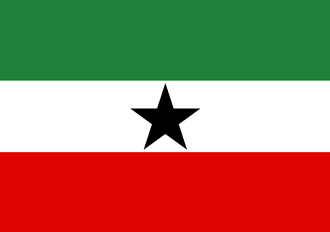 Flag of Somaliland National Republic. Photo by Yeahwaffles – Own work, CC0, Wikipedia
Most Israelis have never heard of Somaliland, and many would struggle to locate it on a map. The same appears to be true of President Donald Trump, who reportedly dismissed Israel’s recognition of the entity and admitted he had no idea what this “Somaliland” was. But that is hardly a reason to underestimate the strategic importance of strengthening ties between Israel and Somaliland, a state in the making that is moderate, pro-Western, stable and prosperous, and has functioned as a de facto independent country for nearly four decades, even if it remains unrecognized by the international community.
Somaliland is situated in a region of major security, diplomatic and economic importance to Israel, at the entrance to the Red Sea and opposite the Houthi-controlled areas of Yemen. The fact that a Muslim polity is seeking closer relations with Israel suggests that reports of Israel’s growing isolation and waning global influence were somewhat premature. It also indicates that there are still countries eager to forge close ties with Israel and that continue to believe the road to Washington runs through Jerusalem.
Crucially, Israel is not acting alone. It is coordinating closely with the United Arab Emirates, which is seeking to establish influence in Somaliland and is prepared to invest substantial sums to do so, as well as with the US, which is looking for a strategic foothold in the area in light of the Iranian and Houthi threats and China’s expanding presence in the Horn of Africa.
The outreach to Somaliland should be seen as part of a broader strategic picture aimed at building a network of cooperation between Israel and its neighbors. At the forefront are Greece and Cyprus, with which Israel has forged an intimate partnership that includes military and security dimensions. Alongside them are Jordan and Egypt, now bound to Israel through economic agreements that have made them dependent on Israeli supplies of gas and water. Finally, there is the UAE, which only recently signed arms procurement agreements with Israel worth billions of dollars. This is a necessary move that complements, deepens and secures Israel’s military achievements over the past two years.
Israel has come a long way since the “periphery alliance” devised by David Ben-Gurion in the late 1950s, in response to the threat posed at the time by Egyptian leader Gamal Abdel Nasser. Nasser mobilized the entire Arab world under the banner of Arab nationalism. In response, Ben-Gurion initiated covert cooperation with non-Arab states on the margins of the Middle East that also felt threatened by Nasser. These included Ethiopia in the south, Turkey in the north and Iran in the east, all of which viewed military and intelligence cooperation with Israel as a means of countering the Egyptian threat.
Much water has flowed through the Yarkon River since then, and the Middle East has been transformed. Yesterday’s enemies have become friends and even allies, while former partners have turned into rivals or outright adversaries. Egypt signed a peace treaty with Israel, Iran has become a strategic existential threat, and Turkey has emerged as a hostile rival.
Turkey, however, has been replaced by Greece and Cyprus, joined by Romania and Bulgaria, and to some extent Serbia and Croatia. All are former Ottoman territories that know full well who Turkey is and what kind of threat it can pose. Iran, for its part, has been replaced by Azerbaijan, alongside Kazakhstan, which recently joined the Abraham Accords.
Ben-Gurion’s “alliance of minorities” from the early days of the Jewish community in Mandatory Palestine is also undergoing a revival, reflected in Israel’s close ties today with the Druze in Syria, the Kurds in Iraq, and perhaps in the future the Alawites along Syria’s coast and Christians in Lebanon.
The changes sweeping the region have opened a window of opportunity to deepen ties and cooperation with both near and distant neighbors. This is a vital component of strengthening Israel’s security, alongside its military power. It must not be neglected, and it is better discussed less in public. Above all, it is essential to integrate moderate Arab states into this framework. In practice, that means most of the Arab world. If Israel succeeds in doing so, it could fundamentally reshape the map of the Middle East.
Strengthening ties with Somaliland, then, is not an isolated move. It is part of a broader strategy to establish a regional system of cooperation, first and foremost with Greece and Cyprus, and beyond them with a growing circle of partners who share common interests and threats.


Leave a Reply
You must be logged in to post a comment.