
Parallels can be drawn between the pre-state era and today. The current Israeli leadership must draw the necessary lessons from the historic decision made then by David Ben-Gurion-the declaration of statehood.
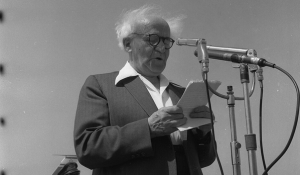 Ben-Guryon. Photo by Meitar Collection / National Library of Israel / The Pritzker Family National Photography Collection, CC BY 4.0, Wikipedia [Cropped]
Ahead of the 78th Independence Day of the State of Israel, it is fitting to return to the foundational moment in Israel’s history-the declaration of independence-not only as a moving historical event, but as a profound political act that changed the rules of the game.
It is important to remember that even on the eve of the declaration, the Jewish Yishuv in the Land of Israel was not an abstract idea, a theoretical concept, or a distant hope. It was a living reality: settlements, agriculture, industry, national institutions, and a defense force. In many respects, a de facto state already existed here. One could, in theory, have continued along this path-establishing additional communities, expanding territorial presence, and further entrenching facts on the ground.
But the leadership of the Yishuv understood a fundamental principle: facts on the ground, however strong, are not a substitute for sovereignty. Without a political decision, even an established reality remains temporary, vulnerable, and unanchored.
The decision not to yield to fears and to declare the establishment of a Jewish state in the Land of Israel was not self-evident. David Ben-Gurion understood well that such a declaration would come at a heavy price-diplomatic, security-related, and human. He knew the state would immediately face war and international pressure, and yet he chose to act.
It was the courage to decide and the commitment to the national goal that enabled the transition from consolidation to sovereign reality. With the declaration of independence, a state was not created ex nihilo; rather, an emerging reality was anchored into a binding political fact. The declaration formally defined, for the first time, the sovereignty of the Jewish people in its land.
It should be noted that the profound shock of the Holocaust helped shape the international environment in which this decision was made. This shock sharpened the recognition of the need for a state framework for the Jewish people and increased international willingness to accept a decisive political move.
This is the power of sovereignty: not only to govern, but to define.
Even today, decades later, a similar reality exists in certain respects. In Judea and Samaria, there is a clear reality of development and flourishing Jewish communities, infrastructure, civilian and security presence, and full civic life. This reality exists and is becoming entrenched. Yet, as in the past, the gap between de facto and de jure remains. Settlement creates reality, but does not formally define it. It establishes presence, but does not determine its status.
The events of October 7 once again demonstrated the depth of the ongoing security threat, which in some respects has even intensified. The massacre underscored the limitations of a reality not anchored in a full political decision. It influenced regional and international perceptions and sharpened the need for a clear definition of responsibility, control, and sovereignty.
The historical lesson is clear: just as settlement alone was not sufficient and the establishment of a state was required, so too settlement in Judea and Samaria is not sufficient to establish sovereignty. As long as there is no political decision, even a reality of settlements may, Heaven forbid, remain vulnerable and subject to political change. Without a political decision, even well-established, large, and long-standing communities cannot prevent scenarios of evacuation or dangerous political withdrawals and concessions.
A political decision, however, is the moment when reality ceases to be temporary and becomes permanent; the moment when facts are no longer open to interpretation but become a binding framework.
The power of the Declaration of Independence lay in closing the gap between what existed in practice and what was formally recognized. It did not merely add content; it gave full legal and political validity to what already existed and was developing. So too with the application of sovereignty over Judea, Samaria and Gaza: not the creation of a new reality, but the anchoring of an existing one. Not a beginning, but a completion. Not a tactical move, but a historic decision.
Independence Day reminds us that there are moments when a people must move from consolidation to decision, from habit to definition, from waiting to declaration. The courage that underpinned the declaration then-the willingness to pay a price, withstand pressure, and decide-is the same courage required today in the leadership choice to formally define Israel’s sovereignty across its territory, from the sea to the Jordan River.
Even in a dynamic diplomatic reality, where new opportunities are emerging on the international stage, the decision depends on the leadership’s ability to translate an evolving reality into a binding sovereign act.
History, ultimately, does not grant sovereignty; it retroactively confirms it for those who had the courage to act in time.


The Jewish institutions in what was then called “Palestine” had no real alternative but to declare Israel’s independence, because the British, who held a :mandate to rule Palestine from the League of Nations, had abruptly decided to withdraw from the country on May 15, 1948, making no provision whatsoever for the government of the country after their withdrawal. One British historian described this behavior by the British government under Clement Atlee as an “experiment in anarchy.” Perhaps the most irresponsible action ever by a colonial government. This left the Jewish institutions in Palestine, such as the Jewish Agency, no choice but to declare Israel’s independence. The joint declaration issued by the Jewish Agency and several other Jewish institutions in Palestine was the only way the Jewish population could “provide for the common defense” (in the words of the U.S. Constitution) and survive the invasion by the five invading Arab states that had already begun.
Trouble now is that unlike in1948 the Arabs of the 1967 territories have powerful allies and know NOT to run away as they did in disorganised fright in 1948.
In 1967 Rabin’s reaction to the 1967 [unexpectedly overwhelming] victory was -and is – pertinent: “What do we do with a million Arabs?” but now it is 2 million.
Eshkol at the time quipped, “The dowry is wonderful but the bride is so homely!”
Read – plain Jane or has a face like the back of a bus.