
Peloni: Either the United States is THE world power, or it is a regional hegemon. If the former is true, why is it that the US is using the same rhetoric which Russia coined in its invasion of Ukraine, ie that Venezuela is in America’s sphere of influence. In fact, if the US is the world’s super power, the relevance of the concept imbued in the Monroe Doctrine would give it authority which it has used for decades around the world. In conveying that US actions in Venezuela are related to the proximity of it geographically to the US, is the US abdicating its right of action against similar bad actors presumably committing war crimes against the American people? While the notion of charity begins at home is a valuable concept, reliance upon the edict of America when it was a nascent state with limited means compared to the empires of the 19th Century reveals a rather stark message to America’s adversaries that this limit of resolve might be a signal to regional powers that they might assume the same role. Is this a matter of bad messaging, or was this the message intended for America’s peer adversaries.
By Jonathan Schanzer | NYP | Published Jan. 4, 2026
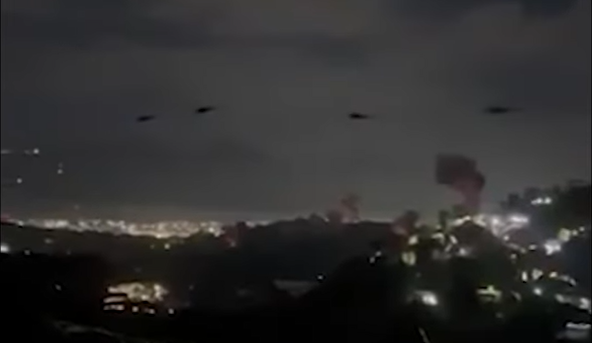 Helicopter force involved in capturing Maduro. Screengrab via Youtube. [Cropped]
The Trump administration’s capture of Venezuelan dictator Nicolás Maduro on Saturday was a US victory on two fronts: the war on drugs and the great-power competition with China and Russia.
For years, the war on drugs has been fought at home, primarily with slogans, aimed at changing the behavior of American citizens.
President Trump upended that feckless approach in 2025 when he began bombing the narco-vessels bringing drugs to the United States.
His strategy was controversial, to put it mildly: Even strong proponents of the US military and fierce opponents of the narco-kingpins were alarmed by America’s use of force in the Caribbean Basin.
This weekend, Trump upped the ante again: He brought down a narco-state through regime change.
The flow of dangerous drugs to the United States can be expected to slow as a result.
The deterrent effect of this operation cannot be overstated. The cartels and kingpins that have historically poisoned the US with drugs are now on notice.
Sure, the US military will continue to bomb their vessels on the high seas. But what scares them more now is the prospect of being captured and then getting shipped to the United States to face justice.
Don’t expect everyone in the United States to cheer this historic event, though.
Ever since the failed experiments to rebuild Iraq and Afghanistan, neo-isolationists in Washington have warned that America must avoid regime change at all costs.
Their howls of disapproval can be expected in the days and weeks to come.
For now, Trump intends for the United States to run the government in Venezuela until a suitable government can be installed. And that carries with it significant risk.
If Venezuela unravels, Trump will be blamed. If the wider region descends into chaos, the president will be saddled with that, too.
Will Trump’s base give him the opportunity to improve upon the regime-change failures of his predecessors? He appears determined to try.
In truth, the regime-change controversy is of secondary importance.
Bringing down Maduro was about bringing the Western hemisphere back under the influence of the United States.
Maduro was not just the head of a narco-state. He was an ally of America’s nastiest enemies.
In fact, Maduro met with a senior Chinese delegation in Caracas shortly before he was captured by US special forces.
But Maduro’s regime was not just an ally to China. The regime in Caracas was also a valuable partner to other rogue states like Russia, Cuba and Iran.
Even the Republic of Turkey, a notoriously unreliable NATO ally, has been an ally to the Maduro regime.
The government of President Recep Tayyip Erdogan is the fifth member of Venezuela’s “Fabulous Five” — the countries that helped prop up the Venezuelan strongman.
One or more of these regimes may try to exploit the vacuum in Venezuela.
They may not be able to restore Maduro to power. But they can try to make America pay a price for ousting their ally.
The Trump administration must bare its teeth now, and warn them to keep out.
If done right, the ousting of Maduro will weaken the influence of America’s adversaries in our hemisphere.
It will deprive the cartels of a transit hub for shipments to the United States. And it will deprive our enemies of a valued ally.
If that’s how things play out, not a bad start to 2026.
Jonathan Schanzer, executive director of Foundation for Defense of Democracies, is a former terrorism finance analyst at the US Treasury Department. X: @JSchanzer.


Leave a Reply
You must be logged in to post a comment.