
Summary of Analysis by Khaled Hassan
Jalal Tagreeb
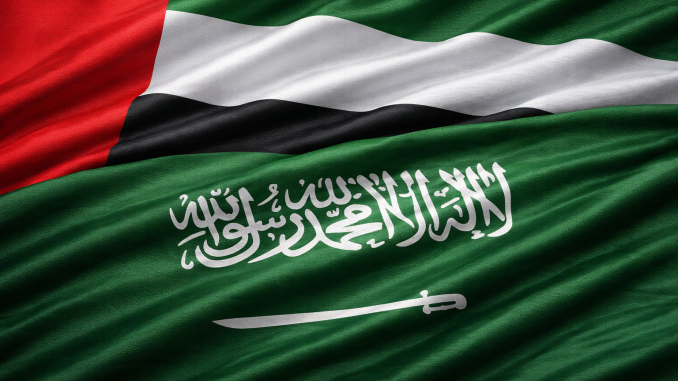 Saudi and Emirati flags. Image via AI
The contemporary geopolitical landscape of the Middle East has witnessed unprecedented transformations in recent years, with the United Arab Emirates and Saudi Arabia emerging as two of the region’s most influential powers. While both nations have undergone remarkable development under the leadership of Crown Prince Mohammed bin Salman and Sheikh Mohammed bin Zayed, their approaches to foreign policy have diverged significantly, reflecting fundamentally different philosophies about how to navigate an increasingly complex and non-traditional international environment.
This analysis, presented by Khaled Hassan, a researcher in national security and foreign relations and member of the Israeli Presidential Council, examines these divergent approaches through three critical case studies: the Israeli-Palestinian conflict, Yemen, and Sudan. The comparison reveals a stark contrast between the UAE’s innovative, risk-taking approach and Saudi Arabia’s return to traditional principles, with profound implications for both nations’ regional and international influence.
At the outset, it is essential to acknowledge that both Saudi Arabia and the UAE have experienced continuous development that would have been difficult to imagine even a decade or two ago. The leadership of both nations has demonstrated a pioneering role that many would not have anticipated. However, the manner in which each country has chosen to exercise this leadership reveals fundamental differences in strategic thinking and approach to international relations. The UAE has positioned itself as a nation willing to embrace non-traditional solutions and think beyond conventional boundaries, while Saudi Arabia, after a period of considering more innovative approaches, appears to have retreated to more traditional positions grounded in established principles and historical precedents.
The Israeli-Palestinian conflict serves as perhaps the most illustrative example of these divergent approaches. The UAE’s decision to recognize Israel and become the leading force behind the Abraham Accords represents a transformative moment in Middle Eastern diplomacy. This recognition has elevated the UAE from being merely a regional or Islamic world player to becoming a significant international actor with substantial global influence. The strategic value of this move became evident when Israel contemplated annexing parts of the West Bank, known in Israel as Judea and Samaria. The UAE’s threat to withdraw from or diminish the Abraham Accords served as a powerful deterrent, demonstrating how recognition of Israel could be converted into tangible political leverage. This represents not just regional influence but genuine international power that Saudi Arabia, despite its size and resources, currently cannot match.
In contrast, Saudi Arabia’s position on normalization with Israel reveals the limitations of traditional thinking in a non-traditional era. The Saudi leadership has explicitly stated that it sees no future for normalization with Israel under Netanyahu’s government or the current right-wing coalition. However, this position reflects what might be characterized as short-sighted thinking, as future Israeli governments are likely to be equally or even more right-wing than the current administration. By conditioning normalization on circumstances that may never materialize, Saudi Arabia has effectively surrendered a significant source of international and regional influence. The UAE, by recognizing this reality and acting accordingly, has transformed its relationship with Israel into a source of power and influence that extends far beyond the Middle East.
The situation in Yemen provides another compelling illustration of these different approaches. The UAE’s support for the emergence of a southern Yemeni state represents creative, innovative thinking that many would consider remarkable. The Emirati approach demonstrates a willingness not only to achieve what is possible but to engage in creative thinking that envisions what could be achieved in the future, unconstrained by narrow limitations. This represents the kind of innovation and imagination that is perhaps lacking throughout much of the Arab world. The UAE’s position shows a capacity to take risks and envision future possibilities that go beyond immediate constraints, reflecting a sophisticated understanding of how regional dynamics are evolving.
Saudi Arabia, conversely, maintains a traditional stance on Yemen, arguing that any division of any state is contrary to Arab interests and fundamental principles. While this position is logically consistent and not inherently wrong, it represents traditional thinking in an era that demands non-traditional solutions. The challenge lies not in the logic of the position itself, but in its application to a fundamentally changed regional environment. With the Houthi movement controlling significant territory and creating serious problems in crucial maritime passages such as the approaches to the Suez Canal, the UAE is creating innovative solutions that others might fear to even contemplate. Meanwhile, Saudi Arabia remains committed to traditional frameworks of what should and should not be done, continuing along this path even as regional realities evolve in ways that challenge these traditional assumptions.
The case of Sudan reveals perhaps the most striking contradictions in the Saudi approach and highlights the inconsistency between stated principles and actual policy. Saudi Arabia maintains that it only deals with state institutions and does not support militias or non-state actors. However, when examining the Rapid Support Forces led by Hemedti and comparing them with Burhan’s forces, it becomes clear that both emerged from the same military structure. Hemedti is not simply a militia leader who emerged from the streets; rather, he and Burhan represent two sides of the same coin, both products of the same military institution and the same foundational thinking, though their paths have diverged. The question then becomes: what strategic interest does Saudi Arabia serve by supporting Burhan, whose leadership has demonstrably failed? After all, if he had not already failed, the current situation would not have developed, and Hemedti would not have been able to achieve what he has accomplished.
When this traditional thinking is compared with the Emirati approach, which seeks new visions and new players in the region rather than perpetuating the same patterns, the limitations of Saudi policy become apparent. The UAE recognizes that continuing with the same traditional patterns, thinking, and approaches will not produce different results. However, the most significant paradox in Saudi policy emerges when considering Syria, which exposes a fundamental contradiction in the kingdom’s stated principles.
In Syria, Saudi Arabia has thrown its support behind Ahmed al-Sharaa, despite his decidedly non-traditional background. Al-Sharaa was not a known politician who rose through established channels or came to power through conventional means. Rather, he has a background with terrorist organizations and was a militia leader of Hayat Tahrir al-Sham, one of multiple warring factions in Syria. His performance at the Doha Forum in Qatar was revealing when he was questioned about al-Qaeda and his terrorist background. Rather than distance himself from these associations, he somewhat defended these groups, arguing that the real terrorists are those who kill children and foreign imperialists. Yet al-Sharaa succeeded where others failed; his militia won the war, and he is now Syria’s leader, enjoying Saudi support.
This presents a glaring inconsistency: how can Saudi Arabia support someone with a militia background in Syria while simultaneously refusing to support non-state actors in Sudan, insisting on dealing only with state institutions? This question demands an answer from Saudi decision-makers. While there may be factors unknown to outside observers, and researchers must acknowledge the limits of their knowledge, this apparent contradiction highlights the problems with an inconsistent application of traditional principles. Saudi Arabia claims to support only state institutions, yet in Syria, it backed a successful militia leader who overthrew the Assad regime, which itself represented state institutions for decades and proved to be a failed experiment.
This inconsistency reflects a broader pattern of retreat from the non-traditional thinking that briefly characterized Saudi foreign policy. There was a period when Saudi Arabia under Crown Prince Mohammed bin Salman appeared to be moving toward a less traditional approach in its international relations. The very concept of Saudi-Israeli normalization was non-traditional and, for most Saudis and Arabs, represented a radical departure from established positions. When the Crown Prince discussed this possibility, it seemed revolutionary and unprecedented. However, there has been a retreat from this non-traditional vision, with Saudi Arabia now returning to traditional foundations and principles, insisting that normalization with Israel will only occur after the establishment of a Palestinian state on 1967 borders—positions that have been articulated for decades.
This return to traditional thinking contrasts sharply with the UAE’s sustained commitment to innovative approaches in foreign policy. The Emiratis have adopted and maintained a non-traditional approach in what is fundamentally a non-traditional era, while Saudi Arabia has moved in the opposite direction, returning to traditional frameworks and principles that have guided Saudi policy for decades. The implications of these divergent paths are significant for both nations’ roles in regional and international affairs.
The philosophical differences between the two approaches extend to how each nation conceptualizes its identity and role in the world. The UAE has established the Abrahamic Family House and positions itself to the entire world as a center for humanity, not merely as a center for the Islamic or Arab nation. The Emirati message emphasizes the establishment of humanitarian principles, rights, and equality among Muslims, Jews, Christians, Hindus, and anyone else who is welcomed. In contrast, Saudi foreign policy continues to emphasize its role as an Islamic, Arab, and Ummah-focused state, with its international role flowing from this primary identity. Saudi Arabia maintains that its foreign policy is fundamentally rooted in an Arab, Islamic, and Ummah-centered role rather than a broader international one.
This difference is problematic because while two billion Muslims in the world naturally see Saudi Arabia as having significant importance, this leaves the non-Islamic world—Christians, Hindus, Jews, atheists, and others—without a clear connection to Saudi Arabia’s vision. These diverse populations can look to the UAE and see a nation that represents principles and values they can embrace and support, enabling them to back the UAE’s pioneering international role in ways they cannot support Saudi Arabia. The kingdom remains somewhat reserved and committed to an Islamic, Arab, Ummah-centered role, while the UAE manages to fulfill both functions simultaneously. The UAE can claim to play a major pioneering international role while simultaneously sending aid to Gaza that no one else can send precisely because of its recognition of Israel. This recognition enables the UAE to deal with Israel, pressure the Israeli government, and send assistance that others cannot, while also accomplishing things in Yemen that no one else can achieve.
This represents remarkable creativity and expertise, generating substantial power and influence through thinking outside the box. Unfortunately, in comparison, Saudi foreign policy appears constrained by traditional frameworks. The assessment suggests that the Emirati approach will continue along this non-traditional path that thinks outside conventional boundaries, while Saudi Arabia’s direction over the medium term—roughly the next five years—will likely involve a return to traditions, a return to the box, a return to somewhat traditional thinking and scope. This trajectory will constrain Saudi Arabia in numerous areas: in normalization with Israel, in dealing with issues in Sudan and Yemen, and in Syria. As southern Yemen emerges as a state, though born under fire, Saudi Arabia will find itself constrained in its response due to its adherence to traditional principles.
The question of Syria is particularly instructive regarding these constraints. If Ahmed al-Sharaa fails—and this represents a genuine risk—what will be the implications for Saudi Arabia’s bet on traditional state institutions? The inconsistency of supporting al-Sharaa while refusing to engage with non-traditional actors elsewhere reveals the limitations of applying traditional principles inconsistently in a fundamentally non-traditional era. The central argument is that success in the current era requires thinking outside the box and approaching situations with a fresh perspective. It is no longer tenable to view the situation in Sudan in 2025 through a traditional lens or to bet on Burhan simply because he represents continuity when, frankly, Burhan is not a new figure and his track record does not demonstrate success. Betting on traditional thinking again will result in the constraining of foreign policy.
In conclusion, while both the UAE and Saudi Arabia deserve success and the entire region benefits from their stability and prosperity, the analysis suggests that the UAE’s approach is better suited to the demands of the contemporary international environment. The wish for normalization, peace, security for all people in the region, and an end to wars by 2026 depends significantly on the willingness of regional powers to adapt their thinking to non-traditional circumstances. The UAE has demonstrated this adaptability by converting recognition of Israel into leverage, by supporting innovative solutions in Yemen, and by positioning itself as a global center for humanitarian values rather than limiting itself to a regional religious identity. Saudi Arabia, despite its considerable resources and regional importance, has chosen to return to traditional principles that, while providing consistency and alignment with historical Saudi positions, may ultimately limit its ability to shape regional outcomes and exercise international influence in an era that increasingly rewards innovative, non-traditional thinking. The contrast between these two approaches will likely define the evolution of Gulf foreign policy for years to come, with significant implications for regional stability, conflict resolution, and the broader international order in the Middle East.
He now focuses on analyzing cultural and ideological contrasts between the West and the Middle East. Through his writings and translations, he aims to foster meaningful dialogue, encourage critical engagement with Islamic tradition, and promote intellectual honesty. His writings, debates, and a selection of his previously refuted Islamic arguments can be found here:


Leave a Reply
You must be logged in to post a comment.