
Peloni: Time is not on Israel’s side, and it never was. As the clock ticks by Hamas has become stronger, better equipped, further entrenched and better secured within its position of dominance over the people of Gaza.
On paper, billions of dollars have been pledged for the reconstruction of the Gaza Strip, and a multinational force is in the process of being formed. But it remains doubtful that any of it will come to fruition, since the key to everything has always been, and remains, the disarmament of Hamas.
Prof. Eyal Zisser | Feb 23, 2026
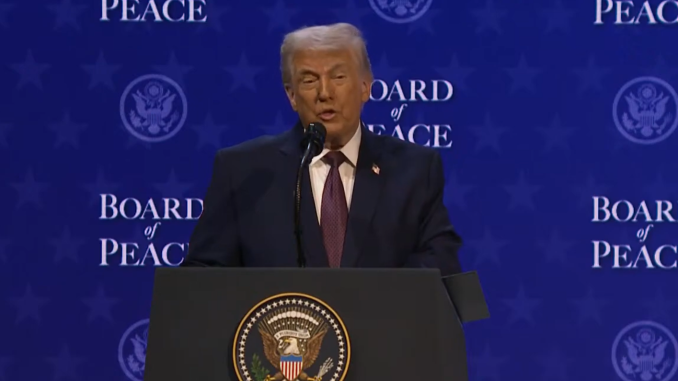 Trump Speaks at Board of Peace Initiation. Screengrab via Youtube
According to Trump’s plan, the Board of Peace will oversee the stabilization of the ceasefire in the Gaza Strip, the deployment of international forces there and the establishment of an alternative civilian government to replace Hamas. Above all, it is meant to supervise the disarmament of Hamas. Only after that, the board would initiate a large-scale reconstruction effort.
As often happens with Trump-led initiatives, the launch was a high-profile media event attended by leaders from around the world, many eager to align themselves with the US president and appear in the official photograph. But the gap between the spectacle in Washington and the reality on the ground in Gaza could hardly be wider.
On paper, billions of dollars in pledges have been secured for Gaza’s reconstruction, and a multinational force is reportedly in the process of being assembled. Yet it remains doubtful whether any of this will materialize. The key to everything has always been, and remains, the dismantling of Hamas’ military capabilities.
True, various international actors are speaking on Hamas’ behalf, committing in its name that the group will lay down its arms and relinquish control of Gaza. In practice, however, no Hamas official has made such a declaration. On the contrary, the organization’s spokesmen have repeatedly stressed their determination to retain their weapons and their refusal to disarm. On the ground, Hamas continues rebuilding its strength under the cover of the quiet afforded by the ceasefire.
Much of the international community, and apparently the Americans as well, seem untroubled by this reality. The priority, it appears, is maintaining the illusion of calm and showing signs of progress, in the hope that launching reconstruction will generate momentum among Gaza’s residents and eventually compel Hamas to yield. Anyone familiar with Gaza and the broader Middle East knows this is wishful thinking.
The process is moving forward, and Israel is not standing in its way. Instead, it is quietly murmuring, perhaps to itself, that Hamas’ disarmament is a red line. It is doubtful anyone is listening. More troubling still, Israel does not appear to have a clear course of action in response to current developments in Gaza. The country risks walking knowingly into a trap: a reality in which Hamas continues to rule the Strip under the umbrella of Trump’s initiative, while Israel refrains from responding.
This recalls the period following Israel’s 2005 disengagement from Gaza, when it withdrew its forces and transferred control to the Palestinian Authority in the hope that it would know how to confront Hamas. Worse, it evokes the situation on the eve of October 7, when Israel effectively accepted Hamas’ rule in Gaza in exchange for relative quiet along the border.
Already, familiar arguments are resurfacing: that Hamas has been weakened and now seeks calm in order to rebuild Gaza. Some in Israel view this as a convenient reality, one that spares the government from making difficult decisions and taking decisive action. It is easier simply to go along with the current course.
Israel must define clear red lines from which it will not retreat, especially regarding the link between Hamas’ disarmament and any progress on other issues in Gaza. It must also formulate an operational plan for what increasingly appears to be a realistic scenario: that what was in Gaza will remain in Gaza.
Failing to act now could make future action impossible, particularly once international forces and representatives of Trump’s Board of Peace are deployed on the ground and reconstruction funds begin flowing into the Strip. If a confrontation with Trump becomes unavoidable, it would be better for Israel to face it on terms that suit its interests, rather than after all leverage has been lost.
For now, Hamas appears shrewd enough to keep a low profile and wait out the storm. Israel, however, cannot afford to accept a situation in which the terrorist organization retains its weapons and gradually reestablishes its presence as permanent.


Rafael Medoff
https://m.facebook.com/story.php?story_fbid=pfbid02Ch3R1XoeF3L9GwG5eQ5iBgEmKhAZpF2KBDmFy15AFQbXoVcthSrBRPNemuboSytWl&id=100003735608743
We keep giving war a chance but somehow the signs are wrong. The chances being given are for the Arabs to win. The last time Israel really won a war was 1967 – the 6 day war. In that war, Israeli intelligence and the IDF were in partnership to avoid being defeated, which could only mean Israel’s demise.
Ever since, the international community has joined up to insist that Israel not win a war to the required degree, namely that our enemies surrender. It is time for that kind of war, as explained over and over by the US as the result of WW2 This is the only kind of result we need rather than depending on the diplomacy of those who have nothing to lose.
https://www.presidency.ucsb.edu/documents/2016-republican-party-platform
Since recent reports from Israel tell us that Hamas is digging new tunnels in the strip faster than Israel can destroy them, we should be concerned.
We were happy to hear that the Philadelphi corridor was under Israeli control but it seems that this is at the level of fantasy. If they are able to rearm and build more tunnels, the route through the Sinai Peninsula has not been cut off.
Our “peace partner”, Egypt is actually breaking the peace agreements on a daily basis. The question is when they will come out into the open and actually attack Israel. I guess they know that will not work out well for them but if they get enough help from Saudi Arabia, Qatar, Iran and Turkey, they may take the risk. Their allies may also feel that they can risk open involvement in the Egyptian endeavor to remove Israel from the middle eastern map.
I guess there is a lot going on behind the scenes that we are not privy to. We are left to pray that Trump knows what he is doing. However, he is currently juggling so many hot irons that one of them is sure to fall sometime soon.