
Peloni: One of the great challenges for the current US administrations has been to deal with the threat emanating from Turkey which it has failed to contain in many ways. The early failures to restrain Turkey over the past year has only emboldened the delusional fantasies of Turkey extending its colonial control over the Middle East and Eastern Europe. This will only serve to undermine Trump’s efforts for a Asia pivot as well as the establishment of the IMEC.
Dr. Nikos Michailidis | MEMRI | Mar 11, 2026
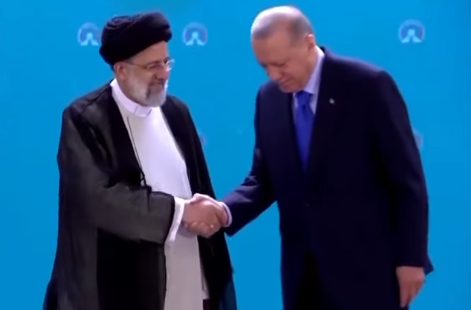 Turkey’s Pres. Erdogan meets Iranian Supreme Leader Ayatollah Khamenei. Screengrab via Youtube.
Turkey’s foreign policy under the authoritarian rule of President Recep Tayyip Erdo?an has devolved into a brazen exercise in neo-Ottoman expansionism, flagrantly disregarding international norms and prioritizing territorial aggrandizement over NATO alliance obligations. Officials in Ankara like to describe it as “strategic autonomy.”
It has been a central doctrine in contemporary Turkish foreign policy since the mid-2010s. It represents Turkey’s pursuit of greater independence from traditional Western alliances – especially the United States and NATO – while reducing dependency in security. This approach emerged amid discussions about shifts toward a multipolar world order, rising anti-western sentiment across the country, and a desire to assert Turkey as a regional power with global influence.
Proclaimed as an “independent and national foreign policy,” it involves hedging strategies: maintaining NATO membership for leverage while deepening ties with non-Western powers like Russia and China, pursuing assertive military interventions (e.g., in Syria, Libya, and the Eastern Mediterranean), and building domestic defense capabilities to achieve self-reliance. However, critics note it has led to transactional opportunism, new dependencies (e.g., on Russia), and tensions within NATO, rather than a fully coherent or sustainable grand strategy.
The “strategic autonomy” doctrine is little more than a veil for aggressive posturing in the Eastern Mediterranean, where Ankara’s illegal maritime claims, militarized bullying, and cynical hedging with U.S. adversaries like Russia, have systematically eroded American security priorities, fractured NATO unity, and plunged the region into heightened instability. As of early 2026, Turkey’s provocative actions over gas resources, proxy wars, and refugee blackmail betray its NATO commitments and embolden revisionist states. In turn, this stance demands a forceful U.S. response to curb this destabilizing force.
Turkey On Energy
Central to Turkey’s belligerence are its illegitimate assertions over the Eastern Mediterranean’s vast hydrocarbon deposits. Erdo?an has weaponized the “Blue Homeland” doctrine – a revisionist fantasy that ignores UNCLOS principles, the United Nations Convention on the Law of the Sea, that provides a comprehensive legal framework governing all marine and maritime activities worldwide, defining maritime zones such as the territorial sea (up to 12 nautical miles), exclusive economic zones (up to 200 nautical miles), continental shelf rights, high seas freedoms, and the deep seabed.
Ankara uses the “Blue Homeland” expansionist doctrine to dispatch survey ships like the Oruç Reis and Yavuz into waters rightfully belonging to Greece and Cyprus, backed by threatening naval escorts. In 2025, as Cyprus advanced drilling partnerships with entities like QatarEnergy, Erdo?an’s regime issued belligerent threats of “retaliation,” which escalated fears of armed conflict between supposed NATO partners. This thuggish behavior sabotages vital projects like the EastMed pipeline, which could diversify Europe’s energy sources away from Russian dominance, and instead forces reliance on precarious alternatives and enriches Turkey’s coffers through coerced transit roles. By flouting maritime law and intimidating neighbors, Ankara actively obstructs U.S.-backed energy security initiatives, revealing a regime more interested in extortion than cooperation.
![A map published in a Turkish daily depicting the border of Turkey's "Blue Homeland."[1]](https://www.israpundit.org/wp-content/uploads/2026/03/mdb912.avif) A map published in a Turkish daily depicting the border of Turkey’s “Blue Homeland.”[1]
A map published in a Turkish daily depicting the border of Turkey’s “Blue Homeland.”[1]
Turkey In Proxy Conflicts
Turkey’s militaristic overreach compounds the damage, turning the region into a tinderbox of proxy conflicts. The 2019 maritime pact with Libya’s Tripoli faction – arbitrarily redrawing boundaries to encroach on Greek and Cypriot zones – has fueled Libya’s endless civil war by flooding it with Turkish drones, Syrian mercenaries, and Islamist militants aligned with the Muslim Brotherhood. This reckless meddling directly counters U.S. diplomacy for Libyan unification and bolsters Qatar’s influence, alienating key American allies like Egypt and the UAE.
In Syria, Turkey’s repeated invasions since 2016 have slaughtered the U.S.-supported Kurdish fighters combatting ISIS, while carving out occupation zones that harbor jihadists and displace civilians – this clashes with Israeli security needs in the fragile post-Assad era.
Meanwhile, Israel’s strategic pivot toward Greece and Cyprus, complete with joint drills, underscores Turkey’s role as a regional pariah, risking NATO’s implosion through internal feuds stoked by Erdo?an’s imperial delusions.
Greek Prime Minister Kyriakos Mitsotakis’ visit to Turkey on February 11, 2026, for the 6th High-Level Cooperation Council with Turkish President Recep Tayyip Erdo?an, yielded no real progress. Amid Turkey’s persistent revisionist claims in the Aegean and Eastern Mediterranean, its longstanding casus belli threat against Greece’s potential legal extension of territorial waters, and ongoing provocations, the talks produced only superficial agreements – six memoranda on trade, migration, culture, and other practical areas – while both sides merely reiterated that issues are “not insurmountable” under international law. Mitsotakis urged Ankara to drop its war threats and embrace genuine goodwill, yet Erdo?an’s regime continued framing dialogue as a tool to maintain leverage without concessions, reinforcing perceptions of Turkish intransigence and opportunistic posturing rather than sincere resolution efforts.
These Turkish policies openly undermine U.S. interests, hollowing out NATO’s effectiveness from within.
The Turkish Problem
The 2019 S-400 deal with Russia – defying explicit U.S. warnings – invited sanctions and Turkey’s ouster from the F-35 program, compromising alliance defenses and exposing NATO secrets to Moscow. Even after a begrudging F-16 compromise in 2025, Turkey’s deepening economic collusion with Putin – laundering sanctioned goods – facilitates Russia’s war machine and undercuts U.S. efforts to isolate the Kremlin. In the Black Sea and Eastern Med, Turkish aggression amplifies Russian leverage.
Erdo?an’s cynical use of refugees as a weapon against Europe fractures transatlantic solidarity. Turkey has weaponized Middle Eastern migration, especially Syrian refugees, as leverage against Europe to extract money and concessions. Through the 2016 EU-Turkey deal, Ankara secured billions in EU funding by promising to control migrant flows across the Aegean. President Erdo?an has repeatedly threatened to “open the gates” and flood Europe with migrants – most notably in 2019 and February 2020 – when frustrated over aid shortfalls or lack of support for Turkish operations in Syria. The 2020 border crisis with Greece was widely seen as deliberate coercion to pressure Brussels for more funds and political backing. This pattern allows Turkey to gain ongoing EU payments while pursuing assertive regional policies with little accountability.
Moreover, U.S. facilities in Turkey, such as ?ncirlik, now operate under duress, forcing Washington to bolster alternatives in Greece and Cyprus – a clear indictment of Ankara’s unreliability. The ripple effects on U.S. strategy are catastrophic.
Turkey’s inflammatory support for Hamas,[2] trade boycotts against Israel, and opportunistic Gaza posturing splinter anti-Iran fronts and derail projects like the India-Middle East-Europe Economic Corridor (IMEC), a major multinational infrastructure initiative announced at the 2023 G20 Summit in New Delhi. It aims to create a multimodal trade and connectivity network linking India to Europe via the Middle East (through countries like the UAE, Saudi Arabia, Jordan, Israel, Cyprus, and Greece), using integrated shipping routes, railways, highways, undersea cables for digital connectivity, and energy pipelines, while serving as a strategic alternative to China’s Belt and Road Initiative to enhance supply chain security, reduce transit times, and promote sustainable economic integration.
Turkey has provided significant political, logistical, and financial support to Hamas, designating it not as a terrorist group but as a legitimate “resistance” or “liberation” movement. Under President Recep Tayyip Erdo?an, Ankara has hosted senior Hamas leaders (including granting citizenship to some), allowed the group to maintain offices and fundraising networks in Istanbul, and engaged in regular high-level meetings. This support has included alleged intelligence sharing, passport issuance, and tolerance of financial flows, even as the U.S. has expressed concerns over Turkey’s role in enabling Hamas funding.
dditionally, allegations of Turkish support for ISIS peaked during 2014-2016, when critics accused Ankara of turning a blind eye to (or tacitly facilitating) foreign fighter transit across its borders, treating wounded militants in hospitals, and indirectly benefiting from ISIS oil smuggling through Turkish territory as part of its opposition to Kurdish forces in Syria. Overall, Erdo?an’s approach has been criticized as opportunistic, bolstering Hamas for regional influence while historically showing leniency toward ISIS networks when convenient for broader geopolitical aims.
By jostling for dominance in Syria against Israel and establishing militarized footholds in Africa, Erdo?an’s regime drags the U.S. into avoidable quagmires.
Solving Turkey
At home, Erdogan’s despotic grip – silencing critics[3] and fabricating foreign conspiracies – breeds domestic volatility that could erupt regionally. Economically, Turkey’s hubris amid crippling inflation and currency collapse leaves it vulnerable to exploitation by Russia and China, further entrenching anti-Western dependencies.
For America, this demands a tougher stance: stringent conditions on arms transfers, expanded alliances with Turkey’s rivals, and rigorous sanction enforcement. Tolerating Erdo?an’s antics invites disaster, empowering aggressors like Russia and Iran.
With Cyprus’s 2026 EU presidency and possible U.S.-mediated dialogues on the horizon, fleeting windows for restraint exist. But without decisive U.S. intervention – imposing clear penalties for further provocations and championing rival energy pathways – Turkey’s toxic policies will inevitably spark wider conflagrations, eroding American leadership in a critical theater. It is time to treat Turkey not as an ally but as the rogue actor it has become.
Unfortunately, Tom Barrack, the U.S. Ambassador to Turkey and Special Envoy for Syria under the Trump administration, has consistently downplayed and defended Erdo?an’s aggressive policies by dismissing accusations of Turkish expansionism or neo-Ottoman ambitions as “nonsense” and insisting Ankara harbors no aggressive intent toward Israel or others. His public misrepresentations – such as ignoring Erdo?an’s explicit war threats against Israel[4] (comparing potential actions to interventions in Libya, Nagorno-Karabakh, and Syria) and the illegal Turkish occupation for more than 50 years of one third of the territories of the Republic of Cyprus – lend legitimacy to Turkey’s revisionist actions in the Eastern Mediterranean, Syria, and beyond.
By portraying Turkey’s military as a “stabilizing force” that could “cool temperatures” in the region, Barrack helps normalize and embolden Erdo?an’s militaristic adventurism without accountability. This alignment, driven by close personal and strategic ties, undermines U.S. deterrence against Turkish aggression, encourages Ankara’s opportunistic interventions, and exacerbates regional tensions rather than restraining them.
* Nikos Michailidis holds a Ph.D in sociocultural anthropology from Princeton. He is a political analyst of the eastern Mediterranean specializing in Turkey.
[1] The Blue Homeland doctrine rejects the Exclusive Economic Zone (EEZ) effects of the Greek islands and instead divides the Aegean Sea in half between Turkey and Greece. The map also reflects the November 2019 “Memorandum of Understanding on the Delimitation of Maritime Jurisdiction Areas in the Mediterranean” that Turkey signed with Libya’s Government of National Accord. That agreement created a Turkey-Libya maritime boundary line running diagonally across the eastern Mediterranean that effectively connects the Turkish coast southwest of Antalya with Libya’s coast near Derna. Finally, the map shows a hypothetical extension of Turkey’s maritime border if a comparable agreement were made with a Palestinian government or with Israel.
Gazetevatan.com/bilim-ve-teknoloji/turkiyenin-mavi-vatan-haritasi-googleda-yayinlandi-1360127, December 12, 2020.

Leave a Reply
You must be logged in to post a comment.