
Mudar Zahran | X | Mar 11, 2026
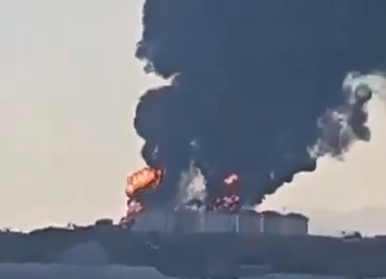 Iranian strike in Oman. Screengrab via Youtube
* Today, 11 March, Iran attacked an oil-producing site in Oman. The strike hit fuel storage tanks at the Port of Salalah, a major energy logistics hub on Oman’s Arabian Sea coast used for tanker refueling and storage. Reports say drones struck several tanks and set parts of the facility on fire. (https://reuters.com/world/middle-east/oil-storage-facilities-hit-omans-salalah-port-ambrey-state-tv-say-2026-03-11/)
* What makes this attack shocking is not just the target but who was targeted. Oman is the Gulf state closest to Iran politically and the country that has long served as the primary mediator between Iran and the West. Yet Tehran still struck its oil infrastructure. That tells you something about how Iran plays political physics in the Middle East.
* Iran’s message appears simple: no oil infrastructure in the Gulf is off limits. And this behavior is not new. Iran has previously targeted oil production even in countries that are not openly hostile.
* Saudi Arabia, for example, signed a Chinese-mediated détente with Iran roughly four years ago. Yet key energy sites have still been hit or targeted:
• Ras Tanura refinery and export terminal – one of the largest oil export hubs on earth and a critical gateway for Saudi crude.
• Berri oil field – an important producing field feeding eastern Saudi export infrastructure.
* Across the wider Gulf region the pattern continues:
• Salalah oil storage tanks – Oman
• Duqm fuel storage facility – Oman
• Sitra / BAPCO refinery – Bahrain
• Mina Salman oil port – Bahrain
• Jebel Ali fuel storage terminal – UAE
* Iran has also threatened shipping through the Strait of Hormuz, the narrow maritime corridor through which roughly one-fifth of the world’s oil supply moves every day.
* But this is not random revenge. Iran appears to understand world politics extremely well. In the Middle East there is an old saying: Iranians are natural carpet weavers. They don’t mind working slowly as long as the pattern is precise.
* What we are seeing now fits that philosophy. Iran appears to be trying to undermine Gulf oil production and disrupt global oil shipping, especially through the Strait of Hormuz.
* The objective is obvious: push oil prices higher, send economic shockwaves across Europe and global markets, and pressure the United States to back off the war.
* Many analysts once dismissed this possibility for one reason: China. Iran exports much of its oil to China, and Beijing is widely viewed as Iran’s geopolitical protector. The assumption was that China would never allow Iran to disrupt global oil flows.
* But China holds very large strategic oil reserves, enough to sustain its economy during a conflict like this. Nobody knows exactly what Beijing is thinking, but it is difficult to imagine Iran taking such a bold step without at least some level of Chinese tolerance.
* Yet the strategy is not working.
* First, the United States is not dependent on Gulf oil. The U.S. is a net exporter of oil and a major exporter of natural gas.
* Second, Washington has access to Venezuelan oil supplies, which could easily be redirected to Europe if necessary.
* In other words: there is no genuine global oil shortage.
* The real issue has been panic in energy markets.
* Some analysts immediately claimed tankers could no longer pass through Hormuz because war-risk insurance was withdrawn and shipping companies were pulling back.
* In response, President Trump ordered the U.S. International Development Finance Corporation (DFC) to step in and provide political-risk insurance and financial guarantees for maritime trade in the Gulf, including a $20 billion reinsurance program to keep tankers sailing. (https://reuters.com/world/us-reinsure-maritime-losses-gulf-up-about-20-billion-agency-says-2026-03-06/)
* The DFC is the U.S. government’s development finance institution, capable of providing loans, guarantees, and political-risk insurance to support international trade and investment.
* And here a serious question arises: Why do some continue to frighten the American markets and American consumers with fears of an oil shortage and rising prices?
* Because Iran’s strategy only succeeds if the markets are gripped by panic and oil prices spike sharply.
* Without this financial panic, Tehran will not be able to deliver the economic shock it seeks.
* And thus, those who continue to amplify fears of an oil shortage and rising prices are, in practice, contributing to serving the Iranian strategy.
* Whether they realize it or not, they are helping to create the panic that Tehran needs for its plan to succeed.
* At best, some of them may simply be trying to profit from fear in the volatile markets.
* At worst, some of them may be part of globalization circles that see profit in perpetuating fear, conflicts, and geopolitical tensions.
* Iran may continue its attempts to use oil markets and shipping lanes as a weapon, but the fundamentals of the global energy market—in terms of supplies, reserves, and American production—make this strategy far less impactful than Tehran hopes.


My comment: But how much chocolate have they got?
https://www.koreatimes.co.kr/southkorea/20260312/s-korea-to-release-2246-mil-barrels-from-oil-reserves-under-iea-plan
I don’t understand the logic here:
https://blogs.constellation.com/energy-management/u-s-becoming-a-net-energy-exporter-why-imports-still-matter/
or of this AI Overview:
As Ted used to say all the time in a different context: “You can’t suck and blow at the same time.” No?
Or is this “The New Math”
“It’s so simple, so very simple, that only a child can do it.”
“The New Math”- Tom Lehrer
https://youtu.be/W6OaYPVueW4?si=bMX7apcFLOtcgO8i
I’ve mentioned Dubai. Chocolate, rather than oil, also played a decisive role in the outcome of World War 2. I presume you’ve all heard of the Guns of Toblerone.
So, only long-term closing of the Hormuz Paasage would cause pain for China. The other gulf countries will not sell anything but they have financial reserves so they are OK. Iran has closed off their own export path.