
Peloni: So much about the early years of the American Republic remains relevant to current events in the world today, and Sha’i ben-Tekoa does an exemplary job demonstrating this fact in relating the events leading to America’s first war against Jihadism while being led by America’s first liberal president.
By Sha’i ben-Tekoa
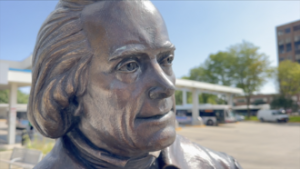 Thomas Jefferson statue, created bt Edward Hlavka. By Maxjolls – Own work, CC0, Wikipedia
Secretary of War Pete Hegseth has approved sending an amphibious force to the war zone, led by an assault ship, the U.S.S. Tripoli, a ship named for a war, including a force of about 2,200 Marines.
The United States’ War with Tripoli began on May 10, 1801, two months after Thomas Jefferson became president, when Pasha Yusuf Karamanli declared war against the United States, which included, per the culture, launching a mob to invade the U.S. Consulate and loot it, forcing Consul James Leander Cathcart to escape to the roof and flee across the white-washed rooftops of the Arab town to the Danish Consulate where he hid for ten days until the Danes could smuggle him into the harbor and aboard a vessel bound for Leghorn, Italy.
On December 10, 1803, President Jefferson in the White House with a gung-ho William Eaton, former intelligence officer in the U.S. Army and former consul in Tunis, planned an attack on Tripoli that Eaton would lead and be provided by Jefferson with 1,000 rifles, 11 U.S. Marines, and a strongbox containing gold coins.
On October 31, 1803, in the second year of the war, the U.S.S. Philadelphia ran aground outside Tripoli harbor and more than 300 U.S. Navy sailors were captured and enslaved.
Eaton, once in Egypt with his Marines, used the cash and rifles to recruit and arm a thousand mercenaries and march them 600 miles westward from Alexandria to capture the Libyan port of Darna, which so frightened the Pasha he sued for peace and released his American slaves. The Marine Corps hymn commemorates this march “…to the shores of Tripoli,” which, in effect, became a hostage-rescue mission.
The legality of what Jefferson and Eaton planned and pulled off was of dubious Constitutional legality, though perfectly in line with Jefferson’s call for war with the Muslims of North Africa already of 17 years’ duration when he became President. He had spent five years in Paris after the Revolution as first a trade commissioner then ambassador where much of his time was trying but failing to liberate American hostage-slaves in Algiers. Between 1784 and 1796 there had been more than 140 of them
Jefferson was the No. 1 American hawk for war with the so-called “Barbary Pirates” as a menace to America’s vital merchant fleet carrying the natural resources of the country to international markets. He learned in those years that the “pirates” was an inaccurate nickname. In truth, they were not independent, freebooting armed robbers on the high seas who when ashore hung out in taverns swigging rum and pawing at wenches. No, their cruisers were the official navies of the Muslim powers along the North African littoral whose livelihood was hijacking and enslaving infidels and in the name of the jihad. These “pirates” not only did not drink alcohol, three times daily when at sea they spread their prayer mats on deck, facing Mecca, to pray. Whoever heard of religious pirates?
Jefferson in Paris studied the situation in the Mediterranean, which included in 1786 meeting with an Arab sheik representing Tripoli who answered him when he asked why his city was demanding tribute. That year the U.S. was less than four years old and had never aggressed against Tripoli. Failure to pay meant American merchant vessels would be hijacked and the seamen and innocent passengers enslaved. Between 1784 and 1796, over one hundred forty Americans had been hostage-slaves in Barbary, and Jefferson wanted to know why.
And the answer he got from the sheik was that the jihad against infidels is eternal.
In his half-decade in Paris, the future Sage of Monticello purchased a translation of the Koran to understand the enemy — and never mind Keith Ellison, the Democratic attorney general and convert to Islam in Minnesota, now under investigation for a role in the Somali theft of billions of American taxpayers’ dollars, took the oath of office on that very same Koran in the proud and false belief that Jefferson owned it because he valued its contents. Nonsense. Jefferson was a known Deistic opponent of organized religion in general who learned Islam was a predatory and cruel faith.
After the Revolution, the infant Republic was wallowing in Revolutionary War debt and marketing its natural resources overseas was crucial to the economic success of the new country. The Navy that fought in the Revolutionary had been disbanded, so America’s merchant ships were unprotected. Jefferson was the most ardent proponent of building a navy, when many Americans imagined the new country did not need one since it was so far away from Europe and its forever wars.
Jefferson understood, as the anti-navalists in his generation did not, that the Muslims on the “Barbary Shore” were waging a religious war. These were not common “pirates.” They were jihadis, and the only way to deal with them was with superior military force.
Patron saint of American Liberalism, author of the Declaration of Independence, author of the Virginia Statute for Religious Freedom, and Father of the US. Navy Thomas Jefferson would not recognize today’s Democrats as his kind of liberal.
PHANTOM NATION: Inventing the “Palestinians” as the Obstacle to Peace is available at Amazon.com in hard cover or a Kindle ebook. His podcasts can be heard on www.phantom-nation.com.


For 1,400 years, the followers of Islam have had but a single goal: conquer the world, kill anyone who gets in the way, and make slaves of the survivors. That goal remains today as it was 1,400 years ago. Our so-called “leaders” in the West had best wake up to that while they still can.