
Peloni: Is this hypothesis about why the US has failed to open the Strait of Hormuz proving accurate? Well, if Trump is about to declare victory after having not achieved victory, John Konrad’s analysis offer us some insight as to why he would choose such a course.
See summary in the comments: https://www.israpundit.org/the-hormuz-hypothesis-what-if-the-u-s-navy-isnt-in-a-hurry-to-reopen-the-strait/#comment-63356000295041
John Konrad | March 18, 2026
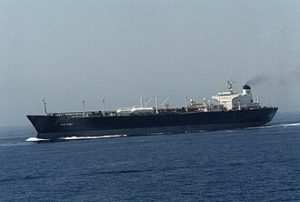 A port view of the reflagged Kuwaiti supertanker GAS KING underway. Photo by Department of Defense. American Forces Information Service. Defense Visual Information Center. 1994 -Public Domain, Wikipedia
By Captain John Konrad (Opinion) – The Strait of Hormuz is twenty-one miles wide. Two shipping channels, each two miles across, separated by a two-mile buffer. There is no alternative. Saudi Arabia’s East-West Pipeline to Yanbu and the UAE’s pipeline to Fujairah can handle maybe five million barrels combined. The math doesn’t work. The bottleneck is not political. It is geological and hydrographic.
Every TV analyst in America is talking about minesweepers and carrier strike groups. They are asking the wrong questions. The binding constraint on Hormuz was never a minefield or insurance. It is the US Navy’s willingness and ability to reopen it.
Every talking point suggests the White House and Navy are working hard to reopen the strait but progress is slow. A new posts on Truth Social suggests we may have to considet a new hypothesis.
“I wonder what would happen if we “finished off” what’s left of the Iranian Terror State, and let the Countries that use it, we don’t, be responsible for the so called Strait?” wrote President Trump in a psot this morning. “That would get some of our non-responsive “Allies” in gear, and fast!!!”
Let's unpack this..
What if the White House has no intention of reopening the Strait of Hormuz?
What if this war is really about ships & tariffs?
I had a long discussion with senior DOE official yesterday on background. I can’t share any details but it’s clear everyone’s… https://t.co/DCP0uw7C4E
— John ? Konrad V (@johnkonrad) March 18, 2026
Which leads to a question, White House may have no intention of reopening the Strait of Hormuz?
The Insurance Kill Switch
When the seven P&I clubs belonging to the International Group issued 72-hour cancellation notices for war risk coverage in the Persian Gulf on March 5, they did not just raise costs. They made transit impossible.
P&I clubs insure roughly 90 percent of the world’s ocean-going tonnage. Without their coverage, ships cannot sail. Port authorities will not let them dock. Banks will not finance the cargo. Charterers will not book the vessel. The entire system, from loading berth to discharge terminal, is underwritten by a chain of contracts that begins with a club in London, Oslo, or Tokyo. When the clubs pulled war risk extensions, that chain broke. Not for a few ships. For the global fleet.


The problem is that the Iranians would love nothing more than to use any ship they did not authorize for target practice. They choose not to fire on vessels sailing to China and a few other places but the main shipping in the gulf is stuck because they intend to sail to “unfriendly” ports. There are a few solutions available but those in need have the option to act first while keeping a watchful eye on the skies above. Just by the way, the gulf is considered to be “international waters”. However, they are near enough to shoot at anything that moves there.
The Woke Reich Does Not Get to Define MAGA
https://open.substack.com/pub/lel817/p/the-woke-reich-does-not-get-to-define?r=1q2uiq&utm_campaign=post&utm_medium=web&showWelcomeOnShare=true
I don’t understand this explanation. Could someone please simplify?
Also I wondered – what is the so hard about preventing Iran from stopping free passage? I didn’t undsrstand why the US can’t prevent this blocade.
It’s not in the US best interst to open the strait. China is coughing blood. Why help them? Russia does not care and push comes to shove, Russia would love to see China on the ropes.
@Renanah Goldhar-Gemeiner
Trump wanted to reform the US Navy so that it would be independent and capable of meeting the needs of standing alone. This was blocked from many avenues. This left the US in a position of being dependent upon its allies. Meanwhile when the US called for its allies to honor their part of their alliance with the US, they all sat on their hands, despite the fact that America, unlike its allies, is energy independent.
Beyond this, Trump stated he would provide the insurance needed to protect ships going thru the Hormuz, but he intentionally or inadvertently left a loophole in this commitment which indicated that he would cover the hulls, machinery and cargo, but not personal, third party or pollution liability. This loophole is what is keeping the Strait closed, because the reason ships won’t go thru is not because they will be sunk, but because there is no insurance which will cover their sailing, which limits their ability to make dock and transfer cargo when they get where they are going. So 1000 ships are trapped in the Arabian/Persian Sea because they aren’t being insured to sail. Trump could fix this by extending his insurance offer to cover the liability issues, but he has purposefully not done so.
The consequence of this is that countries such as the US and Saudi Arabia which are energy independent/exporters will have stable if increased energy costs, while countries which have no energy reserves such as Europe and China will have exponentially rising energy costs. Hence, whereas the old world order held that the waterways would be kept open by force if need be, the rising new world order has these waterways closed, hence instead of having a global pricing for oil, the price will now be fractured based on the presence or absence of national energy reserves of the countries in question. So, while US gas will go upto $4/gal, it won’t see pricing such as $20/gal or more, which is what Europe is potentially facing if they are not able to open the Straits of Hormuz on their own, which is specifically impossible given Europe’s lack of the required naval assets.
This leaves the US in a very comfortable position, while leaving China and Europe in the unenviable position of facing souring fuel prices because they wouldn’t participate in Trump’s call to keep Hormuz open. So as Donaldo explained above, it has been revealed that it isn’t really in Trump’s interest to solve the problem in the Strait of Hormuz, which is why he is calling for those nations which are dependent upon oil from the Arabian/Persian Gulf to go take it on their own.
What is more, this gives Trump the leverage over Congress and those centers of power which pushed Congress to block Trump’s goal for modernizing and expanding the Navy, so that the US will possibly still be able to move forward with a plan where the US will have the means to undertake such tasks as opening the Straits of Hormuz on its own without the need of its erstwhile non-Israeli allies.
This is a brief explanation, but it gives you a large portion of what is discussed in Konrad’s Hormuz Hypothesis.