
Yossi Baum | X | April 13, 2026
Translated by Peloni
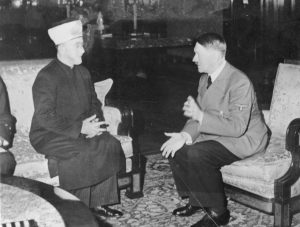 The Grand Mufti of Palestine received by Hitler. Photo by Bundesarchiv, Bild 146-1987-004-09A / Heinrich Hoffmann / CC-BY-SA 3.0, CC BY-SA 3.0 de, Wikipedia
*Must Read*: The Jerusalem Mufti, Al-Husseini, the “father of Palestinian ideology,” personally worked toward the murder of hundreds of thousands of Jews (not to say: millions) in the Holocaust.
The left does everything to obscure this, but the simple truth is: Haj Amin al-Husseini, the father of the murderous “Palestinian” ideology, was a senior Nazi and a full partner in the German killing machine, with all that this implies.
Al-Husseini, a Middle Eastern figure who spent three long years during the Holocaust in Berlin, was a senior Nazi not as a metaphor, but in the most practical sense imaginable. This was expressed across the entire range of his activities –
From the crematoria plan he prepared for Jews in the region, through his direct involvement in the killing of hundreds of thousands of Jews, the recruitment of tens of thousands of Muslims into Nazi SS service, and his extensive role in incitement and international dissemination of Nazi propaganda – including explicit and unambiguous calls for the mass murder of Jews wherever they were found.
His position within the Nazi system was reciprocal: the Nazis themselves provided him with significant financial and political support for his activities. This was not an isolated episode, but a strategic partnership that began with Hitler’s rise to power and continued thereafter, including espionage and wartime activity on his part against Britain (and France), which served the Nazi war effort. He was an ally and confidant of Himmler, Ribbentrop, Eichmann, and others.
It is also documented in the testimony at Nuremberg of Dieter Wisliceny, Eichmann’s deputy, who stated: “In my opinion, the Mufti who stayed in Berlin from 1941 played a role in the decision of the German government to destroy the Jews of Europe, a role whose importance cannot be underestimated” (without entering the public debate surrounding this testimony).
Moreover, although Nazi racial ideology generally regarded Arabs as inferior, Haj Amin al-Husseini was granted the status of “Honorary Aryan” as a sign of appreciation for his cooperation with the Nazi regime.
Given the importance of the matter—not only historically but also due to its implications for the contemporary roots of the Israeli–Palestinian conflict—I will outline his main actions and Nazi connections chronologically. I urge everyone to read this despite its length. Spreading this information is critical for the future of the Jewish people and the Land of Israel:
1933: Two months after Hitler came to power, he was the first to congratulate the new German consul, requested that Germany declare a boycott of Jews, and began promoting pro-Nazi propaganda in his newspaper.
1934: Wilhelm Frick, a senior Nazi official, visited the region and provided the Mufti with 120,000 pounds to fund Nazi propaganda efforts.
1935: The Mufti’s first major operation involved receiving funding worth millions of dollars from Italian Foreign Minister Galeazzo Ciano to poison the water wells of Tel Aviv. The plan was only partially carried out, resulting in minor damage to water pipes that was quickly repaired.
That same year, he also established a youth movement modeled on the Hitler Youth, at one point officially referred to as the “Nazi Scouts.”
1936 onward: The Great Arab Revolt against the British, during which thousands were killed, began at his initiative. During this period, he also orchestrated assassinations of political opponents. Most of his moderate opponents were either killed or forced into exile.
A postwar German military report stated: “Only through funds provided by Germany to the Grand Mufti of Jerusalem was the revolt in Palestine made possible.”
1937: He attempted to enlist Nazi Germany in support of the Palestinian cause. In a meeting with German consul Walter Della, he expressed support for “New Germany” and urged opposition to a Jewish state. He also asked Germany to halt policies encouraging Jewish emigration to Palestine and to pressure Poland to reduce Jewish refugee immigration to British-controlled Palestine.
A speech he delivered in Syria containing strong antisemitic rhetoric was translated into German by Nazi authorities and published in German newspapers.
In October, Eichmann was sent to Palestine in connection with contacts with the Mufti, but the British disrupted the visit. The resulting Nazi position aligned with the Mufti’s expectations: opposition to Jewish immigration to Palestine.
1938: As the revolt continued, including the killing of the British governor of Galilee, al-Husseini fled to Lebanon and continued directing operations from there. Lacking resources, he requested German assistance, but Germany declined, believing the time was not yet right for open confrontation with Britain.
1939: World War II began while al-Husseini was in Lebanon. The British considered requesting his extradition from French authorities due to his ties with Germany and Italy.
He later fled to Iraq, where he continued receiving financial support, including from Germany and Italy.
1940:
A. He requested asylum from the pro-Nazi Vichy regime controlling Lebanon and received financial support.
B. After the fall of Paris, he sent a letter to Hitler expressing joy at the German victory and later sent a longer message praising Nazi ideology and proposing cooperation against Britain. The Nazi response indicated willingness to support him militarily and economically.
C. He submitted multiple draft proposals for German-Arab cooperation, including arrangements in which the “Jewish problem” in the Middle East would be handled in a manner consistent with Nazi policy in Europe.
1941:
A. Following Axis advances in Greece and North Africa, he supported a coup in Iraq installing pro-Nazi leadership and overthrowing a pro-British government, alongside Nazi propaganda efforts.
B. After the British retook Iraq, he fled and was associated with encouragement of anti-Jewish violence during the Farhud pogrom, in which hundreds of Jews were killed.
C. He later traveled through Iran and Italy with Axis assistance, met Mussolini, and received official support and funding.
D. He ultimately reached Germany, met senior Nazi leadership, and in late 1941 met Hitler for approximately 90 minutes. He proposed forming an Arab legion for the Nazis and discussed coordinated action against Britain and the Jews.
E. He remained in Berlin and Italy for the remainder of the war, receiving substantial monthly funding from Hitler’s regime and functioning as a senior collaborator in Nazi propaganda and Middle Eastern operations.
1942:
A. He opposed rescue efforts for 70,000 Romanian Jews intended for relocation to the Middle East, contributing to the cancellation of the plan.
B. He also opposed efforts to save 10,000 Jewish children from Slovakia, blocking negotiations for their transfer to Palestine.
C. He broadcast Nazi propaganda across the Middle East and North Africa and operated within Nazi structures as a central coordinator of Arab propaganda efforts.
D. He helped establish Arab SS units and supported recruitment of fighters across Europe.
E. He was involved in the creation of the “Central Islamic Institute” in Berlin, used for coordination between the Nazi regime and Muslim communities.
F. He visited Sachsenhausen concentration camp with senior Nazi and Arab collaborators.
G. At the same time, Nazi forces advanced in North Africa, preparing for potential invasion of Egypt and Palestine.
H. He organized armed Arab groups intended to conduct sabotage operations against British and Jewish targets.
I. He allegedly designated areas for mass killing infrastructure in Palestine; defeat of Axis forces in North Africa prevented implementation of these plans.
1943:
A. He obstructed European efforts to transfer Jews to Palestine.
B. He opposed evacuation of Jewish groups from Bulgaria.
C. He advocated confiscation of Jewish property in North Africa.
D. He continued recruitment of Arab and Muslim forces for Nazi military units.
E. He proposed bombing Jewish institutions in Palestine.
F. He received ongoing Nazi financial support.
G. He maintained close correspondence and mutual praise with Hitler and Himmler.
1944:
A. He supported Operation Atlas, an attempt to poison water supplies in Tel Aviv, which ultimately failed.
B. He helped form Arab military units aligned with Nazi objectives against Britain.
C. He conducted intelligence and sabotage operations in the Middle East.
D. He distributed Nazi propaganda throughout Arab populations.
E. He obstructed Jewish child rescue efforts.
F. In broadcasts from Berlin, he called for violent attacks against Jews.
Before concluding: I will not enter into the debate regarding the Mufti’s influence on the “Final Solution.” However, one point is undisputed: Nazi leadership initially considered deporting European Jews to Palestine, and the Mufti opposed this option. Each reader may draw their own conclusions.
Epilogue: This account should not merely have been posted on social media, but engraved at the entrance of Yad Vashem. The alleged minimization of the Mufti’s role by institutions due to political considerations is presented here as a serious distortion, enabling extremist movements to draw ideological continuity from his legacy. October 7 is framed here as part of a longer historical trajectory.
Sources for the post “The Jerusalem Mufti al-Husseini, father of the ‘Palestinian’ ideology, personally acted to murder hundreds of thousands (not to mention: millions) of Jews in the Holocaust”:
he.wikipedia.org/wiki/%D7%90%D7
he.wikipedia.org/wiki/%D7%90%D7
he.wikipedia.org/wiki/%D7%90%D7
jewishvirtuallibrary.org/the-mufti-rsqu
s-shatterrealityandfacts.blogspot.com/2013/11/
blog.nli.org.il/%d7%97%d7%a9%d
giluydaat.co.il/%D7%97%D7%9C%D
jewishvirtuallibrary.org/the-mufti-rsqu


Leave a Reply
You must be logged in to post a comment.