
Although nearly eight decades have passed since that war in 1948, there is still much to learn from it, not only as a glorious and heroic chapter in the history of the Jewish people and the State of Israel, but also, and above all, as a source of lessons and insights worth remembering and revisiting, which remain relevant today.
Prof. Eyal Zisser | April 19, 2026
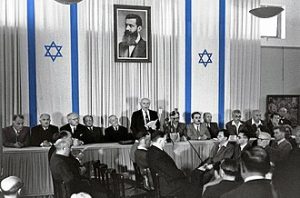 David Ben-Gurion (First Prime Minister of Israel) publicly pronouncing the Declaration of the State of Israel, May 14 1948. Photo by Rudi Weissenstein – Israel Ministry of Foreign Affairs, Public Domain, Wikipedia
The 78th Independence Day, which Israel marks this week, is a good opportunity to return to our roots, to the foundations and sources, and above all to the starting point of our journey: the War of Independence, which broke out following the declaration of statehood on the fifth of Iyar, 5708. It was a fateful war, a war for survival, and our victory in it secured Israel’s future for many years.
For most Israeli citizens, the War of Independence is a distant and even forgotten memory, as over the past three years they have been consumed by a war for the home front against Iran and its proxies in the region around us, Hamas and Hezbollah, both terrorist organizations. And as then, so today, this has been a hard and prolonged war, in effect a succession of operations, much like those of the War of Independence, from Operation Nachshon, which opened the road to Jerusalem, to Operation Uvda, which opened the road to Eilat. Only this time the campaigns have been Swords of Iron, Northern Arrows, Rising Lion and Roar of the Lion, with more still to come.
Yet although nearly eight decades have passed since that war in 1948, there is still much to learn from it, not only as a glorious and heroic chapter in the history of the Jewish people and the state, but also, and above all, as a source of lessons and insights worth remembering and revisiting, which remain relevant today.
The War of Independence in fact began with the UN resolution of November 29, 1947, after the Arabs of Mandatory Palestine launched a struggle against the Jewish community in an attempt to prevent the resolution from being implemented. Needless to say, they suffered a crushing defeat in that struggle and brought a grave disaster upon themselves. But another, decisive stage of the war began when Arab armies invaded the Land of Israel after the establishment of the state, with the aim of destroying the newly founded country.
It is hard to overstate the scale of the threat facing the State of Israel in those days. The Jordanian Arab Legion, a formidable force in 1948, laid siege to Jerusalem and prevented water and food from entering the city. At the same time, Egyptian armored columns reached the Ad Halom bridge, 35 kilometers (22 miles) from Tel Aviv. The city was also bombed incessantly by Egyptian aircraft, and in the first week of the war alone the attacks caused about 100 deaths, more than our losses in the two rounds of confrontation with Iran.
And as today, the world then showed indifference and even estrangement. And when people invoke US President Harry Truman as a steadfast pillar of friendship and warmth toward Israel, it is worth remembering that he was a lone pillar even within the US, where most senior members of his administration were fiercely opposed to the establishment of Israel.
Skepticism was also widespread among many in the Israeli leadership, and it is difficult to grasp that the decision to establish the state passed by a narrow margin of six supporters against four opponents, who believed it should be avoided because of international pressure and fears of defeat on the battlefield.
But Israel rose to the challenge. Israeli society, which displayed resilience, cohesion and unity, mobilized for the campaign. Thus, for example, more than half of the ultra-Orthodox yeshiva students of those years enlisted in the army at the instruction of their rabbis. Israel Defense Forces commanders were not free of mistakes and failures, but they showed determination and resolve in carrying out the missions assigned to them, and often went far beyond what was required. And finally there was the leadership, headed by David Ben-Gurion, who directed the war with a firm hand and broad strategic vision, while also managing to build a nation and a state, advance the principle of statehood over factionalism on both Right and Left, and understand when and how to end the war. He did so while giving priority to absorbing mass immigration and building society and the economy over continued fighting, even at the cost of forgoing military gains that would not truly have changed the overall picture.
Ben-Gurion had no doubt that victory in the war did not mean the end of the conflict. On the contrary, he believed the next round of fighting was only a matter of time, but he held that a ceasefire would allow us to build ourselves up and prepare better for what lay ahead.
The War of Independence was the hardest and bloodiest of all Israel’s wars. But victory in it was the most important and consequential of all those we have fought since.
In the coming days, then, we will proudly remember that war, the War of Independence, of revival and of sovereignty.


Leave a Reply
You must be logged in to post a comment.