
Peloni: Will PM Ali al-Zaidi prove to be a reformer, a compromise candidate or Iran’s latest proxy leader in Iraq? The truth is that he may not even be capable of forming a govt, and he has just one month before Iraq is back to square one while looking for a new parlaimentary leader. What is certain is that al-Zaidi is an acceptable candidate for Trump, so we will see if having been chosen to lead the govt after 5 months of political log jams, this Shiite candidate from a region which is generally opposes Iran’s rule in Iraq will be able to form a govt, and if so, what sort of government he might be able to form in a country still dominated by Iran and its paramilitary groups.
More than five months after its national elections, Iraq may finally have a new leader.
Bridget Toomey
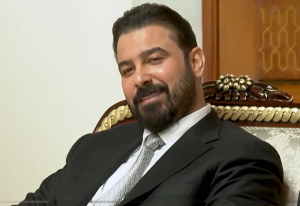 PM Ali al-Zaidi. Screengrab via Youtube
On April 27, Iraqi President Nizar Amedi named Ali al-Zaidi, a businessman who has not held political office, as prime minister-designate. Zaidi now has 30 days to form a government by selecting a cabinet which must be approved by Iraq’s Council of Representatives, its national parliament. The nomination does not guarantee that Zaidi will assume the top office. In 2020, two consecutive prime minister-designates failed to take office after proving unable to assemble a cabinet with parliamentary support.
The Coordination Framework (CF), a political coalition of Tehran-aligned, Shiite parties that constitute the largest bloc in parliament, struggled to agree on a nominee for prime minister following the November 2025 election. The CF nominated former Prime Minister Nouri al-Maliki in late January, despite internal opposition. President Donald Trump’s rejection of Maliki, a close partner of Tehran, doomed his candidacy. Zaidi received America’s blessing on April 29.
Zaidi’s lack of political experience helped ensure consensus within the CF, in part because it suggests he will take direction willingly. The coalition, which contains U.S.-designated terrorist Qais Khazali in its leadership, likely intends to maintain decision-making authority, and ensure the prime minister does no more than execute its priorities.
Zaidi’s Ties to Illicit Finance Are Cause for Concern
Zaidi served as chairman of al-Janoob Islamic Bank, which in 2024 the Central Bank of Iraq (CBI) prohibited from participating in the dollar auction, the CBI’s method of distributing dollars to Iraqi financial institutions prior to the auction’s termination in early 2025. Washington was concerned the cash was making its way to the Islamic Republic and its partners.
Iraq is a critical hub for illicit Iranian financing. Iraqi oil smuggling networks, involving Tehran’s partners deeply embedded in the government in Baghdad, generate around $1 billion of annual revenue for Tehran and its partners. Iranian partners also exploit Iraq’s access to the U.S. dollar through numerous, innovative schemes.
This illegal activity, along with militia attacks during the recent war, placed Iraq in the crosshairs not only of Operation Epic Fury, but also Operation Economic Fury. The Trump administration is withholding shipment of U.S. dollars to Iraq, as well as some security and financial support. The U.S. Treasury Department also sanctioned Iraqi militia commanders while the Rewards for Justice (RFJ) program issued three rewards of up to $10 million for information on Iraqi militia leaders.
Baghdad’s Next Government Won’t Confront Iran-Backed Iraqi Militias Alone
A new prime minister, especially one from the Tehran-aligned CF, will not change Baghdad’s approach to the militias without pressure from the United States.
Tehran’s Iraqi partners came out of the recent war emboldened. Despite a $10 million reward for information being issued on April 23, Abu Ala al-Wala’i, leader of Kataib Sayyid al-Shuhada — an Iran-backed, U.S.-designated foreign terrorist organization (FTO) — attended the CF meeting the next day to discuss the prime minister’s selection.
During the conflict, the Iraqi government chose not to rein in the militias launching dozens of attacks against American diplomatic and military infrastructure. Instead, Baghdad authorized the militias to respond to U.S. airstrikes against them. This legitimized militias acting outside of state control and at the direction of Tehran. As the U.S. Treasury designation of militia commanders said, “These militias operate with near impunity.”
Washington Should Maintain Red Lines in Government Formation
Iraq is a crucial arena for fighting Iranian malign influence, illicit finance, and terrorist activity. The only way to accomplish this without sparking an economic or military crisis in Iraq is partnership with Baghdad, likely with Zaidi. Washington should maintain red lines for Iraq’s government formation, such as allowing no militiamen into the cabinet or senior positions. Zaidi’s obscurity makes his personal motivations and ambitions an unknown. Washington’s approval indicates a perception that he can be worked with, but a government stacked with Iranian partners would be damaging to Iraq-U.S. relations and Iraq’s future.
Bridget Toomey is a research analyst at the Foundation for Defense of Democracies (FDD). For more analysis from Bridget and FDD, please subscribe HERE. Follow FDD on X @FDD. Follow Bridget on X @BridgetKToomey. FDD is a Washington, DC-based, nonpartisan research institute focusing on national security and foreign policy.


Leave a Reply
You must be logged in to post a comment.