
Ahmad Sharawi
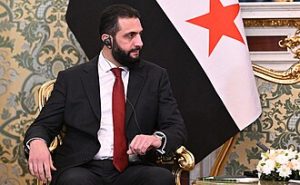 Abu Muhammad al-Jolani. Photo by Kremlin.ru, CC BY 4.0, Wikiepedia
The Syrian government’s effort to integrate foreign fighters into its armed forces may be unraveling.
On May 5, Syrian authorities arrested 16 Uzbek fighters following a standoff with armed members of the Uzbek community in the northwestern province of Idlib. The confrontation erupted after Syrian security forces detained an Uzbek fighter in the Syrian army for looting, prompting dozens of Uzbek militants to surround the security headquarters in Idlib. Clashes also erupted between government forces and Uzbek fighters in the Idlib village of Kafraya. Uzbek jihadists, most notably members of Katibat al-Tawhid wal-Jihad (Battalion of Monotheism and Jihad), a U.S.-designated terrorist organization, have preserved their extremist affiliations and demonstrated questionable loyalty despite the accommodating stance of the government in Damascus.
Most of the foreign fighters were part of the jihadist coalition under the leadership of Ahmad al-Sharaa that ousted the Bashar al-Assad regime. Now president, Sharaa previously led Hayat Tahrir al-Sham (HTS), a force that emerged from al-Qaeda’s branch in Syria. After taking power, Sharaa rapidly integrated thousands of foreign fighters into the country’s new armed forces. Syrian defense ministry sources told Reuters last year that Sharaa defended this approach to Western skeptics on the grounds that excluding the foreign fighters would drive them back to al-Qaeda or the Islamic State.
Idlib Clashes Not a One-Off
The showdown in Idlib was only one of many clashes between the state and foreign jihadists. In October 2025, Syrian government forces launched an operation in the Harem camp near Idlib against foreign jihadists from Firqat al-Ghuraba (Foreigners Brigade), led by Omar Omsen, a U.S.-designated terrorist wanted by France for recruiting French nationals to fight in Syria. The clashes reportedly erupted after members of the group kidnapped a French girl in the camp and planned to extort her mother, which prompted Syrian forces to intervene. In response, Omsen called on foreign fighters across Syria to mobilize against the government.
Firqat al-Ghuraba has established a parallel policing system within its camp, holding trials and issuing sentences outside the authority of the Syrian state.
U.S.-Designated Terrorist Groups Remain in Syrian Army
The Syrian government originally sought to institutionalize the foreign groups by integrating segments of them into the military and security apparatus in an attempt to impose greater discipline through state control.
However, the ideological extremism of some of these factions — and their alleged involvement in massacres against religious minorities — has exposed the serious risks of this policy.
For example, Damascus integrated the Turkistan Islamic Party (TIP), a Uyghur jihadist group, into the Syrian army’s 84th Division, a unit reportedly composed largely of foreign fighters. TIP maintained longstanding ties to al-Qaeda, fighting alongside the group in Afghanistan before 2001, while its current emir, Abdul Haq al-Turkistani, sits on al-Qaeda’s Shura Council. In 2015, TIP fighters desecrated churches in Jisr al-Shughur in Idlib.
Another faction integrated into the 84th Division is Liwa al-Muhajireen wal-Ansar (Brigade of Emigrants and Supporters), a U.S.-designated Salafi-jihadist group comprising fighters from Arab countries as well as the North Caucasus. Sharaa promoted to the rank of colonel its commander, Dhu al-Qarnayn Zanour Abdul Hameed, who now serves as a commander within the 84th Division.
U.S. Should Use Leverage of Review Process To Press for Change
“Tell all foreign terrorists to leave Syria,” the White House press secretary posted last year following President Donald Trump’s first meeting with Sharaa. Trump had praised Sharaa and committed to lifting sanctions on Syria to facilitate its recovery. Trump demanded no formal concessions in return, but the White House made clear its reservations about Syria integrating jihadists.
Despite these concerns, Washington has never made progress in U.S.-Syrian relations conditional on Sharaa addressing the problem. The United States still retains leverage through Syria’s designation since 1979 as a State Sponsor of Terrorism (SST), a status Washington has been reviewing since December 2025. The United States should use the leverage provided by the SST review process to pressure Damascus to remove or demote foreign fighters within its security forces, particularly members of U.S.-designated terrorist organizations serving in the Syrian army. Additionally, Washington should press Damascus to refrain from deploying these factions to sensitive areas where sectarian tensions remain acute.
Ahmad Sharawi?is a senior research analyst at the Foundation for Defense of Democracies (FDD). For more analysis from Ahmad and FDD, please subscribe?HERE. Follow FDD on X?@FDD. Follow Ahmad on X?@AhmadA_Sharawi. FDD is a Washington, DC-based, nonpartisan research institute focusing on national security and foreign policy.


Leave a Reply
You must be logged in to post a comment.