
Peloni: Recall that America’s real opponent in Iran remain China, and the pressure being brought to bear on Iran is not coming from the US, but from Iran’s partner, China. The role being played in this war by China is complicated by the fact that China is partnered with other Gulf states, who were betrayed by China not preventing the Iranian attacks on their countries. In addition to this, US naval control of key waterways, including the Strait of Malacca thru which Chinese shipping transits, has had its own influence on China. What is more the importance of the normal flow of oil from Iran, 90% of which goes to China, remains key to China’s economy. This is the backdrop under which China is currently using its influence over Iran to bring it to the table. The last time China used its influence, of course, was during the meeting in Pakistan. So we will see if the current effort is more productive than the last one…they have one week to produce results according to the latest US deadline.
Jack Burnham
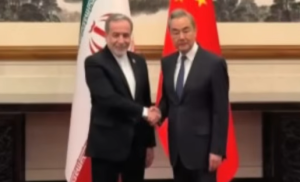 Iranian FM Araghchi Meets Chinese FM Wang Yi in Beijing. Screengrab via Youtube
China is looking to engineer an off-ramp to end the current U.S.-Iran conflict without forcing Tehran to fold.
On May 6, Iran’s Foreign Minister Abbas Araghchi met in Beijing with China’s Foreign Minister Wang Yi to discuss the ongoing conflict and deepen relations between Tehran and Beijing — two members of an emerging Axis of Aggressors. The meeting was held as Iran continues to threaten international shipping through the Strait of Hormuz while facing an American blockade, roiling global energy markets and hindering the Chinese economy.
Though the meeting failed to produce any firm commitments, Beijing’s diplomatic outreach highlights its focus on easing Tehran into accepting an end to the hostilities without overtly coercing the regime to surrender.
Beijing Focuses on Strait of Hormuz While Avoiding Iran’s Nuclear Program
In his meeting with Araghchi, Yi emphasized China’s desire to reopen the Strait of Hormuz while avoiding assigning blame to Tehran for the closure, calling the issue a cause of “common concern” that could be resolved by diplomatic dialogue. In response, Araghchi promised that the Strait would soon be open via a “comprehensive and permanent solution,” though he stopped short of offering firm commitments to end attacks on international shipping. At the meeting, Yi declined to mention the ongoing U.S. maritime presence in the Strait, partially retreating from Beijing’s previous criticism of the U.S blockade as a “dangerous and irresponsible act” that could prompt further escalation.
China also carefully refrained from commenting directly on the future of Iran’s nuclear weapons program. During the meeting, Yi claimed that Beijing “appreciates” Iran’s pledge not to develop nuclear weapons while simultaneously recognizing Tehran’s right to enrichment for peaceful purposes. This posture echoes China’s previous claims about Iran’s nuclear program. During the June 2025 12-Day War, China condemned joint U.S.-Israeli strikes on Iranian enrichment facilities as targeting peaceful civilian infrastructure, with China’s UN ambassador calling the most recent round of strikes “serious violations of international law.”
China Has Provided Key Lifelines to Iran
Since the outbreak of the war, Beijing has paired diplomatic outreach with limited support to Tehran, seeking to forestall complete regime collapse without upending relations with Washington or other Gulf states. Prior to the blockade, China received over 90 percent of Iran’s crude exports, offering a financial lifeline to the regime that has yet to be fully severed as Chinese “teapot” refineries gain access to Iranian oil currently on the water in Southeast Asia. This trade has long allowed Tehran to pay its armed forces, with nearly half of Iran’s oil revenue flowing to its military capabilities and much of the sector dominated by the Islamic Revolutionary Guard Corps (IRGC).
China has also provided more direct support for Tehran’s military capabilities, such as dual-use chemical precursors, including those that can be used to produce propellant for solid-fuel ballistic missiles. In addition, The Financial Times reported on April 15 that the IRGC previously purchased imagery from a Chinese-operated commercial satellite to target U.S. military installations in the region, launching strikes that may have destroyed radar installations, communications equipment, and airborne command-and-control platforms. China also remains a key supplier for Iran’s drone sector, providing engines, computer chips, and gyroscopes, allowing Tehran to continue launching one-way attack drones against U.S. and Israeli forces and U.S. partner states across the region.
Washington Should Raise Cost of Beijing’s Support for Tehran
The United States should press China to place greater pressure on Iran to back away from its maximalist demands. The Commerce Department should use its Entity List authority to target Chinese firms providing dual-use goods to Iran, including commercial satellite firms and drone manufacturers, cutting them off from the American market.
The United States should also continue to target Chinese entities and banks tied to illicit Iranian oil sales with secondary sanctions, building on the Treasury Department’s efforts to sanction Hengli Refinery, China’s second-largest teapot refinery. These steps will raise the cost for China’s continued support for Iran, particularly as Beijing looks to maintain a trade truce with Washington ahead of a high-level summit next week.
Jack Burnham is a senior research analyst in the China Program at the Foundation for Defense of Democracies (FDD). For more analysis from Jack and FDD, please subscribe?HERE. Follow FDD on X?@FDD. Follow Jack on X?@JackBurnham802. FDD is a Washington, DC-based, nonpartisan research institute focusing on national security and foreign policy.


Fuck those chink bastards.
This statement is typical of world politics in this age. Anyone can claim that this or that is a violation of their own preferred interpretation of international law.
Reviewing China’s support of Iran in the current war scenario, they are using Iran as a proxy on a larger scale than Iran used Hamas, Hezbollah and the Houthis. There is no difference at all and they may also need to be brought down a significant number of pegs. Trump has been working on this subject too, if we just reconsider the effects of the closing of the straights of Hormuz. One recent mention in the news was that Australia are so in trouble by a lack of oil that they are buying from the Chinese! My feeling is that this subject is not receiving adequate attention.