
Peloni: A rare telling of how a warped historical record is used to reframe reality, something which led to a civil war in Princeton University surrounding a modern exhibition of art by Jewish two veterans of the American Civil War.
Kelleigh Nelson
I hope you will be an artist as it seems to me you are cut out for one. But whatever you do, try to prove to the world that if we did not succeed in our struggle, we were worthy of success. — Robert E. Lee’s advice to Ezekiel, as recalled in his memoirs.
When we talk about art, we can separate the man from the art, if it’s worth separating. And if you can do that with all these canonical artists, why can’t we do that with Ezekiel? — Samantha Baskind, author of Moses Jacob Ezekiel: Jewish, Confederate, Expatriate Sculptor and art historian, regarding his complex legacy.
A great Virginian, a great artist, a great American, and a great citizen of world fame. — President Warren G. Harding in a message read at Ezekiel’s 1921 funeral.
I feel my inability to express myself fully on this expansive subject, and I must now beg of you to allow my work to speak for itself and for me.” – Moses Jacob Ezekiel, speech at the unveiling of Religious Liberty, 1876
In reality no one in the South would have raised an arm to fight for slavery. It was an evil we had inherited and wanted to get rid of. Our struggle was simply a constitutional one, based upon state’s rights, and especially on free trade, and no tariff. Moses Ezekiel
A familiar American monument was removed on December 20-22, 2023 from the spot in Arlington National Cemetery where it stood since June 1914. It is stored in a secure place by the Virginia Department of Defense (DoD), now the Department of War.
President Woodrow Wilson presided over the dedication of Moses Jacob Ezekiel’s Confederate Memorial, also referred to as the Reconciliation Monument, which marked the graves of over 400 Southerners who fought for the independence of their states. He characterized the monument as an “emblem of a united people.” The Washington Post on May 24, 1914 reported that the Confederate Memorial “means, primarily, peace.”
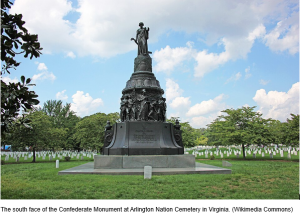
Arlington National Cemetery was land formerly owned by Robert E. Lee. By the time Lee’s son sold the Arlington estate back to the U.S. government in 1883 for $150,000, there were over 17,000 graves on the land. While the estate was originally confiscated and turned into a cemetery in 1864, the 1883 sale was deemed necessary to legally clear the title after the Supreme Court ruled the original seizure improper.
Following a 2025 agreement, the statue is slated to be refurbished and returned to Arlington by 2027, with the granite base remaining at the original site.
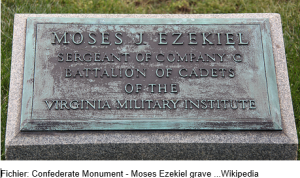
Moses Ezekiel is buried beneath it.
Designed by sculptor and Confederate veteran Moses Jacob Ezekiel, the bronze monument was removed in December 2023 following a mandate from the Congressional Naming Commission (CNC). The Biden administration, for obvious ideological and ultra-woke purposes, were tasked with renaming US Army bases honoring Confederates. The CNC was composed of eight members appointed by Secretary of Defense Lloyd Austin and Congressional leaders.
After years of destruction in American cities by the Marxist forces of Black Lives Matter and Antifa seeking to “dismantle” existing social and economic structures in the U.S., the communist tactic of “divide and conquer” was ablaze once again. The age-old strategy to purposely sow division, pit rival factions against each other and create infighting had succeeded. Communists continue to use it successfully.
On January 1, 2021, the Senate, with a vote of 81 to 13, elected to push Biden’s “racial reconciliation” through. Only four Republican senators from the Southern states dared to sustain President Trump’s former veto of this decision, Tom Cotton (R-AR), Ted Cruz (R-TX), John Kennedy (R-LA), Rand Paul (R-KY). (Three other conservative Republican senators outside the South—Mike Braun of Indiana, Mike Lee of Utah, and Rand Paul of Kentucky—also voted to sustain the veto.)
Despicable and shameful!
The commission concluded that the monument promoted a “mythologized vision” of the Confederacy and included “highly sanitized depictions of slavery.” The CNC was a bipartisan federal body created by Congress in 2021 (via the FY2021 NDAA) to identify and recommend renaming for the DoD assets that commemorated the Confederate States of America. We know this was done intentionally to deal with former American heroes no longer appreciated by the communists’ desire to divide and conquer.
Even the naval ship, the U.S.S. Chancellorsville, was slated for change. The CNC decided to efface this commemoration and event from our memory. Why? Because the struggle that took place there in Chancellorsville was one of General Robert E. Lee’s greatest victories, although the battle resulted in General Thomas Jonathan “Stonewall” Jackson’s death by friendly fire.
The Army had changed those names during the Biden Administration, based on a 2022 study completed by the Pentagon’s Naming Commission that recommended new titles for military installations that had been named after leaders of the Confederacy. The Confederate leaders were American citizens just as were the Union soldiers. They had been promised that they could secede should they dislike what the federal government was doing. President James Buchanan who preceded Lincoln had allowed seven states to peaceably secede, South Carolina (Dec 20, 1860) was followed by Mississippi, Florida, Alabama, Georgia, Louisiana, and Texas (by Feb 1, 1861).
In 1898, President McKinley had mandated honoring and decorating Confederate graves. In 1958, the U.S. Department of Veterans Affairs was legally mandated to furnish headstones for Confederate veterans as American veterans!
The reunification of America was very obvious by 1898. The Spanish-American War saw Union and Confederate soldiers who fought side by side. President William McKinley, a Union veteran, announced that, henceforth, Southern war dead would be honored in all cemeteries on federal property and, in particular, at Arlington National Cemetery, the chief burial grounds of the American military. Two years later, in 1900, Congress passed legislation to establish a Confederate section in Arlington that would be known as Jackson Circle. The design for Jackson Circle was drawn up by the U.S. Army Corp of Engineers and marked with an “M” to signify the designation of memorial.
Moses Ezekiel was at that time America’s most renowned sculptor of the period and was also a former Confederate soldier. He was an artist of Sephardic descent commissioned to create a work worthy of the solemn setting. The sculpture was to be a bronze plinth holding a statue of a woman representing the South, holding an olive wreath of peace in her outstretched hand. Around the plinth are scenes of families tearfully seeing sons and fathers off to war and controversially today, a black soldier marching in the Confederate ranks and a black mammy comforting her owner’s crying child. Yes, there were black soldiers in the Confederate Army!
Brigadier General Ty Seidule was the CNC’s Vice Chairman and received his appointment from Sec. of Defense, Lloyd Austin. The general reported that the projected cost to make Ezekiel’s disfavored monument disappear and for renaming nine military bases, two naval ships, and removing all memorials in Arlington National Cemetery with Confederate associations would come to $62.5 million tax dollars.
All that money to erase the Confederacy from the U.S. Military.
What an abomination to the soldiers of the south. While there is no exact, official number, it is safe to conclude that the vast majority of the 750,000 to over 1 million men who served in the Confederate Army were descendants of the American Revolution (War for Independence).
Given that the Southern population was highly established and less impacted by the surge of late-19th-century immigration compared to the North, the connection to Revolutionary-era families was immense.
Ezekiel’s memorial to the southern soldiers will return to guard his brothers-in-arms.
General Forrest and Black Civil Rights
General Nathan Bedford Forrest had forty-seven black men from his plantation who willingly went with him to war and whether they won or lost, he told them they were free men. Eight of them guarded Forrest and 45 of them surrendered with him. He managed to get them funds after the war and referred to them as the best of the Confederate soldiers. Few people know that Forrest actually kissed a black woman on the cheek on a stage during a public speech in 1875. The incident occurred on July 5, in Memphis, Tennessee, at a meeting of the “Jubilee of Pole Bearers,” a Black fraternal organization where Forrest spoke to that group.
Whenever there were problems within the black communities, Forrest was called on by the black men to help them. If you read Eddy W. Davison’s “Nathan Bedford Forrest: In Search of the Enigma,” on page 464 and 474-475, you can see that Forrest not only publicly disavowed the KKK and worked to terminate it, but in August 1874, Forrest “volunteered to help ‘exterminate’ those men responsible for the continued violence against the blacks.” Forrest rode with county sheriffs throughout Tennessee to eliminate the Klan. The United States Congress recognized Forrest’s efforts to dismantle the Klan in 1871.
Yet, he and his wife, Mary Ann were disinterred in Elmwood Cemetery in Memphis, Tennessee and were reinterred at the Son’s of Confederate Veteran’s Elm Springs property in Columbia, TN, in September 2021.
The General was a postwar activist for black civil rights and the South’s first civil rights leader. Forrest pleaded with both local and federal governments to establish training programs for black Americans. His pleas went unheard, so he took it upon himself. “As president of the Selma, Marion & Memphis Railroad, Forrest employed former slaves as construction engineers, crew foremen, train engineers and conductors. Blacks were hired as managers, as well as laborers.”
When Forrest’s cavalry surrendered in May 1865, sixty-five blacks were on Forrest’s muster role, including eight in Forrest’s Escort, the general’s handpicked elite inner circle. Commenting on the performance of his black soldiers, Forrest said, “Finer Confederates never fought.”
When Forrest died in 1877, Memphis newspapers reported that his funeral procession was over two miles long. The throng of mourners was estimated to include over 3,000 black citizens of Memphis.
Sadly, the truth rarely reaches the American people. The “woke” erasure of history was inflicted upon America, thus any memory that didn’t line up with politically correct dogma was effaced and destroyed.
Ezekiel’s Fame
Moses Jacob Ezekiel was born in Richmond, Virginia to a family with Spanish-Jewish roots. His father had suffered financial difficulties so Moses grew up with his grandparents. His artistic gifts were noted early on, when at the age of 13, he produced a clay bust of his father, Jacob.
He entered the Virginia Military Institute (VMI) in 1862 and became the first Jewish cadet at that school. In 1864, he and his fellow cadets were sent into battle. Apart from prominent individuals such as Judah P. Benjamin and Phoebe Yates Pember, Jewish Confederates have been virtually invisible in the massive body of published work on America’s horrific self-induced war. Robert Rosen, author of The Jewish Confederates, will dissuade you of the myth that Jewish Americans were not involved in the Southern War for Independence.
In his memoirs, Ezekiel recalled the Battle of New Market on May 15, 1864:
“It was raining, and… we marched through fields of mud in which I lost my shoes. Our battalion was beautifully in line when we crossed an open field. Halfway across, the Minié balls began to whistle around our ears, and the artillery shells came howling toward us…. we advanced in as perfect order as if drawn up for dress parade.”
They eventually succeeded in capturing a Union cannon and hoisting the VMI flag on top of it in victory.
After the war, Ezekiel attended Virginia Medical College taking anatomy classes. He later joined his father in a new business venture where he produced a small clay sculpture, “Industry,” which portrayed a girl knitting socks while studying her lessons. That sculpture gained attention from the local press and his artistic career was off to a grand start.
In 1869, he moved to Berlin and took a position with a renowned sculptor where he studied life-modeling under the tutelage of Albert Wolff. In 1873, his bas relief, “Israel” would earn first place in the Prix de Rome and award him a year’s study in the Italian capital.
Ezekiel became a member of the Jewish fraternal organization Independent Order of B’nai B’rith and they were the ones who commissioned him to sculp “Religious Liberty.” The sculpture is located in front of the National Museum of American Jewish History on Independence Mall in Philadelphia.
American financier W.W. Corcoran commissioned Ezekiel to make marbles of history’s great artists, including Michelangelo and Leonardo Da Vinci.
At his studio in Rome, he displayed a large Confederate battle flag. His many famous visitors included President Ulysses S. Grant, composer Franz Liszt and so many more. He also created a bust of Rabbi Isaac Mayer Wise, who was then America’s most famous exponent of Reform Judaism.
In 1900, Ezekiel donated “Virginia Mourning Her Dead” to his alma mater, VMI, in honor of the cadets who served with him at the Battle of New Market. Six of those cadets, one of whom died in Ezekiel’s arms, are set in a copper box at the foundation of this monument. Fourteen years later, this brilliant artist received his final and greatest commission from a huge number of groups, including Daughters of the Confederacy. He produced the Confederate Monument, which he named the “New South,” at Arlington National Cemetery. Beneath the monument is the artist’s plaque, which reads, “Moses J. Ezekiel, Sergeant of Company C, Battalion of Cadets of Virginia Military Institute.”
Ezekiel died in 1917 in Rome, and WWI delayed his homecoming to Virginia. The U.S. Marine Band played “Liebestraum,” a composition by his close friend, Franz Liszt. Until very recently, every president since 1914 has sent a wreath to Ezekiel’s monument in honor of the valor of Southern soldiers buried at Arlington and in honor of Ezekiel.
Nearly 100 million Americans are descended from those who served the Confederacy. The monument that honors these patriots and their families, whom the woke government in D.C. was hellbent to destroy, must be returned to its rightful place in Arlington.
One last recent piece of disturbing news came from Princeton in 2021.
Princeton and Ezekiel’s Art
Princeton University sparked a major academic and cultural debate when it canceled the planned 2022 exhibition of 19th-century Jewish art. The exhibit was to feature works by Moses Jacob Ezekiel, the first prominent Jewish-American sculptor. University officials raised concerns over Ezekiel’s documented, lifelong ties to the Confederacy. He served in the Confederate Army, was a veteran of the Battle of New Market, and created the Confederate Memorial at Arlington National Cemetery.
Princeton requested that works by Ezekiel and another Jewish artist with Confederate ties (Theodore Moise) be swapped out for other creators. The show’s donor and curator refused, resulting in the exhibition’s cancellation.
Princeton Alumni Weekly published this piece, “Exhibit Canceled After Dispute Between Library and Donor.”
Samantha Baskind, biographical author of Moses Jacob Ezekiel: Jewish, Confederate, Expatriate, Sculptor disagreed with the cancellation as mentioned in the Princeton Weekly article.
Conclusion
Encouraged by Robert E. Lee, among others, to make a name for himself and for his people, Ezekiel would write:
“The race to which I belong had been oppressed and looked down upon through so many ages, I felt that I had a mission to perform. That mission was to show that, as the only Jew born in America up to that time who had dedicated himself to sculpture, I owed it to myself to succeed in doing something worthy in spite of all the difficulties and trials to which I was subjected.”
Attribution: Years ago I read an article by Richard Hines and Paul Gottfried regarding the removal of Ezekiel’s magnificent statue. I took notes from that article which sparked my interest in more research. What an amazing artist we had in Moses Ezekiel. His masterpiece must be returned to its rightful place honoring the soldiers of the Confederacy.


Leave a Reply
You must be logged in to post a comment.