
Peloni: History half told are how the most successful libels begin, and it was no coincident that this is how the false reality in which the fabled Nabka was fabricated.
Mamdani digs himself deeper into fanatic Islamism.
Am Thinker | May 21, 2026
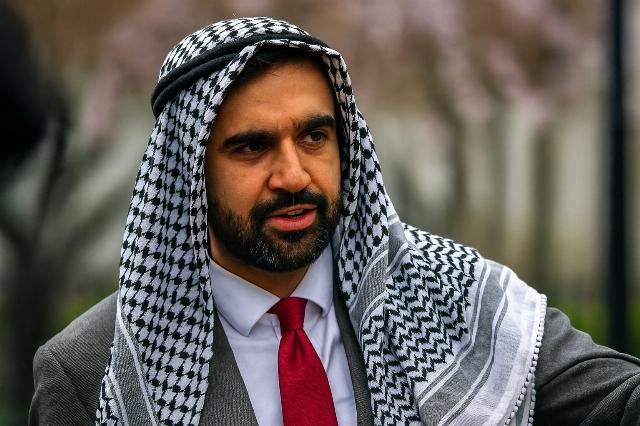 Image via ChatGPT
Earlier this month, Zohran Mamdani shared an official video marking so-called “Nakba Day.” Leaning heavily into standard progressive, anti-Israel spin, the video used isolated family histories to recycle decades-old “blame Israel first” talking points. By falsely portraying the 1948 war purely as a unilateral act of Israeli aggression, the producers of this propaganda deliberately erased crucial historical context. They omitted the fact that five Arab armies invaded the nascent Jewish state, choosing instead to treat refugees from that era as a unique situation in order to foment a perpetual assignment of blame. The very word “Nakba” is politically charged and is used by anti-Israel extremists to refer to the Palestinian refugee situation that developed during the 1948 Arab–Israeli war following the complete Arab rejection of the UN’s partition plan.
When far too many political commentators and politicians today look at the 1940s and 1950s, they often suffer from a severe case of historical amnesia. They treat the creation of Israel in 1948 as an exceptional, historically distinct tragedy rather than what it actually was: a standard, albeit painful, partition just like others. When British India was divided along ethnic/religious lines into India and Pakistan in 1947, the global community accepted the massive bilateral migration of more than 14 million people as a permanent reality. Yet when it comes to the Middle East, a completely different, weaponized standard is applied.
The narrative in the propaganda video Mamdani promoted conveniently omits the fact that five invading Arab armies explicitly rejected the 1947 United Nations Partition Plan and launched a war of annihilation against the newly established state of Israel. It ignores the historical reality that Arab leadership fervently urged residents to flee the fighting, promising them a swift return following a definitive defeat of Israel — to be more historically precise they said “after we drive the Jews into the Sea.” By focusing solely on Israeli actions, this brand of revisionism completely absolves the nations that surround Israel of their foundational role in creating the refugee situation.
The greatest deception of the “Nakba” propaganda narrative, however, is that it ignores the other half of the story. It’s not just that the late 1940s did not have a unilateral expulsion of Arabs; what’s missing is the truth that the time marked a massive regional exchange of populations.
While possibly as many as 700,000 Arabs were displaced during the war launched by their own leaders, a parallel state-sanctioned tragedy unfolded across the wider Arab world. In the years immediately following 1948, ancient Jewish communities in countries such as Iraq, Morocco, Egypt, Yemen, Syria, Lebanon, and Libya faced immediate retribution. These communities had existed since the capture of Jerusalem and Judea by the ancient Romans, before the advent of Islam. These Jews were subjected to riots, asset confiscation, forced denationalization, and systemic expulsion after the 1948 war. Which is not to say that they ever had it easy before that.
Between 1948 and the early 1950s, Israel absorbed nearly one million Jewish refugees from Arab and Islamic nations. These individuals arrived with virtually nothing, having been stripped of their property and wealth by host governments. Despite severe economic austerity and rationing, Israel immediately granted these Jews full citizenship and worked tirelessly to integrate them into the fabric of the nation.
Contrast this with the behavior of the Arab countries. While Israel absorbed its refugees, neighboring Arab states deliberately corralled Palestinian refugees into squalid, permanent camps. Countries such as Lebanon, Syria, Egypt, and others denied these refugees citizenship, restricted their right to work, and used them as political pawns. The international community enabled this by creating UNRWA — a specialized UN agency dedicated solely to perpetuating Palestinian refugee status across generations — while completely ignoring the million Jewish refugees who needed resettlement by Israel.
Had the international community applied the same standard to the Middle East that it applied to India and Pakistan, the demographic shifts of 1948 would have been finalized almost 80 years ago. In the Asian subcontinent, millions of Hindus, Muslims, and Sikhs were permanently resettled by their respective new home nations. No one proposed a “right of return” for Pakistani Hindus to Karachi, nor did anyone demand that India repatriate millions of Muslims to Delhi. Both nations understood that partition meant a permanent separation of populations.
The 1948 population exchange is an unalterable reality of history. Israel’s neighbors should have integrated their fellow Arabs many decades ago, matching Israel’s absorption of a million Jewish refugees. True progress begins by rejecting the selective outrage of politicians like Mamdani, being truthful about history, shutting down UNRWA, and finally accepting the existence of Israel.
Moshe Phillips is national chairman of Americans For A Safe Israel. AFSI is a leading pro-Israel advocacy and education organization.


“Natasha Hausdorff examines Zohran Mamdani’s Claims About Israel and International Law”
https://youtu.be/X9PqfM3DRKY>
Muslim Protesters camped out in front of Jewish girl’s school in Brooklyn – Meira K.
https://youtu.be/M8HsdcrP2pU?si=Ek6yMw7Wr50mpa8M
https://www.theyeshivaworld.com/news/general/2551241/shock-in-queens-former-hatzalah-volunteer-found-shot-dead-near-kissena-lake-massive-nypd-investigation-underway.html
llinkedfrom
https://www.jta.org/2026/05/20/ny/longtime-jewish-bakery-owner-found-shot-dead-in-queens
Note the difference in emphasis
This story would be nice if a few important facts weren’t missing. One of the missing facts is that those who complain most about Israel surviving its birth are those that did their utmost to make it still-born. Great Britain denied Jewish refugees access to the Mandate of Palestine. They did their utmost to deny Jews any weapons while making sure the Arabs had plenty. They did this in order to gain access to oil fields and to keep their Arab friends happy. The short version is called greed. Many other countries have done similarly, attracted by the new rich Arabs’ wealth.
The fact that Moslems carry on this story is simply to carry on the attempt, by all means possible, to get rid of the Jews. The continuation of the war against Israel shows that they are still trying, with the aid of the same complainers from Arab and European countries, without success. Just as an example, think of France.
Most Arab countries don’t even have a dog in the
race but take the side of Israel’s neighbors when called upon. Mamdani is doing the same, and we need not ask why.
@dreuveni
😀
Good one.