
A Record of Inaction, Rising Disorder, and a City in Decline
Michel Benchimol
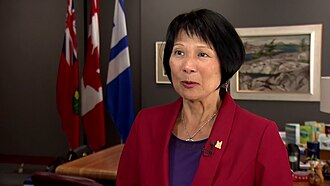 Olivia Chow in an interview with TVA Nouvelles. Photo by TVA Nouvelles, CC BY 3.0, Wikipedia
Toronto in Decline: Olivia Chow’s Failed Leadership and a City Losing Control
Toronto is being mismanaged, and the consequences are now visible in every corner of daily life.
This is a city that used to function. It used to move. It used to offer a reasonable path for people willing to work, build, and invest in their future.
That is no longer the case.
What has replaced it is a city defined by rising costs, worsening disorder, and a growing sense that leadership is not just ineffective—but absent and destructive.
At the center of that failure is Mayor Olivia Chow.
Olivia Chow: Not Up to the Job
Olivia Chow inherited a difficult situation and made it worse. Time and again, she has shown an inability to make hard decisions, impose discipline, or deliver measurable results. Her administration is characterized by delay, ambiguity, and a persistent preference for rhetoric over action.
This is not a question of ideology. It is a question of competence.
Toronto needs a mayor who governs. What it has is a mayor who signals, deflects, and hesitates.
The gap between what is required and what is being delivered is no longer debatable—it is obvious.
Affordability: Getting Worse on Every Front
Under Chow, affordability has not improved—it has deteriorated across the board.
Housing is further out of reach. Rents continue to climb without meaningful intervention. Property taxes are rising. The cost of living is escalating with no coordinated response.
There is no serious, aggressive plan to relieve pressure. No sense of urgency. No indication that City Hall understands the scale of the crisis, let alone how to address it.
Residents are being squeezed from every direction—and the mayor’s response has been passive at best.
Housing: A Failure to Act
Toronto’s housing crisis demands speed, clarity, and political will.
What it has received under Chow is delay, process, and avoidance.
Projects stall.
Approvals drag. Bureaucracy expands. Opposition is accommodated rather than confronted.
At its core, housing is a matter of supply and demand. When demand continues to rise but supply is delayed, restricted, or blocked, prices inevitably climb and affordability worsens.
Instead of aggressively expanding housing supply to meet the needs of a growing city, this administration has allowed delays and indecision to deepen the imbalance.
This is not caution—it is paralysis.
Every month of inaction further constrains supply while demand continues to grow, intensifying the crisis. Every delayed decision pushes affordability further out of reach. And every excuse reinforces the same conclusion: this administration is not capable of delivering at the scale required.
Congestion: A City That Has Stopped Functioning
Construction is poorly coordinated. Road closures are constant, overlapping, and disruptive. Traffic congestion continues to worsen, while the steady expansion of bike lanes in already crowded corridors has further reduced road capacity and intensified gridlock. Transit remains unreliable. Commutes are unpredictable, longer, and often intolerable.
There is little evidence of strong central management imposing order on the chaos. No visible accountability. No clear urgency to address what is plainly deteriorating.
This is what mismanagement looks like in real time.
Public Safety and the Jewish Community: Weakness Where Strength Is Required
A city’s most basic responsibility is to maintain order and protect its residents. On that measure, this administration is woefully falling short—and nowhere is that more evident than in its handling of rising antisemitism.
Across Toronto, public safety is fraying. Disorder in public spaces is increasingly normalized. Transit incidents, open drug use, and unchecked encampments have eroded confidence in the city’s ability to enforce basic standards.
For Jewish residents, this broader breakdown is compounded by something more targeted and more alarming.
Antisemitic incidents—harassment, vandalism, intimidation, and aggressive protests directed at Jewish schools, synagogues, and institutions—have become more frequent and more brazen.
And yet, the response from Mayor Chow has been pathetically and consistently inadequate.
Statements are cautious. Actions are limited. The tone is measured to the point of detachment.
At a time that demands clarity and resolve, Chow has chosen restraint and ambiguity.
That is not leadership—it is avoidance.
Protecting Jewish Torontonians should not be politically delicate. It should be immediate, visible, and unequivocal. Instead, what we have seen is hesitation in the face of intimidation.
That sends a message—whether intended or not—that enforcement is negotiable and that some forms of hostility will be tolerated longer than they should be.
For a city that claims to stand for inclusion, this is a glaring failure.
A Pattern of Failure, Not Isolated Mistakes
These are not one-off issues. They are the predictable result of a mayor who does not impose control, does not enforce accountability, and does not act with urgency.
The pattern is clear:
Problems escalate
Responses lag
Decisions are softened or delayed
Accountability is diffused
Nothing moves with speed or precision
This is not governance. It is drift disguised as management.
And over time, drift becomes decline.
Bradford: A Clear Alternative Focused on Results
Brad Bradford represents a fundamentally different approach—one grounded in execution, discipline, and measurable outcomes.
His priorities are direct:
Accelerating housing with real timelines and accountability
Imposing coordination on infrastructure and construction
Restoring basic order to public spaces and transit
Enforcing fiscal discipline
Taking a clear, unapologetic stance on public safety—including decisive action against antisemitism and firm protection for Jewish communities
This is not about tone. It is about control, competence, and results.
Toronto does not need another round of well-phrased intentions. It needs a mayor willing to act—and to be judged on outcomes.
The Stakes Are Immediate
This is not theoretical.
People are leaving.
Families are stretched to the limit.
Businesses are losing confidence.
Communities feel less safe and less supported.
And City Hall, under Olivia Chow, has not demonstrated that it can reverse any of it.
I will be voting for Brad Bradford
This is what I intend to do. And if you, like me, believe Olivia Chow’s leadership has been a serious failure—marked by weak execution, poor priorities, and an inability to effectively respond to Toronto’s growing challenges—then I hope you understand how critical this election truly is.
This is about more than politics. It is about protecting our community, safeguarding public safety, and preserving the welfare, stability, and future of Toronto.
Do not underestimate how confusion can shape an election. In crowded races, the effect of multiple candidates can be to split attention, divide support, and make it harder for voters to stay focused on the larger issues at stake.
When voters become distracted, fragmented, or disengaged, accountability becomes weaker and meaningful change becomes harder to achieve.
That is why clarity and unity matter. This is not a time to be distracted by noise, personalities, or political confusion. It is a time to remain focused on leadership, competence, safety, affordability, and the long-term future of our city.
If we care about protecting our community and restoring stronger leadership in Toronto, then this election must be treated with urgency and seriousness.
The future of our city, the safety of our neighberhoods, and the well-being of future generations depend on citizens being informed, engaged, and making their voices count.
This is a defining moment. Division weakens impact. Clarity, focus, and participation strengthen it.
This is not a time for complacency. It is not a time for division. It is a time for unity, resolve, and action.
Protect our community. Protect the future of our city. Stay focused. Stand together. Vote.
Michel Benchimol
*********
P.s. want to make one thing absolutely clear: I am not involved in this political race in any capacity. I do not know either Brad Bradford or Olivia Chow personally, I have no relationship with either candidate, and I am not involved in, affiliated with, or connected to any campaign, organization, or political effort on behalf of anyone. My views are solely those of a concerned Toronto resident and citizen who believes it is important to speak openly about issues affecting the safety of our communities, the cost of living, quality of life, and the overall direction of our city. My comments are based entirely on my own observations, concerns, and convictions — nothing more.
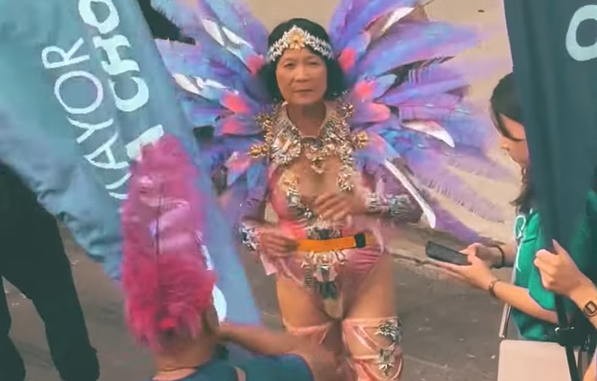 Toronto Mayor Olivia Chow participating in the Toronto Caribbean Carnival Grand Parade. Screengrab via Youtube


Fortunately I live just outside of Toronto, but although the name “Olivia Chow” is constantly on my mind (not necessarily in a good sense) the name Brad Bradford is not. If Mr. Bradford is what is required to revive Toronto, then his name should be on billboards/walls everywhere.
Get to it Brad supporters!!!