
Update: Hezbollah chief Naim Qassem described the proposed Lebanon-Israel ceasefire proposal as “Satan’s dream in heaven.” He went on to threaten Israel’s northern communities, stating that they will not be safe so long as Israeli forces are present in Lebanon.
Peloni: Once again, Hezbollah is saved from destruction under the ruse of a Lebanon peace agreement which has no legitimacy if Lebanon does not hold authority over Hezbollah. Notably, such hypocrisy as to suggest that Lebanon does have any influence over Hezbollah comes right out of nonsensical playbook which led to October 7. Notably, several thousand Hezbollah fighters have been eliminated over the past weeks, and it is being argued that the diminishing number of Hezbollah militants may give Lebanon the edge to finally wield control over Hezbollah, but this defies the reality of Hezbollah’s control over the Lebanese Armed Forces. In the more than a year prior to the current engagement with Hezbollah, under the oversight of Amb. Tom Barrack, Lebanon took a year to prove that it lacked any control over Hezbollah, and in fact, the Lebanese effort to pretend otherwise simply provided Hezbollah with the means by which to regroup, rearm and return to battle. I fully expect we are looking at the same game being played currently, with the notable difference of the IDF being situated in a forward position in Lebanon.
Hezbollah official rejects ceasefire agreement which only restricts Israeli targeting of Dahiyeh
| Published: June 4, 2026
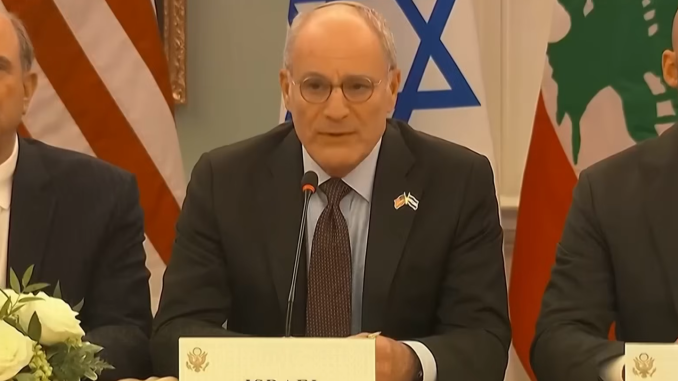 Amb. Leighter addressing the agreement to a ceasefire in Lebanon. Screengrab via Youtube.
In a joint statement on Thursday, Israel and Lebanon agreed to renew the ceasefire, which had been announced by U.S. President Donald Trump in mid-April and has been recently imperiled by fighting between Hezbollah and the IDF.
The U.S. has been eager to reach an agreement in Lebanon that could end the fighting there, as part of its negotiations with the Islamic Republic of Iran, which has insisted that Lebanon must be part of any comprehensive deal to end the war in Iran.
The U.S.-brokered agreement between Israel and Lebanon is contingent upon Hezbollah stopping its attacks on Israeli soldiers and Israel’s northern border communities, which led to the Israeli incursions into southern Lebanon in 2024 in Operation Northern Arrows, as well as earlier this year.
“The ceasefire is contingent on a complete cessation of Hizbollah fire and the evacuation of all Hizbollah operatives from the South Litani Sector,” the statement reads.
However, Hezbollah, which has received Iran’s backing for decades, is not a direct party to the negotiations between Israel and Lebanon. Moreover, the organization enjoys strong support among segments of both the Shi’a and Sunni Muslim populations of Lebanon. Its political arm controls one of the three largest blocs in the nation’s parliament.
The recognition of the quandary posed by Hezbollah is evident in the text of the joint statement, in which the terror group is mentioned as the aggressor only by Israel and the United States.
The agreement speaks of the creation of “pilot zones in which the Lebanese Armed Forces will take exclusive control of the territory to the exclusion of all non-state actors.”
“All countries reaffirmed that the future of the relationship between Israel and Lebanon must be decided by the two sovereign governments,” the statement continues. “They rejected any attempt, by any state or non-state actor, to hold Lebanon’s future hostage.”
The agreement speaks of progression towards “a security framework…aimed at sustainably ensuring the sovereignty, security and territorial integrity of Lebanon and Israel.”
“This includes the dismantlement of non-state armed groups and the prevention of their re-emergence,” the statement continued.
The disarmament and dismantling of Hezbollah were previously agreed upon by Israel and Lebanon in the ceasefire negotiated in 2024. That particular agreement called on Israel to withdraw from territory in southern Lebanon, while allowing Israel to maintain five security positions in Lebanese territory along the border until Hezbollah had been cleared from the area south of the Litani River.
As part of the agreement, the Lebanese Armed Forces were to take possession of territory evacuated by Hezbollah, ensuring the disarmament of the territory. However, as with the 2006 UN Resolution 1701, Hezbollah did not fully withdraw from those territories and the IDF repeatedly struck the terror infrastructure of the group throughout the country of Lebanon.
The joint statement highlights Israel’s concern for its own security and territorial integrity.
“Israel reaffirmed that its security and respect for its territorial integrity can only be achieved through the disarmament of Hizbollah and the dismantlement of its infrastructure throughout Lebanon,” the statement reads.
Israel affirmed its willingness to continue “direct negotiations under the leadership of the United States to resolve all outstanding issues and achieve durable peace and security.”
Lebanon made no mention of Hezbollah and spoke only of “internationally recognized borders,” “territorial integrity,” and “full state sovereignty.”
“Lebanon reaffirmed the necessity for mutual respect of internationally recognized borders, the urgent need for full implementation of the cessation of hostilities, underscoring the principles of territorial integrity and full state sovereignty.”
The Lebanese government even appeared to indicate its weakness relative to Hezbollah, which has often been called a “state within a state” by analysts.
“Lebanon committed to enhancing the capacity of the Lebanese Armed Forces, with U.S. support, to assert effective control throughout the country,” it said.
While being hailed as a renewal of the ceasefire, the joint statement offers no specifics regarding the outstanding issues of the continued Hezbollah attacks on Israeli targets, nor the terms for a withdrawal by Israeli forces.
On Thursday morning, a high-ranking Hezbollah official threatened to attack Haifa and Tel Aviv if Israel renews strikes in Beirut.
Mahmoud Qamati, deputy head of Hezbollah’s political council, told Qatari outlet Al-Araby that the group cannot accept an agreement to stop firing only in exchange for an Israeli commitment not to target the Dahiyeh district of Beirut, the group’s main stronghold.
“The equation of Dahiyeh against settlements in the north cannot be accepted in any way,” Qamati said. “It is not possible for the firing towards the north to stop in exchange for Dahiyeh not being attacked,” he added. “From the start, the campaign is in full swing, and the horizon is open.”
On Wednesday, the IDF announced that it located and destroyed a Hezbollah weapons storage facility in southern Lebanon.
Israel and Lebanon have agreed to continue the dialogue under the oversight of the United States.
“The two parties agreed to reconvene the political and security tracks the week of June 22, with a view toward reaching a comprehensive agreement. The United States agreed to continue facilitating communication between the parties in the interim.“


Update: Hezbollah chief Naim Qassem described the proposed Lebanon-Israel ceasefire proposal as “Satan’s dream in heaven.” He went on to threaten Israel’s northern communities, stating that they will not be safe so long as Israeli forces are present in Lebanon.
Is the charade over yet?
We’ve Forgotten 9/11
https://open.substack.com/pub/lel817/p/we-have-forgotten-911?r=1q2uiq&utm_campaign=post&utm_medium=web&showWelcomeOnShare=true