
Ambassador (ret.) Yoram Ettinger, “Second Thought: a US-Israel Initiative” | June 19, 2026
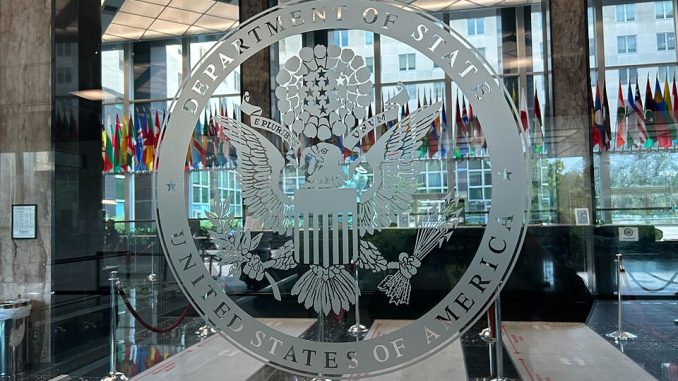 State Department Seal. Photo by U.S. Department of State – Flickr, Public Domain, Wikipedia
*The US-initiated negotiation with the Ayatollah regime – which has been preoccupied, since February 1979, with anti-US global war, terrorism and drug trafficking – is consistent with the traditional approach to the Middle East by the State Department’s establishment, irrespective of the fact that this establishment has been sidelined by President Trump from the center stage of shaping US foreign policy during his first and second terms.
*The State Department’s policy in the Middle East has been driven by short-term (sprint-like), containment-driven considerations, and high susceptibility to pressure, rather than long-term (marathon-like) regional and global stability considerations. Thus, it has fuelled regional and global instability, producing severe unintended consequences. For example, it has eroded the US’ posture of deterrence, yielding a robust tailwind to anti-US (marathon-like) entities, intensifying ruthless despotism (e.g., the Ayatollah regime since its inception in 1979). It has emboldened China (also in Latin America), Russia (in the Baltic Sea and East Europe) and anti-US Islamic terrorism (also on US soil). In addition, it has jeopardized the stability of the pro-US Arab regimes, inducing them to explore closer defense and commercial ties with China and Russia, and dealing a severe setback to the US national and homeland security.
*The State Department establishment has systematically attempted to base its Middle East policy on Western values, such as “Money Talks,” good faith negotiation, peaceful coexistence, adherence to human rights, democracy and durable peace.
*Assessing the Middle East via Western lenses has been sustained, irrespective of its self-destructive track record (please see below). Moreover, this approach has been repudiated by the 1,400-year-old intrinsic features of the Middle East, such as the 1,400-year-absence of intra-Muslim and intra-Arab peaceful coexistence, and the centrality of religion, fanatic ideology and historic milestones (e.g., the 680 Battle of Kerbala), which transcend financial and diplomatic considerations. Other non-Western features of the Middle East highlight tenuous, shifty and unpredictable regimes, policies and accords, brutal intolerance (toward the “infidel” and among the “believers”), violent religious and ethnic fragmentation, and the superiority of tribal – rather than national – loyalty.
A Sample of Self-Destructive US Middle East Policy
*The State Department establishment embraced Ayatollah Khomeini in 1978/79, referring to him as “an Iranian edition of Ghandi.” It took lightly his fanatic anti-US ideology, while backstabbing the Shah of Iran, “America’s policeman in the Gulf.” Thus, it catapulted the Ayatollah regime from a second rate strategic power to the most effective global epicenter of anti-US terrorism, drug trafficking and money laundering, constituting a clear and present threat to US homeland security.
*The pro-Soviet Saddam Hussein benefitted from US financial and intelligence cooperation until his August 1990 invasion of Kuwait, which led to two Gulf Wars.
*Bashar Assad was portrayed as a potential moderate and pro-American by the State Department establishment, only to prove himself to be a more vicious butcher than his father, Hafez Assad.
*The State Department establishment welcomed the 2010/11 Arab Tsunami, as if it were an Arab Spring, reflecting peace, youth and Facebook revolutions. In 2026, the Arab Tsunami is still raging on the Arab Street, as it has been on-again-off-again since the 7th century.
*The State Department-initiated, US-led NATO military offensive against Gaddafi, succeeded in lynching Gaddafi, but transformed Libya into a major platform of anti-Western terrorism and an arena of civil wars (which are still raging), involving Turkey, Russia, Greece, Egypt, the UAE, Saudi Arabia, Qatar, France and Italy.
*The cheering of the disengagement from Islamic terrorists in Afghanistan may have been premature, since Islamic terrorists are mandated not to disengage from the US, committed to bring “The Great American Satan” to submission. They present the US with a choice: to pre-empt Islamic terrorists, or to react to Islamic terrorism on US soil, which may dwarf 9/11.
*In 2011, a 30-year-ally of the US, Egyptian President Mubarak, was publicly abandoned by President Obama, who hailed the anti-US Muslim Brotherhood, paving its road to the helm in Egypt, which intensified the Brotherhood’s attempts to topple every pro-US Arab regime (e.g., Morocco, Jordan, Saudi Arabi, the UAE).
*In 2015, President Obama concluded the JCPOA, which accorded the Ayatollah regime unprecedent diplomatic legitimacy, a few hundred billions of dollars in unfrozen assets and sanctions relief, most of it funnelled to the IRGC, Hezbollah, and other terror proxies, as well as to the Ayatollah’s entrenchment in Latin America, the US’ “soft underbelly.”
The Bottom Line
*Rogue and terrorist regimes bite the hand that feeds them.
*A US policy which is shaped through Western – rather than Middle Eastern – lenses, sacrifices the inconvenient, frustrating, bleeding and relatively insoluble Middle East reality on the altar of a convenient, peaceful and soluble alternate reality is bound to severely undermine US interests.
*The US is better-served by learning from history by avoiding – rather than repeating – past mistakes.
*Middle East leopards don’t change spots, only tactics.


In the meantime, Obama plays the long game in the US!