
Peloni: The Nile is another area within the region where US policies seem more arbitrary than deliberate in regards to US interests.
Amb. Alberto M. Fernandez | MEMRI | June 22, 2026
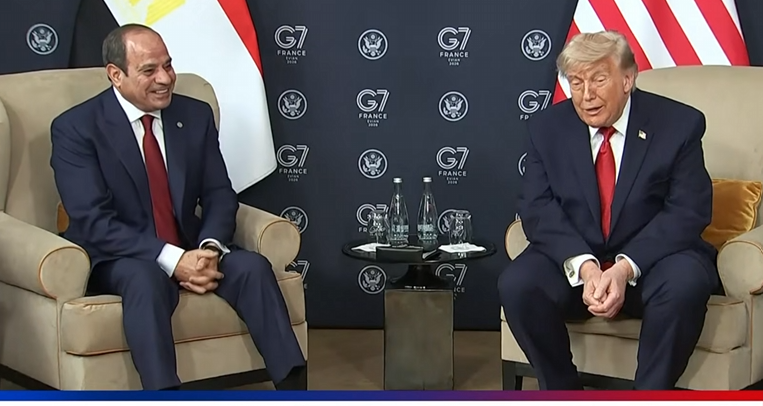 Trump meets with Egyptian Pres. Sisi at G7 on June 17, 2026. Screengrab via Youtube
For those who try to follow the politics of the Nile, the gyrations are dizzying. On June 17, U.S. President Donald Trump met with Egyptian President Al-Sisi at the G-7 and took a pro-Egyptian, anti-Ethiopian position on the waters of the Nile.[1] Then the United States sanctioned the anti-Ethiopian “hardliners” of the rebel Tigray Peoples’ Liberation Front (TPLF) on June 18. Only last month, the U.S. signaled a willingness to lift some sanctions on Eritrea, “the North Korea of Africa,” which is currently the great patron of the TPLF. Eritrea is now backed by Egypt, which seeks to rein in Ethiopia, especially on the question of building more dams on the Ethiopian Blue Nile.[2]
Some of the apparent confusion could be due to the U.S. president’s patented type of public diplomacy.[3] The fact that the U.S. does not seem to have a well-formulated policy for the Horn of Africa probably factors in as well.[4]
But the larger problem has nothing to do with Trump or with the lack of a special envoy for the Horn but rather larger, older issues involving the two rival ancient states on the Nile. There was a time, under the late great Emperor Haile Selassie when the United States was closely allied to Ethiopia and when Egypt under Nasser was seen as an American adversary. The situation switched when Ethiopia became a hardcore Communist state backed by Russia and Cuba while Egypt threw out the Russians and then made peace with Israel under Sadat.
After the Camp David Accords of 1979, Egypt became one of the largest recipients of U.S. aid (more military than economic) and remains so. And after the fall of the Ethiopian dictator Mengistu in 1991, ties with the United States rapidly improved. Today Ethiopia is also a major recipient of American aid (economic not military).[5] Both are large countries with seeming regional weight (Egypt was invited to the G7, Ethiopia was not).[6]
Obviously, it is in the American interest to have good relations with both countries and the question of the Nile waters is a sensitive one. But should both countries have equal weight in American calculations – or Egypt have more, as currently seems to be the case? Or is an argument to be made that Ethiopia’s potential and future importance is of far greater potential benefit to the United States than our legacy relationship with Cairo.
Much of Egypt’s importance to the United States is, in a way, negative. It is not something good that Egypt does of its own accord and self-interest but because it is encouraged – paid – to do so. Egypt’s peace with Israel matters because Israel matters to the United States. Yet almost 50 years since making peace with the Jewish state, Egypt’s relations with Israel are cool and have been so for years. Egyptian policy often works at cross purposes to the United States.[7]
The Egyptian government, as seen through its state-controlled media, maintains a cold, technically correct, but often adversarial relationship with Israel. Only 11 percent of Egyptians want “normalization” with Israel.[8] Pro-regime media routinely indulges in antisemitism and is often anti-American to boot. Egypt provides a service by controlling access to Hamas-ruled Gaza, which it can loosen or tighten as it sees fit. The dominant Egyptian military has seen since 2014 a massive expansion of the armed forces into the private sector.[9] And despite official enmity toward the banned Muslim Brotherhood, radical Islam, often implacably hostile to the West, is still found in Egypt.[10]
In contrast to Egypt, Ethiopia is, with all its faults in the field of human rights, a democracy. It has a far younger population than Egypt and a much higher economic growth rate (10.2 percent in 2025 for Ethiopia, 4.1 percent for Egypt). Ethiopia has a far lower debt to GDP ratio compared to Egypt (34.8 percent compared to 86.83 percent for Egypt). Ethiopia is currently building the largest and most advanced airport hub in Africa at Bishoftu, a $10 billion project.[11] The country is also prioritizing development, investing in a massive new oil refinery and urea fertilizer plant.[12] More controversially, and bitterly opposed by Egypt, Ethiopia seeks to build more hydroelectric dams and secure direct access to the Red Sea.[13] All of this ambitious but tenuous reform and synergy comes while Ethiopia is surrounded by a ring of fire of failed states: Sudan, Eritrea, South Sudan, Somalia.[14] Only Djibouti and Kenya seem stable among Ethiopia’s neighbors. Like most of Sub-Saharan Africa, the United States is far better liked in mostly Christian Ethiopia than it is in Egypt.[15]
All this is not to say that there are not major problems in Ethiopia, there most certainly are. There are insurgencies, ethnic tensions and potentially a catastrophic war in the wings with the Eritrean-supported TPLF.[16] There is wide popular dissatisfaction at the economic situation and on the state of Ethiopia’s democracy.[17]
Flashing warning signs exist in both countries, pointing to future conflict but there seems to be a dynamism and a space for progress and potential reform in a pro-American Ethiopia that is lacking in an often-diffident and stagnant Egypt ruled by mercurial army generals. Renewing Ethiopia’s access to the African Growth and Opportunity Act (AGOA), which was suspended under Biden, seems like an important step to take in the Trump Administration’s realist recalculating of American interests.[18]
It seems very much in the American interest that Ethiopia succeeds and flourishes, that it should matter more positively in American calculations, while recognizing that we cannot let an impoverished, radicalized-under-the-surface Egypt implode. We have a legacy in Egypt that we have to manage but the greater potential exists in an Ethiopia reforming in one of the most volatile regions (after the Middle East) in the world.
*Alberto Fernandez is Vice President of MEMRI.
[1] Thenationalnews.com/news/mena/2026/05/17/egypt-deepens-ties-with-eritrea-as-it-seeks-to-isolate-ethiopia-in-horn-of-africa, May 17, 2026.
[2] Facebook.com/Egy.Pres.Spokesman/posts/pfbid0WaiKD8tW6J7JWiRxSuva7iHL5V7kXByZBJ7z4shbrNgMs5QgpzPA3y3ew2RzHNBul?rdid=CHrI8YqaTt6Ew4SN#, June 17, 2026.
[3] Dostor.org/5602152, February 27, 2026.
[4] Hornreview.org/2026/02/13/how-the-2026-u-s-defense-strategy-recasts-the-horn-of-africa, February 27, 2026.
[5] https://www.usnews.com/news/best-countries/articles/countries-that-receive-the-most-foreign-aid-from-the-u-s, January 27, 2025.
[6] English.ahram.org.eg/NewsContent/1/1234/570889/Egypt/Foreign-Affairs/Egypt%E2%80%99s-return-to-the-G.aspx, June 15, 2026.
[7] https://www.meforum.org/mef-observer/cairo-gambles-on-undermining-trumps-gaza-plan, October 2, 2025.
[8] https://www.washingtoninstitute.org/policy-analysis/new-egyptian-opinion-poll-continued-dissatisfaction-government-performance-almost, December 21, 2022.
[9] https://cihrs-rowaq.org/the-growth-of-the-military-economy-in-egypt-since-2014-the-impact-on-investment-dynamics-and-investor-rights/?lang=en, August 19, 2025.
[10] Alarabiya.net/arab-and-world/egypt/2026/06/17/%D8%AE%D8%A7%D8%B1%D8%B7%D8%A9-%D8%B7%D8%B1%D9%8A%D9%82-%D9%85%D8%B5%D8%B1%D9%8A%D8%A9-%D9%84%D9%85%D8%AD%D8%A7%D8%B5%D8%B1%D8%A9-40-%D8%AA%D9%8A%D8%A7%D8%B1%D8%A7-%D9%85%D8%AA%D8%B7%D8%B1%D9%81%D8%A7#:~:text=%D8%A3%D8%B9%D9%84%D9%86%20%D9%88%D8%B2%D9%8A%D8%B1%20%D8%A7%D9%84%D8%A3%D9%88%D9%82%D8%A7%D9%81%20%D8%A7%D9%84%D9%85%D8%B5%D8%B1%D9%8A%D8%8C%20%D8%A3%D8%B3%D8%A7%D9%85%D8%A9%20%D8%A7%D9%84%D8%A3%D8%B2%D9%87%D8%B1%D9%8A%D8%8C%20%D8%B9%D9%86%20%D9%85%D9%84%D8%A7%D9%85%D8%AD,40%20%D8%AA%D9%8A%D8%A7%D8%B1%D8%A7%20%D9%85%D8%AA%D8%B7%D8%B1%D9%81%D8%A7%20%D8%AA%D8%AF%D9%88%D8%B1%20%D9%81%D9%8A%20%D9%81%D9%84%D9%83%2035%20%D9%81%D9%83%D8%B1%D8%A9, June 17, 2026.
[11] Afdb.org/en/news-and-events/press-releases/10-billion-mega-airport-financing-partnership-between-ethiopian-airlines-and-african-development-bank-takes-85992, August 12, 2025.
[12] Apanews.net/ethiopian-pm-launches-oil-refinery-project, October 2, 2025.
[14] Addisstandard.com/the-fire-next-door-sudan-tigray-and-ethiopias-strategic-encirclement, June 19, 2026.
[15] Wilsoncenter.org/blog-post/african-perception-united-states-evolving-geopolitical-landscape, July 27, 2023.
[16] Theafricareport.com/421798/ethiopia-what-we-know-about-warnings-of-a-tplf-offensive-in-the-coming-days-as-obasanjo-returns-to-tigray, June 12, 2026.
[17] Borkena.com/2026/06/12/beyond-june-1-ethiopias-election-and-the-crisis-of-legitimacy, June 12, 2026.
[18] Carnegieendowment.org/research/2026/05/agoa-africa-trade-tariffs-reform-united-states-trump, May 27, 2026.


Leave a Reply
You must be logged in to post a comment.