
Peloni: In its eagerness to prostrate itself at the alter of Jew Hatred, the world’s democracies have in fact stripped their societies bare of the very norms, guardrails and tenets which distinguish democracy from authoritarianism, liberty from tyranny, and slavery from free people. This of course is because the very basis on which democracies are founded – civil liberties, equal justice, a free press, and the societal deterrence which comes from the routine practice of all of these democratic norms – are in fact the very same basis under which Jews have come to flourish in Western democracies. Hence, we can grasp the true meaning of what is described as the canary in the coal mine, as the very societal boundaries which gave rise to the Golden Age of Jewry in the Diaspora are the same boundaries which empower, protect, and secure the entire populace within a given democratic society. While we Jews will always have Israel, those democracies which have corrupted themselves to secure the ability to safeguard Jew Hunts, to victimize Jewish victimhood, and to return the world to a Medieval standard of living, with all that which such a tragedy includes, will have to live with the nightmare they have carved out for themselves as the very concept of decency is purged, along with every aspect of life which recognizes the dignity of men as a fundamental right in preference of a retrograded nightmare from which there will be little chance of escape for these former democratic realms. The lesson to be taken from all of this for the people of the world is that the curse of Jew Hatred has a broader target than just we Jews, and in supporting the denigration, delegitimization and double standards for the Jews, the Jew Hating miscreants are preparing that same lack of liberty as the inheritance which they will leave to their children and their children’s children.
Victor Satya | July 17, 2026
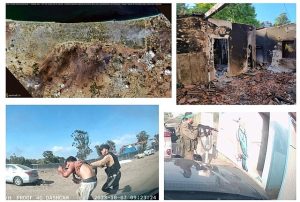 October 7 Collage by Hnuden – Own work, CC0, Wikipedia
When October 7 ended, one might have expected the story to follow a familiar script.
The largest massacre of Jews since the Holocaust had just unfolded. Families were butchered in their homes, and entire communities vanished before the smoke had cleared.
Surely, this would be the moment when the civilized world rediscovered the difference between those who deliberately hunted civilians and those now forced to defend them.
Instead, the story wandered somewhere altogether unexpected.
If Hamas were ever inclined to publish a letter of appreciation to those who most advanced its cause after October 7, conventional wisdom would suggest addressing it to Tehran. Perhaps Beirut. Maybe even Sanaa.
The past two years suggest otherwise.
It would be mailed instead to New York, Geneva, London, Ottawa, Canberra, Paris, and a surprising collection of university campuses, courtrooms, editorial boards, and humanitarian offices. Not because these institutions intended to strengthen Hamas, Hezbollah, or the Houthis, but because history has a habit of caring far more about consequences than intentions.
One can almost picture the letter beginning there.
The first envelope would arrive at the United Nations.
There was every reason to believe that an institution created in the shadow of the Second World War would speak with uncommon clarity after October 7. If ever there existed a moment to distinguish barbarism from civilization, this was surely it.
Instead, the distinction grew increasingly blurred.
UNRWA facilities supported Hamas infrastructure. Records identified hundreds of employees—including educators and administrators—as members of Hamas or Palestinian Islamic Jihad. Yet before long, the international conversation shifted away from those revelations and toward restoring confidence in the agency itself. Funding resumed. Reviews narrowed. Humanitarian language increasingly floated above institutions whose neutrality had become deeply contested.
Dramatic humanitarian claims often circled the globe before careful verification could catch them. Corrections, as always, travelled more slowly than headlines. Without anyone formally declaring it, the central question quietly changed. The world spent less time asking why Hamas built command centers beneath hospitals.
It spent considerably more asking whether Israel had gone too far trying to dismantle them.
Somewhere, one imagines, another sentence is being added to the letter.
“Thank you for making moral ambiguity our most effective weapon.”
The next recipient required no less gratitude.
For decades, Western governments had repeated the same lesson.
Statehood follows negotiations.
Recognition demands abandoning terrorism.
October 7 should have reinforced those principles.
Instead, recognitions of a Palestinian state accelerated.
Britain.
Canada.
Australia.
France.
Portugal.
Others prepared to follow.
One does not need to speculate how this looked. Movements devoted to terror pay close attention to incentives. After decades of being told that diplomacy alone unlocked political legitimacy, they watched diplomacy arrive in the immediate aftermath of unprecedented violence.
This was a reward for terrorism.
Whatever one chooses to call it, the lesson did not require interpretation.
Another paragraph quietly found its way into the letter.
“Thanks for demonstrating that spectacular violence can accomplish what negotiation never could.”
Then the scene shifted.
Not to another battlefield.
To Columbia.
Then UCLA.
Then Harvard.
The rubble disappeared, the slogans did not.
Encampments spread across campuses. The “Al-Aqsa Flood” became a symbol of resistance rather than horror. Calls to “globalize the intifada” echoed through institutions whose entrance halls proudly displayed commitments to tolerance, inclusion, and intellectual inquiry.
For years, Hamas had invested enormous effort attempting to export its worldview beyond Gaza.
The West accomplished much of the distribution itself. The West spent two years constructing narrative tunnels beneath its own institutions, quietly carrying ideas once confined to jihadist propaganda into lecture halls, student unions, newsrooms, and cultural life.
Concrete can eventually be destroyed.
Narratives are considerably harder to excavate.
The letter, by now, had become rather long. Its next destination was The Hague.
Once leaders of a democratic state defending itself after October 7 appear alongside those responsible for October 7 within the same international legal drama, something begins dissolving in the public imagination.
The legal arguments remain separate.
The moral photograph does not.
One imagines Hamas reading the rulings and headlines with understandable satisfaction. Because others had begun speaking the language it had spent decades trying to teach.
Israel has always stood on the front lines of a much larger conflict. The ideology driving Hamas does not merely reject Jewish sovereignty. It rejects the civilization that made Jewish sovereignty possible.
Pluralism.
Religious liberty.
Liberal democracy.
Individual freedom.
Israel is not the destination; it is the nearest obstacle. The tragedy, then, is not simply that so many institutions weakened Israel’s position.
History has witnessed that before.
The greater tragedy is that, in attempting to isolate one democracy, they quietly weakened the moral vocabulary with which liberal societies defend themselves. The road many believed ended in Jerusalem has an unsettling habit of continuing through London, Paris, Berlin, New York, Toronto, Sydney, and every society persuaded that hatred can be safely confined to Jews.
Perhaps Hamas will never write this letter.
It won’t have to.
History has already written most of it, and too many respectable institutions have already signed their names beneath it. The tragedy is not that terrorists found unexpected allies. Terrorist movements always do. The tragedy is that so many of those allies still believe they stand on the opposite side.
The standards abandoned for Israel will not remain abandoned only for Israel.
Barbarism has never respected borders.
It merely begins with the Jews.
Israpundit is entirely dependent on readers support. Please help me continue educating people with the truth about what is going on in Israel and around the world.


Leave a Reply
You must be logged in to post a comment.