
Peloni: This tragedy, which has been ongoing for decades, is far more effective than even the tragedy of October 7 at defeating the Jewish People. Indeed, the very purpose of the Pals deminishing our past is so that they can be better situated to erase our future. This must end. Just as the old conception which held that a terror statelet posed no threat to the Jewish State has been overturned, so too must long held conception that the historical record of our past is not worth the trouble which would be needed to secure it from the malicious intents of our enemies. This betrayal of the Jewish people and its historical record must be ended.
By | July 15,2024
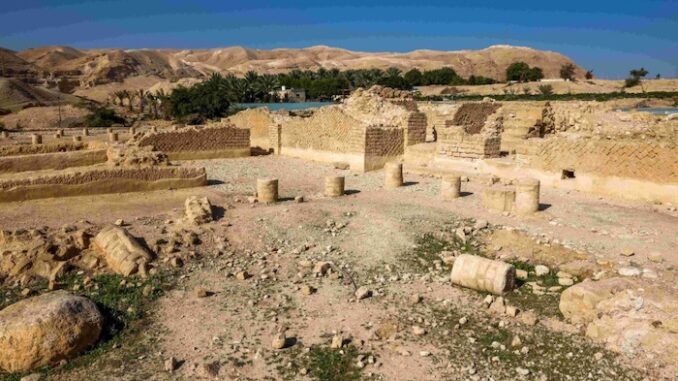
The Palestinians do not only want to destroy the Jews living in Israel, and to replace the Jewish state “from the river to the sea” with a 23rd Arab state. They also want to destroy the evidence of the Jewish past — 3000 years of Jewish history — in Judea and Samaria. More on this attempted annihilation of the history that connects the Jewish people to their land can be found here: “Palestinian destruction of Jewish archaeological sites must be halted – opinion,” by David M. Weinberg, Jerusalem Post, July 13, 2024:
Judea and Samaria (the West Bank) are rich with Jewish national heritage sites.
It is the Biblical heartland. The physical record of the Biblical narrative lies in the ground with hundreds of known archaeological sites, and perhaps thousands of yet undiscovered sites, providing incontrovertible evidence that connects the Jewish People to the Land of Israel.
This is precisely why the Palestinian Authority is systematically destroying archaeological sites in Judea and Samaria, purposefully plundering and erasing Jewish antiquities.
This week the Government of Israel took a first step towards halting the wanton annihilation of Jewish heritage.
For the first time since Israeli archaeological activists conducted in 2020 a broadscale survey of some 300 sites under Palestinian assault, the government decided to back a bill in Knesset, introduced by Likud MK Amit Halevi, that would extend the purview of the Israel Antiquities Authority (IAA) to Judea and Samaria – to manage and preserve historical sites….
Archaic interpretations of the Oslo Accords by Israeli legal advisers have gotten in the way too. They have argued against Israel’s ability to intervene to protect Jewish heritage sites in Area B of the territories, despite the obvious and outrageous PA campaign to obliterate every Jewish/Israeli site possible….
The Israeli Supreme Court in particular has been a comatose, regressive actor in this ongoing saga – foregoing opportunity and after opportunity to force the hand of the Israeli government into action against Palestinian destruction-ism.
The sad result to-date is truly annihilationist: Three thousand years of heritage on its way to near-complete wipe-out within a mere 30 years. This is a tragedy that must be stopped….
The Palestinians are pushing pell-mell to wipe out 3000 years of Jewish history, to efface any connection between the Jews and the Land of Israel. So far they have been doing so without any sustained effort by the Israeli government to protect Jewish archeological sites in Area B of Judea and Samaria (a/k/a the West Bank). “He who controls the past controls the future” is the famous remark of Orwell in 1984. The Palestinians have their own version: “He who destroys the past controls the future.” The government of Israel has to fight on three fronts: against Hamas in Gaza, against Hezbollah on the northern frontier with Lebanon, and against the Palestinians engaged in the determined destruction of the Jewish past in Judea and Samaria. It is in this last campaign that the Israeli authorities have been so disastrously derelict in their duties. They must now act to preserve and protect what remains of the Jewish heritage sites. It’s late in the day.


https://www.c14news.com/article/1486953
@keelie 😀 I fear you may be correct, so, “a picture { being } worth a thousand words” :
https://images.app.goo.gl/dSsEsPxt2P1s25gB6
Sebastien… someone, somewhere will at some point use this sketch to prove the uncontestable importance of the “Palestinian People”.
https://youtu.be/Zso89F2-nsk?si=8e4VGN4cfr-eyL1b
We need severe penalties that include expulsion of the whole family.