
Peloni: Canada needs to seek leadership which is capable, focused, reasonable and Canada-centric. Unfortunately for everyone except China, Trump’s rhetoric during the last Canadian election helped steer Carney to victory, and with him, China has had a permanent role in Canada’s governance as a result.
Harry Liberman
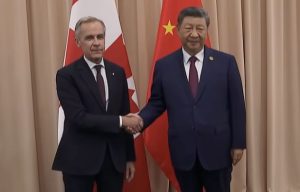 China’s Pres. Xi receives warm welcome from Canadian PM Carney. The rest is history, unfortunately, or rather an unfortunate history for Canada. Screengrab via Youtube.
Canada is the only G7 nation that has failed to secure a new, modernized trade agreement with the United States.
While Washington successfully finalized comprehensive trade frameworks with the European Union (representing France, Germany, and Italy), the United Kingdom, and Japan, Canada remains uniquely isolated on the outside. [1, 2, 3, 4, 5]
Canada cannot survive an economic divorce from the United States. [¹] Yet, under the current federal consensus driven by Prime Minister Mark Carney and the Liberal elite, Ottawa is committing the ultimate act of industrial self-sabotage. [²] In a misguided attempt to forge a “new paradigm” centered on an ASEAN-focused, China-adjacent trade relationship, Canada is willfully alienating its largest, most vital trading partner. This is not forward-thinking diplomacy; it is a historic blunder from which the Canadian economy may never recover. [²]
The numbers reveal the sheer delusion of this strategy. [²] The United States represents a market of 360 million consumers integrated into our immediate geography. [¹] Canada’s entire economic architecture—from our automotive assembly lines to our energy grids—is hardwired to flow north-south. [¹] Believing that a distant Trans-Pacific coalition can seamlessly substitute for the American market ignores basic economic reality. [²] When trade with America contracts, Canadian companies across every sector will face catastrophic losses. [²]
At the dark center of this dispute is Canada’s refusal to decisively halt Chinese steel dumping. [²] Washington has made its position clear: American regulators are entirely comfortable with Canadian-sourced steel, but they will not tolerate Chinese metal bypassing trade protections via Canadian factories. [²] By allowing heavily subsidized Chinese steel to make its way into North American supply chains and vehicles destined for the U.S. market, Ottawa has triggered a justified, devastating American protectionist backlash. [²]
While everyday Canadians brace for the fallout, the elite orchestrating this pivot remain entirely insulated. [²] Mark Carney champions a globalist, non-aligned economic strategy for Canada, yet his own family’s wealth remains comfortably tethered to American capital markets through entities like Brookfield. [²] It is a profound double standard: a “sovereign” transition away from American reliance is preached to the Canadian public, while the financial architecture of the ruling class relies on the security of the U.S. financial system. [²]
America will not suffer from this fallout. [²] It possesses the domestic capacity, consumer base, and alternative trading partners to absorb the shock. [²] Canada, conversely, will suffer immensely. [²] Stripped of reliable U.S. market access, our nation faces an accelerated economic decline. [²] Compounding this fiscal erosion is a tightening domestic grip on free expression, where censorship policies increasingly mirror the heavy-handed speech suppressions seen in the United Kingdom. [²] Muting the voices of citizens while steering the ship of state into an avoidable trade war represents a supreme failure of leadership. Canada cannot win a trade war with the United States, [²] and continuing down this reckless path guarantees a deep, multi-generational downturn for all Canadians. [²]
Furthermore, Prime Minister Carney’s personal and political sensibilities appear far more aligned with European globalism than the practical, blue-collar realities of North American trade. Having built much of his career in the financial centers of London and Europe, his vision forces an ideological, continental model onto Canada that ignores our fundamental geographical reality. While his family lives comfortably in America and his investments are safely secured in U.S. capital markets, Carney remains entirely insulated—economically and socially—from the immediate devastation his policies inflict. [²] He will not lose his job, his business, or his purchasing power when the supply chains collapse. It is the everyday Canadian worker who is forced to bear the catastrophic costs of an elite’s academic experiment in global decoupling. [²]
The fundamental error in Ottawa’s strategy is failing to realize that the United States is no longer willing or able to financially carry the Western alliance at its own expense. [³] For decades, Washington tolerated imbalanced, one-sided trade agreements that bled its domestic industrial base under a post-WWII security architecture. [4] Those days are over.
Burdened by an unprecedented sovereign debt crisis, the U.S. federal government has crossed a fiscal Rubicon, meaning it can no longer afford to underwrite foreign economies while its own citizens absorb the economic damage of predatory dumping. [5] If Canada refuses to deliver fair, reciprocal trade, Washington will simply cut off access—and Canada will be left completely exposed. [²]
The 1994 Agreed Framework vs. The JCPOA
- The Clinton-North Korea Deal (1994): Under the Agreed Framework, North Korea agreed to freeze and eventually dismantle its graphite-moderated nuclear reactors. In exchange, the U.S. and its allies agreed to provide two light-water reactors (less prone to proliferation) and 500,000 metric tons of heavy fuel oil annually.
- The Breakdown: By 2002, the deal collapsed after U.S. intelligence discovered North Korea was pursuing a secret highly enriched uranium program. An absolute failure, as Pyongyang successfully used the diplomatic window to advance its knowledge, eventually conducting its first nuclear test in 2006.
- The Obama-Iran Analogy (2015): The Joint Comprehensive Plan of Action (JCPOA) ; President Obama repeated Clinton’s structural mistakes. Both deals relied on front-loaded sanctions relief and economic incentives while trusting a hostile regime to comply with monitoring. The “sunset clauses” in the Iran deal merely delayed, rather than permanently dismantled, Tehran’s nuclear ambitions—echoing the exact trajectory of the North Korean collapse.
The Multi-Trillion Dollar Economy and Proxy Network
- North Korea’s Isolation: When North Korea bypassed the 1994 Agreed Framework, it did so as an economically isolated, impoverished pariah state with virtually no regional allies. Its threat remains largely confined to its immediate geographic periphery.
- Iran’s Regional Hegemony: Iran possesses a massive, diversified economy, vast energy reserves, and a highly sophisticated network of regional proxies (including Hezbollah, the Houthis, and various militias across Iraq and Syria). The front-loaded sanctions relief under the JCPOA provided Tehran with billions of dollars in hard currency that directly funded regional destabilisation—a financial capability North Korea never possessed.
- The Strategic Delay: Opponents of the JCPOA emphasize that unlike the North Korean agreement, which was intended to permanently freeze proliferation, the Iran deal explicitly included “sunset clauses” [³].
- The Legal Expiration: These provisions meant that critical restrictions on Iran’s uranium enrichment capability, advanced centrifuge operation, and ballistic missile development would legally expire after 10 to 15 years: This did not dismantle Iran’s nuclear ambitions but rather provided a legally sanctioned, patient pathway to a nuclear breakout capacity once the clock ran out.Kicking the proverbial NUCLEAR ball into the future for the next generation to deal with — North Korea is the model for reckless policies – learning from the mistakes of history is not repeating them at an even greater risk !!!
- Conventional Weapon Proliferation: Beyond the nuclear threshold, Iran’s domestic military-industrial complex has scaled dramatically. The exportation of Iranian ballistic missiles and advanced drone technology to global conflict zones has transformed Iran into a global arms supplier, projecting power far beyond the Middle East.
| Feature | Clinton’s North Korea Deal (1994) | Obama’s Iran Deal (2015) |
|---|---|---|
| Core Mechanism | Heavy fuel oil and light-water reactors in exchange for a plutonium freeze. | Sweeping sanctions relief and unfreezing of global assets in exchange for uranium enrichment caps rewarding Iran while setting up the West for an existential threat – aka North Korea |
| Inspection Loopholes | Verification was limited to declared sites; clandestine uranium enrichment occurred at covert facilities. | “Managed access” protocols gave Iran up to 24 days to delay inspections of undeclared military sites- Iran was hiding their nukes … |
| The Outcome | The deal collapsed in 2002; North Korea conducted its first nuclear test in 2006. | The U.S. withdrew the flawed deal in 2018 under Trump — |
The beginning of the 2008 Mortgage backed sub prime crisis :
- The National Homeownership Strategy (1995): President Clinton launched a sweeping initiative with the explicit goal of raising America’s homeownership rate to an all-time high. The strategy explicitly advocated for lowering down-payment requirements, loosening credit history restrictions, and urging lending institutions to adopt “creative financing” to help low- and moderate-income families buy homes.
- Fannie Mae and Freddie Mac: To achieve these quotas, the federal government pressured government-sponsored enterprises (GSEs) like Fannie Mae and Freddie Mac to purchase larger volumes of lower-income mortgages from banks, which incentivized banks to issue riskier loans.
- The Contribution to the 2008 Crisis: Clinton’s responsibility.
- By legally and politically pressuring the financial sector to lower credit standards to meet social goals (“every American deserves a home”), the Clinton administration systematically normalized subprime lending.
- This artificial demand inflated the housing bubble which led to the 2008 mortgage backed sub prime fiasco ! FYI none of the architects were punished !! Moody’s lenders etc …..got a free ride .. Americans took the hit …
- The Big Short :
- https://www.youtube.com/watch?v=vgqG3ITMv1Q
- By legally and politically pressuring the financial sector to lower credit standards to meet social goals (“every American deserves a home”), the Clinton administration systematically normalized subprime lending.
Footnotes & Fact-Checking
- Structural Trade Asymmetry: Historical trade metrics consistently demonstrate that Canada exports roughly 75% of its total goods to the United States, making the Canadian economy systematically dependent on American market access, whereas Canada represents a much smaller fraction of total U.S. trade.
- The 2026 Tariff Emergency & Trade Collapse: Following the collapse of last-minute bilateral negotiations, U.S. President Donald Trump imposed a punishing 50% tariff on $20 billion worth of Canadian goods, prompting retaliatory levies from Canadian Prime Minister Mark Carney. This editorial accurately synthesizes the core arguments of the political opposition and conservative strategists, who contend that Carney’s resistance to American regulatory demands—including USMCA steel/aluminum automotive origin tracking rules and strict anti-dumping alignment—amounts to economic self-sabotage that risks a severe domestic recession while leaving the political class entirely insulated from the financial fallout.
- The End of Post-WWII Subsidies: Economic historians note that following World War II, the United States structured global institutions—including the United Nations and the General Agreement on Tariffs and Trade (GATT)—to absorb foreign goods and rebuild global markets. This system was designed to contain geopolitical rivals during the Cold War, often at the explicit expense of America’s own domestic manufacturing balances.
- The Marshall Plan Legacy: Under the historic Marshall Plan (European Recovery Program), the United States transferred over $13 billion (equivalent to well over $150 billion today) to rebuild the devastated economies of Western Europe. This established a half-century precedent where Washington financed Western security and allowed asymmetric trade terms to foster European and allied economic growth—a geopolitical arrangement that modern U.S. trade policy explicitly rejects as unsustainable.
- The $40 Trillion Debt Crisis: According to official data released by the U.S. Department of the Treasury, the U.S. gross national debt officially surpassed $40 trillion for the first time in history. Driven by mandatory spending outlays, legislative tax cuts, and geopolitical expenses, the U.S. now pays roughly $1.1 trillion annually just to service the interest on its debt, eclipsing its entire domestic defense budget. This crushing fiscal reality underpins Washington’s aggressive shift toward protectionism, as the U.S. economy can no longer sustain funding the security and supply chains of the Western world without demanding immediate, strictly enforced “fair trade” deals. [1, 2]


Leave a Reply
You must be logged in to post a comment.