
PELONI: The Peace Processors were relying heavily on an election in the PA to establish that ‘reforms’ had been implemented in the well corrupted, ever incompetent, and thoroughly duplicitous Fatah leadership, but even under considerable pressure from the Americans, Abu Mazen demonstrated once again that he has no choice but to disappoint the best efforts of the Peace Processors. It will be interesting to see how this is internalized by Washington. Regarding the survey results which Barry Shaw discusses below, it seems impossible for the Pals to find any non-terrorist to support in their still delayed (read as cancelled til further notice) elections. While the survey findings suggest that negotiations are preferred by a plurality, their preferred choice of leadership would seem to suggest something else. Indeed, has there not been enough negotiations with terrorists?
Barry Shaw | The View from Israel | Oct 18, 2026
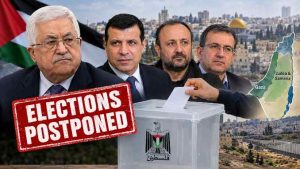 Image created via AI.
Three months after Palestinian President Mahmoud Abbas announced elections, the vote has been postponed once again, deepening questions over the legitimacy of the Palestinian Authority.
Announced by presidential decree on 10 October, the decision cited “Israeli restrictions” on the electoral commission and deteriorating conditions in Gaza and the occupied West Bank.
Blaming Israel was a cop out for the real reason Abbas called off, once again, national elections.
Analysts and Palestinian political insiders say logistical obstacles tell only part of the story.
An unlikely alliance between Hamas and the faction of former Fatah official Mohammed Dahlan, both rivals of Abbas, threatened to upend Fatah’s electoral calculations and challenge its dominance.
The proposed coalition sought to unite major opposition forces and independent figures under one umbrella.
Its announcement last month prompted a flurry of meetings in Cairo between Fatah, Hamas, Dahlan’s faction, and other Palestinian groups.
The talks helped pave the way for postponing the elections from 27 November 2026 to 11 September 2027.
Jibril Rajoub, a senior Fatah official, said earlier this month that the factions would instead prepare for a “comprehensive national dialogue” aimed at reaching “common ground” on political issues before next year’s vote.
But there have been other rounds of talks in Cairo between Hamas, Fatah and other Palestinian factions resulting in nothing.
Behind the language of consensus lies a deeper struggle over who will shape Palestinian politics, as Abbas faces mounting pressure, while an emerging alliance threatens to redraw the political map.
The last Palestinian parliamentary elections were held in 2006, when Hamas won a majority over Fatah, which had long dominated Palestinian politics.
Fighting, particularly in Gaza, between the two factions in 2007 led to the emergence of rival administrations: Hamas in Gaza and Fatah in the West Bank.
Repeated attempts at reconciliation and fresh elections have failed for 20 years, leaving Abbas to govern without a renewed electoral mandate.
A senior Fatah insider, who spoke to Middle East Eye on condition of anonymity, said Abbas announced the elections in July largely in response to international pressure to renew the PA’s legitimacy.
“Most of our Palestinian elections take place under external pressure,” the insider said, pointing to European pressure and reform commitments Abbas had reportedly made to France but never kept.
The timing, however, appeared disconnected from conditions on the ground.
Gaza remained in a violent enclave with civilians struggling to secure food and shelter. In the so-called West Bank, Palestinians face a worsening economic crisis, and tighter movement restrictions due to their terror attacks.
The PA had again chosen the wrong time to hold an election.
Hani al-Masri, a Palestinian political analyst, said the timing also reflected a calculation in Ramallah that Hamas had been weakened by Israeli response to their murderous mass attack against Israel on 7 October 2023, creating an opening for Fatah to regain ground.
But those calculations soon became null and void.
Hamas quickly welcomed the election announcement and declared its intention to participate as part of the broadest possible coalition.
A month later, it announced an alliance put together by UAE-based but Rafah-born Mohammed Dahlan – a striking development given his history as a bitter rival of the group and his close ties to the United Arab Emirates.
“The coalition had yet taken its final shape, but the mere fact that its idea emerged had the impact of a thunderbolt on the PA’s leadership,” Masri said.
“Initially, there was talk that the coalition would bring in major political forces and prominent individuals, which would be able to win a majority of the seats and change the political landscape.”
Masri said opinion polls had continued to show declining support for Fatah and Abbas, driven by internal divisions, corruption allegations, economic hardship, and mounting public anger.
Against this backdrop, the PA pushed the elections back by nearly a year.
But Masri believes the Hamas-Dahlan alliance is unlikely to disappear.
A longtime Fatah member, Dahlan headed the Preventive Security Force in Gaza after the PA was established under the Oslo Accords in the 1990s.
As head of the force, he oversaw crackdowns, arrests and the suppression of Hamas members.
After Hamas won the 2006 elections, it accused Dahlan of plotting a coup. The ensuing infighting ended with Dahlan being driven out of Gaza by force.
He later fell out with Abbas and went into self-imposed exile in the UAE, where he maintains close ties with the country’s rulers.
His new alignment with Hamas surprised many Palestinians and Israelis.
But according to Masri, cooperation between the two sides did not emerge overnight. He said contacts over financial assistance to Gaza had been active as far back as 2017.
Their cooperation intensified after Israel’s genocidal war on Gaza began in 2023, with Dahlan becoming a key figure in bringing in aid, facilitating social initiatives and establishing political contacts.
“The money comes from the UAE, but it’s facilitated by Dahlan,“ the Fatah insider said.
He argued that Dahlan’s role in channelling assistance helped boost his popularity and made a return to Palestinian politics increasingly plausible.
Another factor, he said, was the current PA leadership’s poor performance.
“People think, well, if not Mohammed Dahlan, then who?” he said.
The insider also pointed to Dahlan’s role in backchannel talks with the US over a ceasefire agreement in Gaza.
Hamas, meanwhile, has emerged from the war in a difficult financial and political position, helping explain its willingness to work with a former adversary.
“Hamas needed someone to help it climb down from the tree,” Masri said.
The alliance, he argued, could mark the beginning of a new political order. But he warned that it risked taking shape without a coherent national programme.
“There is a new [political] map taking shape, but it doesn’t have a national programme,” he said.
He argued that any new leadership must address the immediate needs of Palestinians across Gaza and the occupied West Bank while preserving a broader political project.
“It is as though, now, in exchange for a loaf of bread and medicine, we are willing to give up many things,” he said.
I wrote about the potential for a new independent State of Gaza being led by Dahlan in an article I wrote in mid December, 2023, just two months after the genocidal 7/10 Palestinian attack on Israel from Gaza that was published in the Jerusalem Report.
But the news of a Hamas-Dahlan connection came as a shock both to Israel and to the Palestinian Authority.
Dahlan, born in Gaza’s Rafah district, went to war against Hamas on behalf of Arafat’s Fatah-PLO in the 2006 Palestinian civil war and lost.
If successful, the coalition could bring together Hamas, Dahlan and Marwan Barghouti, the head of the Palestinian Tamzin terror organisation who is currently sitting in an Israeli jail serving five life sentences for the mass murder of Israelis.
This would be looked on with deep suspicion by Israel.
However, a recent Palestinian poll taken in October 2026, revealed a shift in Palestinian opinion.
When asked about direct party identification, Fatah received 22% support and Hamas received 19%, while a commanding 33% plurality selected ‘None of the Above’ (reaching 48% in the West Bank compared to 11% in Gaza).
This trend underscores a sustained decline in Hamas’s standing, which dropped from 35% ten months prior to 24% in August, and now stands at 19% nationally (and just 13% in the West Bank).
A decisive 56% majority expressed explicit willingness to vote for a newly formed independent list comprising professional, economic, and civil figures. When testing nine candidate lists among likely voters who have finalized their choices, the National Independent List led by industrialist Bashar Masri tied for first place with the list backed by imprisoned leader Marwan Barghouti and two of his Tanzim colleagues, each securing 22% of the vote. Both independent/reformist lists surpassed the Joint Hamas-Dahlan List (20%), Official Fatah led by Hussein al-Sheikh and backed by President Abbas (13%), and the National Initiative led by Mustafa Barghouti (13%).
Bashar Masri achieved the highest trust rating at 30% (followed by Mustafa Barghouti at 29%), while official PA leaders Hussein al-Sheikh (8%) and Jibril Rajoub (6%) registered minimal confidence.
Post-war political realism, disarmament resistance, and pragmatic settlement:
Despite the devastation of the Gaza war, 62% of the public believes that neither Hamas nor Israel emerged victorious (16% view Hamas as victorious, 17% view Israel as victorious).
Public opinion firmly resists premature concessions, with 74% opposing the disarming of Hamas prior to a complete Israeli military withdrawal. Nevertheless, public strategic conviction favours diplomatic negotiations (42%) over armed struggle (33%) or popular resistance (18%) as the most effective path toward ending occupation and establishing a Palestinian state—a pragmatic realignment that underpins 53% support for a two-state settlement based on 1967 borders. Nonetheless, the current findings indicate an increase in favour of armed resistance by 6 percentage points compared to the findings in August 2026.
Findings showed that 56% nationwide expressed explicit willingness to vote for a newly established independent list of professional, economic, and national figures. But official Fatah fell to 13% and Hamas-Dahlan to 16%.
In a seven-candidate leadership preference test, Marwan Barghouti placed first at 34% (47% West Bank, 15% Gaza), followed by Bashar Masri at 13% (8% West Bank, 21% Gaza), Khalil al-Hayya at 13% (7% West Bank, 21% Gaza), Mustafa Barghouti at 12%, Abbas at only 6%, and Hussein al-Sheikh at 4%.
In a four-candidate test, Mustafa Barghouti led at 37%, followed by Bashar Masri at 21%, Hussein al-Sheikh at 10%, and Rajoub at 6%.
On economic competence and improving living conditions, Bashar Masri ranked first nationally at 30% (26% West Bank, 37% Gaza), ahead of Mustafa Barghouti (29%) and far above PA leaders Hussein al-Sheikh (8%) and Jibril Rajoub (6%).
Positions on Peace, Political Settlement, Regional Roles, and Gaza’s Future:
53% supported a 1967-border two-state settlement with East Jerusalem as capital (56% West Bank, 48% Gaza), while 44% opposed. Settlement expansion was rated the top statehood obstacle (41%), followed by internal Palestinian division (23%). 56% endorsed consultative talks with Israeli anti-occupation figures.
Post-War Shifts in the Perception of the Role of Diplomacy vs. Armed Resistance in Ending the Israeli Occupation:
The October 2026 findings show continued public commitment to diplomacy, standing at 42%, higher than the support for armed struggle (33%) and popular nonviolent resistance (18%) as the most effective path toward ending occupation and establishing a Palestinian state.
However, it is important to point out a highly significant rise in favour of armed resistance in the Gaza Strip during the past two months, from 21% to 37%, probably driven by the Israeli non-stop daily strikes in that area during the past year since the start of the ceasefire.
By contract, favourability of armed struggle in the West Bank continued to drop during the same period from 32% in August to 29% in October. 62% concluded neither side won the Gaza war (16% said Hamas won, 17% said Israel won).
Polling shows a declining perception of a Hamas victory between March 2024 and today. However, about three quarters (74%) rejected disarming Hamas prior to full Israeli withdrawal (78% West Bank, 69% Gaza).
A reversal appears between Gazans and Arabs living under the PA. In list choices, Hamas-Dahlan captures 30% in Gaza (vs. 7% West Bank), whereas Barghouti’s list leads the West Bank at 39% (vs. 7% Gaza).
Younger voters show more radicalism. Youth lean toward 33% support Barghouti’s list and 21% support Masri’s list, while official Fatah gets only 10%.
Significant Changes in Two Months:
1. Leadership Role: In this pollsters August 2026 poll, Marwan Barghouti won 54% in a 3-way race against Hayya (26%) and Abbas (14%). In October, Barghouti remains first (34% in a 7-way race), but independent figures like Bashar Masri (13% national, 21% Gaza) and Mustafa Barghouti (12%) have redistributed preferences toward pragmatic leadership.
2. Party Trends: Our August 2026 poll showed Hamas declining from 35% (late 2025) to 24% (August 2026). October confirms further decline to 19% (13% West Bank). Fatah held flat at 22%. Independent lists absorbed non-aligned growth, with Masri’s and Barghouti’s lists obtaining 22% each, outpolling Official Fatah (13%).
3. Effective Means to End Occupation: Our August 2026 poll documented a shift toward negotiations (44%) over armed struggle (27%) and popular resistance (19%). October findings confirm stability in this pivot, with 53%–56% supporting negotiated settlement and 54% regional frameworks, while maintaining firm opposition (74%) to premature disarmament. A notable exception is however is the rise in favour of armed struggle to 33% in October, which as indicated above, came from the Gaza Strip.
It is clear that we will be hearing the names of Dahlan, Barghouti, and Masri going forward.
Israpundit is entirely dependent on readers support. Please help me continue educating people with the truth about what is going on in Israel and around the world.


Leave a Reply
You must be logged in to post a comment.