
PELONI: The Jihadist movement is not exclusively targeting Israel. Instead it has its sights set on subjugating the entire Western world. The means of this conquest has alternative two tracts, one from Shia Iran and the other from their Sunni cousins. As the Shia tract has been seriously subdued, though not yet vanquished, it is important to recognize that the Muslim Brotherhood and its many associates across the globe represent a sizeable threat, even as many in the West see them as a form of salvation from Western decline when in fact they are the opposite of this. Jihad is now marching across Europe on the back of the migration throngs motivated by the same chants which were claimed to represent Palestinian nationalism when in fact, these chants represent nothing more substantive than simply Jihad. Today that Jihad is marching in Paris and Europe…and America is next.
The Palestinian flag has evolved from a symbol of armed struggle into a universal banner of protest, reflecting a broader assault on Western civilization.
By Ben M. Freeman | Honest Reporting | October 19, 2026
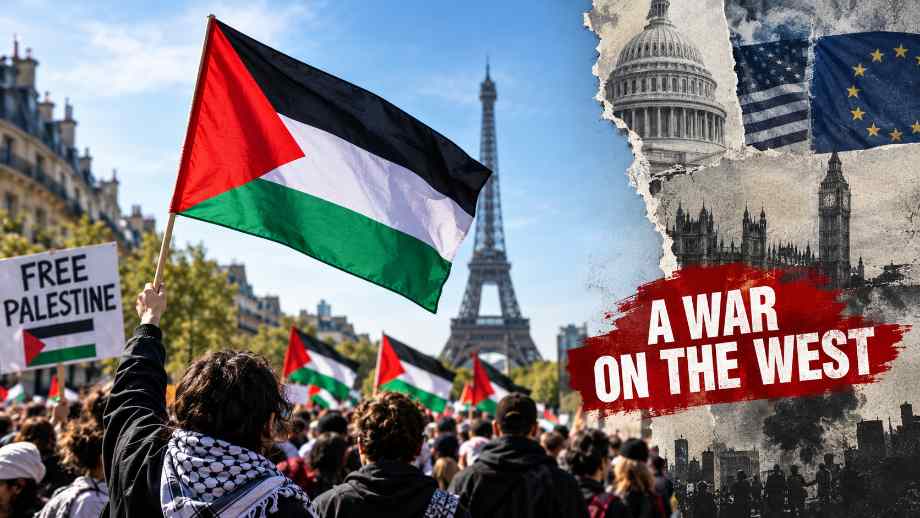 Click Image to Enlarge. Image created via AI.
Since September, French pupils have blockaded hundreds of schools over teacher shortages, overcrowded classrooms and crumbling buildings. On 17 October, some 550,000 people marched across France against the rising cost of living. In Paris, a car was set alight and a Chanel boutique was looted. On paper, this is a story about wages and classrooms. It is not.
The Palestinian cause appears in none of the pupils’ official demands. Yet, as CNews reported, the Palestinian flag has flown at rally after rally. In Carpentras, a video showed pupils brandishing it in front of flames while one of them shouted that they had burned Israel. In Marseille on Saturday, AFP saw young protesters in yellow vests and Palestinian flags dispersed by police outside the town hall. In Rouen, the Jewish community cancelled its October 7th commemoration. Its president told France 3 that the sheer number of Palestinian flags in the pupils’ marches had left them afraid.
Even the satirists have noticed. Within a day of the national march, the Instagram creators have posted “Free Paristine” beside the Palestinian and French flags, with the caption “Intifada Globalized.” It is a joke, but it works because it is not really an exaggeration.
Above every one of these marches flies the same banner. The Palestinian flag is no longer simply the flag of a national movement. It has become the default banner of protest itself, carried at climate strikes and Pride parades, at anti-racism rallies and student occupations, at football grounds and song contests. Whatever the cause, the flag arrives.
This did not happen by accident, and it did not happen overnight. For most of the twentieth century, the Palestinian cause lived in the West on the violent fringe, among urban guerrillas, hijackers, and paramilitaries. Its emblems belonged to them. Today the same flag hangs from town halls and fills football stadiums. Like so much else in this story, from the language of “apartheid” to the chants of “intifada,” it has moved from the fringe to the mainstream. To understand how, we have to begin where the flag began.
A British Design
The flag now held aloft as the ultimate emblem of resistance to Western empire was, in its original form, a product of Western empire. In 1916 the British, at war with the Ottomans, backed the revolt of Hussein bin Ali, the Hashemite Sharif of Mecca. The banner of that revolt, black, green and white stripes with a red triangle at the hoist, is credited to Sir Mark Sykes, the British diplomat whose name is fixed forever to the Sykes-Picot Agreement. As the French historian Michel Gurfinkiel recounts, Sykes drew on the colours of the great early Islamic dynasties and added the red chevron for the Hashemites, who were meant to lead a “Great Arab Kingdom” under British influence.
The flag was never designed for “Palestine”. It was designed for an imagined Arab kingdom stretching across the Levant and Arabia. According to Britannica, its stripes were reordered in 1922 to black, white, and green, and the Arab population of the Mandate informally adopted it. Gurfinkiel notes that Arab nationalists in Mandatory Palestine simply used the Hejaz flag, including during the 1936 revolt. Jordan, Iraq, Syria, Sudan and others built their own flags from the same template.
Remarkably, even some on the Palestinian side have found this uncomfortable. Gurfinkiel cites a 2014 piece by a director of the Middle East Monitor reminding admirers that the flag was the work of Sykes himself. The man who drew the colonial map of the Middle East also drew its most famous anti-colonial flag.
A Flag of Armed Struggle
The flag acquired its specifically Palestinian meaning with the Palestine Liberation Organisation. Founded in 1964, the PLO formally endorsed the flag that December, adopting the pan-Arab banner of the Hashemite revolt rather than inventing a new emblem. Its 1968 National Charter declared armed struggle the only way to liberate Palestine. Through the following decades, the flag became associated with hijackings, massacres, and bombings carried out for the Palestinian cause.
Palestinian militancy also found enthusiastic allies among Europe’s revolutionary left. In 1970, Andreas Baader, Ulrike Meinhof, and other founders of the Red Army Faction travelled to Jordan for weapons training with Fatah. After their arrest in 1972, Black September demanded their release during the Munich Olympics massacre.
In November 1969, on the anniversary of Kristallnacht, the Tupamaros West-Berlin planted a bomb at a Jewish community center. It failed to explode. The group’s leader, Dieter Kunzelmann, had travelled to the Middle East and met Arafat twice. The organization’s statement of responsibility declared that Kristallnacht was being repeated daily by Zionists. In 1976, German revolutionaries joined PFLP terrorists in hijacking an Air France flight to Entebbe, where the hijackers separated Israeli and Jewish passengers from the others. Thirty-one years after Auschwitz, Germans were once again sorting Jews from non-Jews.
The alliance extended beyond Europe. The Black Panther Party’s International Section in Algiers proclaimed support for Palestinian “vanguard forces,” while republican murals in Belfast depicted armed Palestinian and IRA women together.
Durban: The Turning Point
In late August 2001, the United Nations convened its World Conference Against Racism in South Africa. Beside it ran an NGO Forum of more than 7,000 participants. It was meant to be the world’s great gathering against bigotry. It became, in the words of the ADL, an epicentre of antisemitic activity. Copies of the Protocols of the Elders of Zion were sold. Pamphlets carried Hitler’s photograph, wondering aloud what the world would look like had he won. Congressman Tom Lantos, himself a survivor of the Shoah, called it the most sickening display of hate for Jews he had seen since the Nazi period.
The NGO Forum’s declaration branded Israel an apartheid state, guilty of genocide, and called for its complete isolation. That one move did something extraordinary. It fused the Palestinian cause with the moral authority of the anti-apartheid struggle, and thereby with anti-racism itself. Gerald Steinberg, founder of NGO Monitor, told the Jerusalem Post this year that Durban was the blueprint, and the place the boycott movement began.
The infrastructure followed quickly. Israeli Apartheid Week launched in Toronto in 2005 and spread, by its organisers’ count, to some 150 cities and campuses. The same year, Palestinian groups issued the formal BDS call. Each new campaign put the flag in front of a fresh generation of Western students, who learnt it not as the emblem of the 1968 Charter but as the emblem of justice.
Every Cause, One Flag
Durban made the flag the emblem of anti-racism. The decade that followed made it the emblem of everything else. The hinge was the summer of 2014. As war raged between Israel and Hamas, protests erupted in Ferguson, Missouri, after the police shooting of Michael Brown. Palestinians in the West Bank and Gaza tweeted advice to American protesters on coping with tear gas. Moment magazine describes how a new movement of Black-Palestinian solidarity emerged from that convergence, and Palestinian flags were flown on the streets of Ferguson itself. A conflict over policing in suburban St Louis had been absorbed into a conflict thousands of miles away.
Two years later, the Movement for Black Lives published its first platform. Its foreign policy section, as Tablet reported, accused Israel of genocide, branded it an apartheid state, and endorsed BDS. The ADL’s Jonathan Greenblatt called the genocide charge repellent. It did not matter. The template had been set.
This is how intersectionality works in practice. Every struggle is said to be one struggle, against one system of oppression. And at the apex of that system sits a single country. The Palestinian flag becomes the proof of membership: carry it, and you show that your cause is part of the larger fight. Leave it at home, and your solidarity is suspect.
After October 7th
On October 7th, 2023, one of the defining images of the massacre showed Palestinians waving their flag beside a destroyed Israeli tank at the Gaza border fence. For Israelis, the flag became inseparable from that day. For much of the West, the opposite happened. The flag did not retreat. It multiplied.
Eighteen days after the massacre, Celtic supporters in Glasgow defied their own club and filled the stands with Palestinian flags at a Champions League match, alongside a banner reading “Victory to the Resistance.” In May 2024, Greta Thunberg joined protests in Malmö against Israel’s participation in Eurovision, as smoke in the flag’s colors drifted over the crowd. That summer, Queers for Palestine marched down Piccadilly at London Pride chanting that there is no pride in genocide. At Brighton Pride, which had banned national flags, the Jewish Chronicle reported Palestinian flags carried at the very front of the parade, while the Jewish delegation had hidden its own. In France, Michel Gurfinkiel observed, the flag had replaced the old red and black banners of left-wing protest and was flown from town halls.
Pride is the starkest case. A movement for gay liberation now marches behind the flag of a territory where, in 2016, Hamas executed one of its own commanders, Mahmoud Ishtiwi, over accusations of homosexuality. Documents later found in Gaza described the months of torture that preceded his death. That is not solidarity with Palestinians. It is the use of Palestinians as a symbol.
The pattern has not faded. On October 7th this year, the third anniversary of the massacre, several hundred people gathered in Berlin’s Kreuzberg with Palestinian flags. Among them was Greta Thunberg. According to the Jüdische Allgemeine, the crowd chanted for an “Intifada Revolution.” On the day Jews mourn their dead, the flag was raised in celebration of the method by which they were killed.
A War on the West
Why should pupils demanding teachers and marchers demanding gay rights rally behind the same flag? Their causes have nothing in common. Their enemy does.
The flag is not really about Palestine. It is about the West. Since Durban, Israel has been cast as the West’s last colonial outpost, the purest concentrate of everything the movement claims to despise. To oppose Israel is to oppose the whole edifice: democracy, capitalism, the nation state, the civilisation that produced them. That is why the flag fits every protest. Whatever the grievance, the target is the same.
A symbol is not defined only by the intentions of the person holding it. It carries its own history with it. And the history of this flag does not describe a people seeking a home beside the Jewish state. It describes a movement whose founding charter declared armed struggle the only path, and whose banner was waved over a destroyed Israeli tank on the bloodiest day for Jews since the Shoah.
No other national flag works this way. The Sudanese, the Uyghurs, the Kurds, the people of Congo: none of their flags has become the universal symbol of the good. Their causes never had a Durban. No movement spent decades carrying them from the fringe to the centre, and so their flags stay at their own protests.
Fifty years ago, the people who flew this flag in the West were the people who trained in Fatah’s camps and hijacked aircraft. Today they are climate strikers, football fans, Pride marchers and university students. The flag did not move. The mainstream moved to meet it.
Its slogan has made the same journey. “Globalise the intifada” now rings through the streets of Europe, from London to Berlin. An intifada is not a protest. The second one was a campaign of suicide bombings on buses and in restaurants, markets and nightclubs, and it killed more than a thousand Israeli civilians. To globalise it is to export that method to the world. In December 2025, two gunmen did exactly that, murdering 15 people at a Hanukkah celebration on Bondi Beach. Only then did London’s police begin arresting those who chanted it.
That is why the satirist’s caption landed. “Intifada Globalized” is not a punchline. It is a description.
The French pupils who walked out this autumn wanted teachers and decent classrooms. The flag came for something else. It came for the civilization that built those classrooms in the first place. And it was carried there by that civilization’s own children.
Israpundit is entirely dependent on readers support. Please help me continue educating people with the truth about what is going on in Israel and around the world.


Leave a Reply
You must be logged in to post a comment.