
Before the gas chambers came the lies, the laws, and the excuses
Aynaz Anni Cyrus | May 20, 2026
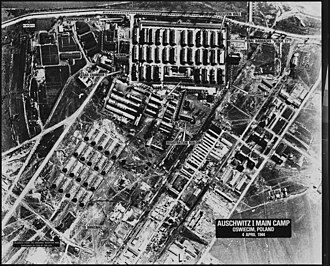 Auschwitz I Main Camp. Photo by 60. Sqad. SAAF, Sortie No. 60/PR288 – U.S. National Archives and Records Administration, Public Domain, Wikipedia
May 20, 1940
The morning air was cold and damp in German-occupied southern Poland.
Near the town of Oswiecim, dust drifted through old military barracks that still carried the smell of decades of military use. The buildings were worn, heavy, gray, and ordinary-looking.
German trucks moved in and out of the newly occupied complex, now controlled by the SS. The structures were old Austro-Hungarian and Polish military buildings; long brick barracks surrounded by fencing, guard posts, and muddy roads scarred by years of soldiers, machinery, and war preparations.
The Germans had renamed the town Auschwitz.
At the gate stood armed guards in black and gray uniforms. Paperwork moved from desk to desk inside converted administrative offices. Orders were barked in German. Supplies were unloaded. Barracks were inspected. Construction plans were already being discussed. The camp was still being organized.
Barracks needed repairs. Security systems needed expansion. Fences had to be reinforced. Roads needed work. Administrative systems had to be built from scratch.
The camp commandant, Rudolf Höss, had only recently been assigned to oversee the project. His task was clear: transform this old military complex into a functioning concentration camp for the expanding Nazi occupation system in Poland.
And from the Nazi perspective, the timing made perfect sense.
Germany had invaded Poland the previous September. Resistance activity was growing. Polish intellectuals, priests, teachers, political organizers, and suspected dissidents were already being arrested in large numbers. The SS needed more detention capacity in occupied territory, especially in areas connected to rail infrastructure.
Oswiecim was useful.
The location sat near major rail lines. The existing military buildings reduced construction costs. The area could be isolated and expanded if necessary. From a bureaucratic standpoint, it was practical.
That practicality is part of what makes the story disturbing.
People often imagine history’s darkest places as being born out of visible madness. But many of them begin inside ordinary offices; with engineers, logistics officers, architects, rail planners, administrators, supply managers, and typed memos.


AI Overview
https://www.timesofisrael.com/timeline-the-history-of-auschwitz-birkenau/
https://www.timesofisrael.com/timeline-the-history-of-auschwitz-birkenau/