
Peloni: Is Turkey going to continue in its role as the catfish of the Middle East, swallowing nations as they lie defeated and vulnerable to Turkish sourced intrigues as was seen to be the consequence of Israel having hollowed out Hezbollah in Syria? Is this what is fueling Trump’s preference of Regime Transformation over Regime Change as described by Mike Doran in a recent podcast?
Jonathan Schanzer | Mar 4, 2026
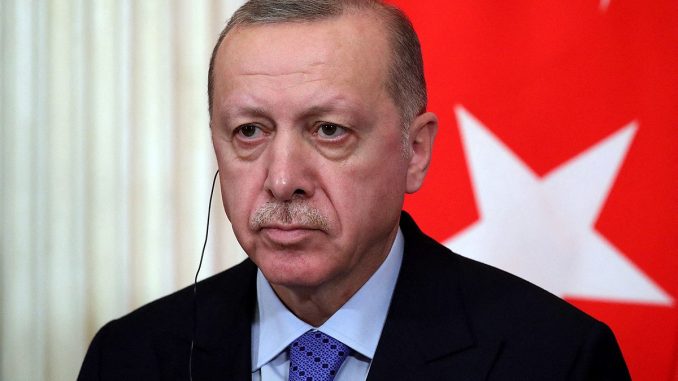 By kremlin.ru, CC BY 4.0, Wikipedia
The US military and the Israeli Defense Forces continue unleashing their might on the Iranian regime — and precise intelligence, overwhelming firepower and a bit of good luck could soon usher the downfall of the Islamic Republic.
Many are asking about the day after, specifically, about who will rule Iran when the regime finally buckles.
It’s a fair question, but it’s too soon to know: The leaders of the Iranian opposition know that it’s not yet safe to announce themselves.
The regime is still in control, and its brutality is by now well understood.
Just ask the families of the estimated 40,000 protesters murdered in the streets in recent weeks.
A better question is this: Which regional powers may try to fill the vacuum after Iran’s dictatorship falls?
Tehran has for years projected power by proxy across the Middle East, sponsoring terrorist groups like Hamas in Gaza, Hezbollah in Lebanon, the Houthis in Yemen, Shiite militias in Iraq, and other malign actors across the region.
Should the regime collapse, other aspiring regional powers will seek to fill the void.
And while many countries may think regional leadership is theirs to inherit, there is one powerful player to watch: the Republic of Turkey.
The country has the second-largest army in NATO.
It has a growing drone industry and a government-tied military contractor, SADAT, that is training and arming militias across the Muslim world.
Concurrently, Ankara has been cultivating terrorist proxies in the Middle East for years.
The Turks are key patrons of Hamas, dating back nearly two decades, and are now trying to ensure their participation in the Gaza peace effort — despite opposition from the Israelis, who are wary of Ankara’s intentions.
But the Turks are deployed elsewhere, too.
Ankara is now supporting Hezbollah in Lebanon.
It’s the primary patron of the new Syrian regime, led by former al-Qaeda leader Ahmad al-Sharaa, making Syria a forward base with key military and intelligence platforms.
That’s to say nothing of Turkey’s longstanding military deployments in Northern Iraq, Somalia, Qatar and more.
In short, Ankara has blanketed the region, leaving it well positioned to fill the void left by the Islamic Republic.
And Turkey’s financial backers in Qatar, a tiny country that controls roughly 12% of the world’s energy, are likely to bankroll this effort.
The alliance of these two Sunni states can be summed up rather simply: They seek to resurrect the influence and ideology of the Muslim Brotherhood, the radical Islamist movement that has inspired generations of terrorists.
Their efforts date back to the Arab Spring of 2011, when chaos erupted across the Middle East.
Turkey and Qatar were then the dominant supporters of the Islamist opposition factions that aimed to topple regimes across the region.
In Libya, for example, rebels raised the Qatari flag upon ousting Moammar Khadafy.
In Egypt, after the Sisi regime crushed the Brotherhood, Turkish strongman Recep Tayyip Erdogan became a foremost global advocate for the movement.
The Arab Spring sputtered by 2016, and the big Turkish-Qatari experiment failed.
But their efforts to support the Brotherhood continued.
One might assume that President Donald Trump’s declared antipathy for the Muslim Brotherhood, articulated in an executive order issued in November, would portend a showdown with Qatar and Turkey.
This has not been the case: The administration has engaged warmly with them both, awarding them seats on Trump’s Board of Peace.
The leaders of both countries enjoy close personal ties with Trump.
This affords the president an opportunity.
He can blunt their efforts to fill the void left by Iran, should the regime collapse.
Preventing the rise of the Muslim Brotherhood axis requires American will and action — so now is the time for Trump to warn our wayward Sunni allies in Akara and Doha that the United States is not waging this war in the Middle East only to cede power to them.
Our aim must be the rise of a pro-American order.
The right kinds of allies would include moderate Gulf Arab states like the United Arab Emirates and Saudi Arabia, along with other countries that have normalized ties with Israel, such as Bahrain and Morocco — or even Egypt and Jordan, if they can commit to such an alliance.
The Greeks and the Cypriots have also proven themselves to be loyal friends, and they have a vested interest in shaping the region’s future.
These states can work with the US and Israel to set the Middle East on a new course.
But only if Trump blunts the advances of the Muslim Brotherhood axis.
Jonathan Schanzer is executive director at Foundation for Defense of Democracies.


Leave a Reply
You must be logged in to post a comment.