
Peloni: The folly of Western support for the Islamist Iranian regime’s hegemony over Lebanon is as nonsensical and distorted as has been the West’s support for the Islamist regime’s hegemony over the Iranian people. Is it possible that the ultimate outcome of the current wars in Lebanon and Iran will seek to maintain this old hat policy while describing it as a new hat? As the US insists that Hezbollah’s dominance in Lebanon can be eliminated with enough resolve from the Lebanese govt which lacks the governing capability to even meet with the Israelis, to have disarmed a single Hezbollah unit, or to even eject what should be understood to be Hezbollah’s most immediate superior in Lebanon, the Iranian ambassador. As Trump is still carving out a safe space in negotiations for the survival of the Mullah regime in Iran, he is simultaneously doing so for Hezbollah’s continued survival in Lebanon, and both of these propositions should be understood to be preserving the stabilization of instability which should be understood to be counter productive to American interests as well as that of her regional allies.
Victor Satya | TOI Blogs | May 3, 2026
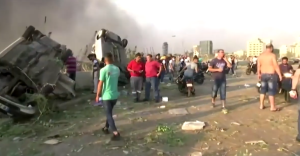 Aftermath scene following the 2020 explosion in Beirut. Screengrab via Youtube
There are few things in modern journalism as reliable as the sunrise, the tide, and the headline: “Israel violates ceasefire.” It appears with precision that one suspects it is pre-written, waiting patiently in a newsroom drawer, needing only the date and a suitably indignant quote from “international observers” to complete it. Rockets may fly, tunnels may open, drones may hum across borders—but the true emergency, we are told, is that Israel has responded.
The phrase itself has become less a description of events and more a kind of liturgical chant—recited reflexively, rarely examined, and never quite expected to make sense. Because if one pauses, even briefly, to consider what is actually happening during these so-called ceasefires, the entire construction begins to wobble like a badly built stage prop.
A ceasefire, in any normal language, implies mutual restraint. It suggests that both sides have agreed, however reluctantly, to stop action for a while. Yet in the peculiar dialect reserved for Israel, a ceasefire appears to mean something closer to a one-sided vow of silence. One party is permitted to reload, regroup, and occasionally fire a test shot, purely for calibration, one assumes, while the other is expected to sit very still and absorb the ambience of impending violence.
When militants emerge from tunnels, or rockets are quietly assembled and positioned, or drones are launched toward civilian areas, these are not treated as violations so much as background noise. The weather of the Middle East. But when Israel acts to prevent these things from becoming funerals, the tone shifts instantly from meteorology to morality play. The cause disappears, the effect is spotlighted, and the verdict is delivered before the evidence has finished arriving.
It is a remarkable inversion. Preparing violence is tolerated; preventing it is condemned. The burglar is halfway through the window, and the scandal—somehow—is that the homeowner raised his voice.
Of course, this inversion does not sustain itself by accident. It is maintained, carefully and consistently, by a style of reporting that has perfected the art of removing context without appearing to do so. Violence, we are told, “erupts.” Clashes “break out.” Strikes “occur.” The passive voice does what it always does best: it ensures that responsibility evaporates into thin air. Cause and effect are untethered, rearranged, and then presented as if they arrived that way.
The result is a kind of moral shell game. By the time the reader reaches the end of the article, the sequence of events has been so thoroughly laundered that the response appears to be the origin. Israel, having acted, becomes the aggressor—not because it initiated violence, but because it interrupted it too forcefully for polite sensibilities.
And yet, even this intellectual contortion begins to look almost straightforward when compared to the second idea currently enjoying polite circulation: that disarming Hezbollah would destabilize Lebanon.
At first glance, one might assume this is satire. It has all the elements. A country whose currency has collapsed, whose infrastructure has decayed, whose capital was partially obliterated in one of the largest non-nuclear explosions in history, is described as delicately balanced—teetering on the edge of stability, provided no one touches the heavily armed, Iranian-backed militia operating within its borders.
But no, we are told, quite seriously, that removing this militia would risk civil war. That Lebanon, which has spent years demonstrating every available symptom of state failure, might become unstable.
One is tempted to ask: compared to what, exactly?
Lebanon’s economy has undergone a contraction so severe that even the more dramatic descriptions struggle to keep pace. Its currency has lost the sort of value usually associated with historical cautionary tales. Its political system has ossified into paralysis. And threading through all of this, like a steel cable wrapped around a crumbling structure, is Hezbollah—armed, autonomous, and answerable not to Beirut, but to Tehran.
And yet the argument persists. Hezbollah, we are told, is not the cause of Lebanon’s instability but its reluctant guardian. A shield, of sorts. This would be more convincing if the shield were not so consistently pointed inward.
Because Hezbollah is not simply a political party with strong opinions and a regrettable fondness for weaponry. It is a military organization with a political wing attached for convenience. It operates beyond the control of the Lebanese state, often in direct contradiction to it, and with the explicit backing of a foreign power whose regional ambitions are anything but subtle.
In other words, it is precisely the sort of entity that makes sovereignty a theoretical exercise.
And here we arrive at the true elegance of the argument: Lebanon cannot disarm Hezbollah because Hezbollah is too powerful, and Hezbollah is too powerful because it has not been disarmed. It is a perfect circle—logically airtight, politically paralyzing, and entirely detached from the small inconvenience of reality.
The international community, for its part, observes this arrangement with a mixture of concern and remarkable patience. Resolutions are passed. Statements are issued. Commitments are reaffirmed. Somewhere, buried in the fine print of diplomatic memory, lies the notion that armed groups operating outside state control should, at some point, cease to do so.
But enforcing such ideas would be difficult. And difficulty, in modern diplomacy, is often treated as a decisive argument against action.
So instead, we arrive at a more comfortable arrangement. Hezbollah remains. Lebanon continues its slow, grinding decline. Israel is urged, with increasing urgency, to exercise restraint in the face of an entity that is under no comparable obligation to do the same. Stability, we are told, must be preserved—by which is meant that nothing fundamental should be changed, no matter how evidently it is failing.
It is a curious definition of peace. One in which violence may be prepared but not prevented, in which sovereignty may be discussed but not enforced, and in which the burden of restraint falls most heavily on the party most willing to exercise it.
And so the headlines continue. “Israel violates ceasefire.” The words appear, familiar and reassuring in their predictability, offering the illusion that the situation has been understood, categorized, and judged. But beneath them lies a far less comforting reality: a system of expectations so inverted that it rewards aggression, penalizes defense, and calls the result stability.
If this is what we now call “peace” and “stability,” the question isn’t whether the logic is broken—but whether anyone still has the courage to admit it.


While this was a thoroughly enjoyable read, it unfortunately contains nothing but the reality we face every day. I wish we had more of this kind of article. It returns us a little to sanity.