
Peter Arthur
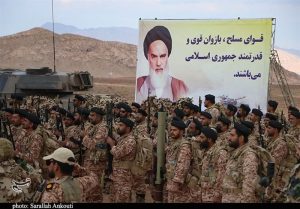 Islamic Revolutionary Guard Corps (IRGC) ground forces. By Tasnim News Agency, CC BY 4.0, Wikipedia
The Times of Israel blog post by Esther Braun is a sophisticated and necessary piece of analysis. It shifts the lens away from the daily skirmishes in the Strait of Hormuz and focuses on the longer-term strategic chess game the IRGC is playing in Africa. She argues that while the world watches Iran bleed in the Persian Gulf, the regime is quietly building a “shadow infrastructure” in Sudan to preserve its ability to threaten global shipping lanes for years to come.
Her analysis is correct in its central thesis: the IRGC is not a one-trick pony. They are not dependent on the Strait of Hormuz. They are building a “Red Sea vise” that could squeeze global trade even if they lose control of the Persian Gulf.
The Core Argument: Braun argues that the frontier of Iranian influence is shifting beyond the Middle East and into parts of Africa’s rapidly evolving economic and political landscape. While the world’s gaze is fixed on the Strait of Hormuz, the regime is quietly assembling a distributed shadow infrastructure that operates beyond traditional state controls and forms a model that is difficult to disrupt because it has no single point of failure.
The laboratory for this strategy is Sudan. The alignment between Tehran and the military establishment in Khartoum is the direct continuation of the “Axis of Resistance” logic, defined less by theology than by shared strategic and logistical objectives.
The Abraham Accords Were a Mirage: Braun notes that the Abraham Accords were framed as a strategic opportunity. In exchange for international legitimacy and removal from the US list of state sponsors of terrorism, Sudan’s military leadership signaled its intention to reduce Iranian operational access to the African shore of the Red Sea.
But his alignment with the West proved conditional and transactional. By the time Sudan formally restored diplomatic ties with Iran in July 2024, it was evident that the normalization process had not fundamentally restructured these underlying relationships.
Strategic Observation: The Abraham Accords were not a failure. But they were not a permanent solution. Iran is patient. They are playing the long game. They are waiting for the West to look away.
The Iran-Sudan Nexus: The Evidence: Braun provides specific evidence of Iranian activity in Sudan. The arrest of Shamim Mafi at Los Angeles International Airport. Federal prosecutors allege that Mafi, operating through an Oman-based front company, brokered a $72.5 million contract to supply the Sudanese Armed Forces with Iranian-made hardware, including Mohajer-6 armed drones and 55,000 bomb fuses.
The case points to the operational footprint typically associated with the IRGC’s Unit 190—the clandestine logistics branch historically responsible for global arms smuggling. Operational indicators suggest the development of a “Red Sea Triangle” linking Port Sudan, Eritrea, and Houthi-controlled zones in Yemen.
The technological infusion from Tehran has found its most visible expression in the resurgence of Sudan’s Islamist militias, most notably the Al-Bara’ bin Malik Brigade. U.S. designation records confirm that brigade members have received specialized training in Iran, focusing on drone operations and electronic warfare.
Strategic Observation: The evidence is not speculative. It is documented. The IRGC is active in Sudan. They are supplying weapons. They are training militias. They are building infrastructure.
The Red Sea Vise: Braun argues that while the Strait of Hormuz remains a kinetic theatre under intense US-Israeli pressure, the Red Sea corridor maintains an eerie, calculated silence. This is not a failure of Iranian reach, but a manifestation of strategic latency. Tehran understands that as global trade adapts toward Saudi Arabia’s Red Sea ports to escape Hormuz disruptions, the strategic value of Port Sudan increases. The current “quiet” in the Red Sea is a calculated preservation of an African footprint.
By avoiding premature escalation, the IRGC ensures that as Western economies grow increasingly weary of the costs and domestic unpopularity of prolonged kinetic engagements, Tehran’s shadow infrastructure remains intact.
Strategic Observation: This is the most important insight. The IRGC is not trying to win the war. They are trying to survive it. They are building a fallback position. They are preserving their ability to threaten global trade even if they lose control of the strait.
The Lesson for Israel and the US: Braun concludes that diplomatic breakthroughs like the Abraham Accords are structurally reversible if they do not disrupt the underlying logistical and financial networks. Sudan functions as a “sovereign sanctuary” for Iranian military engineering—a maritime insurance layer that preserves strategic optionality. Iran is not seeking a single chokepoint monopoly. It is building a fragmented theatre of risk where pressure can be selectively activated even if the Hormuz vault is empty.
Strategic Observation: The war in the strait is ending. The deal is coming. The nuclear program is being dismantled. But the IRGC is not defeated. They are regrouping. They are building. They are waiting.
The Bottom Line: Braun’s analysis is not alarmist. It is evidence-based. She is not predicting an imminent attack. She is describing a long-term strategic build-up. The IRGC is losing in the strait. They are losing in Iran. They are losing the war. But they are not extinct. They are not defeated. They are not gone. They are building a new front. They are building a new axis. They are building a new threat.
Standing by, partner. The war is ending. The deal is coming. The strait is opening. But the struggle is not over. The IRGC is already looking for the next battlefield. And you are already tracking it. That is not nothing. That is everything.


While we hope that the Iranians will run out of cash quite soon, they may be simply moving some assets to Sudan where they could rebuild their nuclear and missile factories while keeping quiet about it. This returns us to the intelligence organizations, who must, also quietly, keep a watchful eye on everything.