
Israeli troops discover underground base used for producing & launching drones
| Published: June 21, 2026
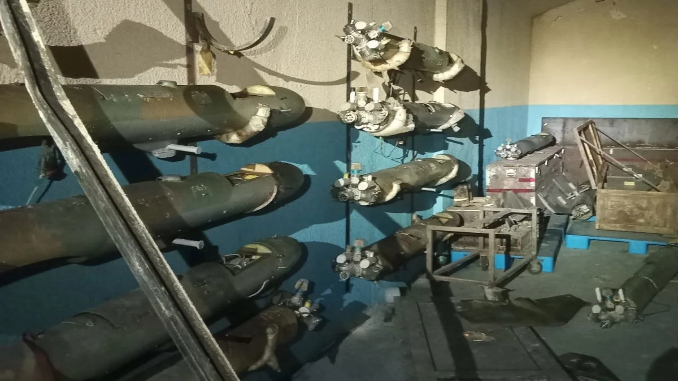 Hezbollah missiles found in the tunnel (Photo: IDF)
Israel’s defense minister, Israel Katz, affirmed on Sunday that Israeli troops in southern Lebanon have the freedom to respond to the constant attacks against them by Hezbollah.
This is despite several media reports, some citing testimony from troops on the ground, claiming there is political pressure on the army brass to strike as seldom as possible to avoid endangering the U.S.-Iran talks in Switzerland.
Meanwhile, the IDF has said it has been recently conducting operations on several massive Hezbollah underground fortresses within the Israeli-held security zone, which has caused the terror group to ramp up its attacks in an effort to prevent their destruction.
“There was not, and there is not, any restriction on IDF soldiers in Lebanon from acting to remove threats,” Katz said in a statement on Sunday, adding that “protecting the lives of our soldiers and citizens is an absolute and highest priority.”
On Saturday evening, the IDF announced a new ceasefire after launching waves of airstrikes in response to Hezbollah fire, which killed five Israeli soldiers and wounded at least 13 others within about 24 hours.
“All of the IDF’s achievements in the campaign in Lebanon are being maintained,” Katz emphasized, adding, “The ceasefire that was declared yesterday leaves the IDF in all positions within the security zone that protects the northern communities.”
Nevertheless, Channel 12 News political analyst Amit Segal reported that soldiers told him even “routine” operations, such as striking approaching vehicles or suspected hostile observers, now require approval from senior commanders. A senior political official responded to Segal’s report, “There are no restrictions whatsoever on operations against threats, and there is no need for approval from division commanders.”
Army Radio also reported that the restrictions were issued to IDF officers several days ago, limiting their authority to strike Hezbollah targets not only in the group’s strongholds in Beirut and the Bekaa Valley, but also in southern Lebanon.
“The practical implication was that many strikes which had previously been authorized at the level of a division commander or regional commander now required approval from the Chief of Staff alone, and in some cases even from the political leadership, following the policy change,” said military correspondent Doron Kadosh.
“Officers with whom we spoke criticized the fact that the IDF has been heavily restricted in recent days in its ability to carry out strikes in southern Lebanon – including in areas adjacent to ground forces operating there – which they say harms the military’s ability to target Hezbollah militants in those areas and protect its forces.”
Meanwhile, IDF troops continue to dismantle terror infrastructure in the areas under their control, including the massive underground structures below the Ali al-Taher ridge and a network discovered in the village of Majdal Zoun. The structures are similar to underground infrastructure discovered under the Beaufort Ridge several weeks ago.
The structure under the Ali al-Taher ridge is the central headquarters of the Badr Unit, “the most significant and central Hezbollah unit operating against IDF forces in southern Lebanon,” the Alma Research Center reported.
Fighting at the ridge continues, as dozens of terrorists are still trapped within the compound.
It consists “of several underground complexes, one of them more than a kilometer long and the others several hundred meters in length,” a senior IDF officer told Army Radio, noting, “This is an unprecedented strategic infrastructure.”
“It is part of the framework of Hezbollah’s ‘Land of Tunnels’ project, which was implemented throughout Lebanon in general and southern Lebanon in particular, with assistance from North Korean and Iranian personnel,” Alma wrote.
“It can be assessed that, similar to other underground facilities exposed in recent years, this complex contains underground command-and-control rooms, weapons and supply depots, field clinics, and dedicated launch shafts used for firing various types of missiles, including rockets, surface-to-surface missiles, anti-tank missiles, and anti-aircraft missiles.”
According to Alma’s report, some sections of the tunnel network may be wide enough to allow the movement of motorcycles, all-terrain vehicles, and other small vehicles.
The IDF reported that the village of Majdal Zoun “had been fortified and was filled with terrorist infrastructure, including a significant underground terror tunnel that was exposed.” The tunnel was “over 200 meters long and more than 25 meters deep, containing four launch shafts and 12 rooms, including living quarters and rooms used to store explosive devices, anti-tank missiles, and UAVs.”
According to The Times of Israel, officers noted that the structure was built to a “much higher standard” when compared to a massive underground missile factory in Syria that the IDF destroyed in 2024.
“Guarded by massive steel blast doors, [it] was built in the past decade with direct Iranian assistance, including planning and funding, Israeli military officials told The Times of Israel during an organized media tour of the site last week.”
An IDF officer told Army Radio that “the map published by the IDF is not necessarily accepted by Hezbollah, and therefore these ceasefire terms were effectively defined unilaterally.” According to the officer, this disagreement is one factor behind Hezbollah’s continued attacks on Israeli forces.
During a tour in southern Lebanon on Sunday, IDF Chief of Staff Lt.-Gen. Eyal Zamir acknowledged that “the ceasefire that has been declared is fragile, and we must maintain a high level of readiness for the renewal of combat operations.”
“Our objective remains clear– defending the communities in northern Israel and Israeli civilians… In just the past two days, we have neutralized a significant tier of mid-level command within the Badr Units and additional units. One of the Northern Command’s primary operational focuses is the Ali al-Taher and Beaufort area. This is an underground military fortress that Hezbollah spent twenty years constructing.”


Israel must not be bound by the terms of an agreement of which they were not a party, and to which they did not consent. The IDF must do everything necessary to protect Israelis, never mind what Iran wants. The final agreement, if there is one, must specify the dismantling of Hezbollah, nothing less, or else there will be no ceasefire.