
By Walter E. Block and Oded J.K. Faran
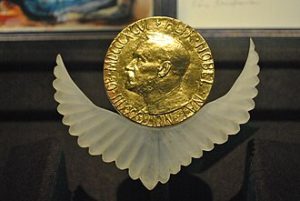 Nobel Peace Prize. By ProtoplasmaKid – Own work, CC BY-SA 4.0, Wikipedia
See Part 1 Here
III. Just Peace and Unjust Peace
The classical liberal and natural rights traditions, from Locke through Bastiat and Mises, have consistently distinguished between the initiation of force and the defense against it.
This distinction, sometimes called the non-aggression principle, holds that the moral evaluation of violence depends not on whether violence is occurring, but on who initiated it and why. A pickpocket who is wrestled to the ground has had his “peace” disturbed. But the victim who restrains him has not acted wrongly, even though the wrestling match involves coercion and conflict. Peace restored on the pickpocket’s terms, with the victim releasing him, would be a morally inferior outcome to the controlled use of force that secures justice.
Scale this argument up and the implications become clear. When country A unjustifiably invades country B, the relevant moral categories are not “peace” and “war” but “aggression” and “defense.” Imposing peace on A, the aggressor, is just. Imposing peace on B, the victim, before it has secured its rights and safety, is not merely neutral but actively unjust. A Nobel Peace Prize that treats the cessation of all hostilities as uniformly praiseworthy, without regard to whose interests that cessation serves, implicitly endorses a conception of peace that is morally hollow.
George Orwell, in Nineteen Eighty-Four, gave us the slogan “War is peace” as a specimen of totalitarian doublethink. But the inverse error, treating all peace as equivalent regardless of the conditions that produced it, is its own category of moral confusion. A negotiated peace that leaves a tyrannical regime intact and its victims unprotected is not a triumph. It is, at best, a deferral of justice.
IV. The Venezuela Case and Its Implications
Consider a hypothetical that illuminates the argument. Suppose the United States were to intervene militarily in Venezuela, arrest Nicolas Maduro and his entire administration, and then oversee a genuine democratic election that brought someone like Maria Corina Machado, the 2025 Nobel Peace Prize laureate herself, to the presidency. From a superficial peace-counting perspective, the United States would have initiated an act of war. From the perspective of elemental justice, however, the analysis is far more complex. Maduro’s regime has for years been the aggressor against the Venezuelan people: jailing opposition leaders, rigging elections, destroying civil society, and driving millions into exile. The relevant question is not whether the United States crossed a border with military force, but whether the Venezuelan people, who had been denied any legitimate avenue of peaceful political change, were thereby liberated or oppressed.
This is not an argument for military adventurism or for abandoning the principle of national sovereignty. It is an argument for moral precision in how we evaluate conflict and its resolution. The same logic applies to the Iranian situation. The Ayatollahs have long been the initiators of regional aggression: financing proxy militias, developing nuclear capabilities in violation of treaty commitments, and systematically oppressing the Iranian population. Peace between Israel and Iran, or between the United States and Iran, that leaves the clerical dictatorship fully intact and empowered may look like diplomacy. But it awards the aggressor the fruits of a game they have been playing for decades.
For a historical parallel, consider the American founding. The Thirteen Colonies broke the peace with Great Britain. They initiated a war. By a crude peace-is-always-better calculus, they were the wrongdoers, the disruptors of tranquility. Yet the classical liberal tradition has uniformly judged the American Revolution as not merely defensible but exemplary, precisely because the colonists were responding to what they regarded as a fundamental violation of their right to self-governance. The principle of free association, the right of any person or group to disengage from a political compact that fails to represent their interests, lies at the heart of that judgment. No one, or any community, should be compelled to associate with a sovereign against their will when that sovereign has forfeited its claim to legitimate authority.
V. Peace Worth Having
The argument, then, is not that Trump has failed to earn the Nobel Peace Prize. By the criteria Alfred Nobel specified, and certainly by comparison with several recent recipients, he has. The argument is that the prize, in its current institutional form, has become a political artifact rather than an honest assessment of those criteria, and that accepting it would be to validate the very body that has most conspicuously failed to apply its own standards impartially.
There is also a deeper point. A peace prize that does not distinguish between just and unjust peace, between the aggressor and the victim, between the liberation of the oppressed and the stabilization of the oppressor, is not an honor worth holding. The highest form of the diplomatic achievement Trump can claim is not that he stopped wars in the abstract, but that in several cases he helped resolve conflicts in ways that left the relevant parties better off. That is the standard by which his legacy should be judged, and it is a standard that the Norwegian Nobel Committee, as currently constituted, has repeatedly demonstrated it does not consistently apply.
Want to cock a snook at the Nobel Peace Prize, Donald? Refuse it. You are a better emblem for what the prize was always supposed to represent than is the committee that selects its winner each year.
Sources
White House Press Release, “President Trump Brokers Another Historic Peace Deal” (August 8, 2025). https://www.whitehouse.gov/articles/2025/08/president-trump-brokers-another-historic-peace-deal/
Jake Horton and Nick Beake, “How Many Wars Has President Trump Really Ended?” BBC Verify (October 15, 2025). https://www.bbc.com/news/articles/c5y3599gx4qo
Peter J. Quaranto and George A. Lopez, “A Closer Look at Trump’s Peace Deals,” Just Security (October 10, 2025). https://www.justsecurity.org/122215/closer-look-trump-peace-deals/
Abraham Accords, Wikipedia (updated 2026). https://en.wikipedia.org/wiki/Abraham_Accords
Abraham Accords official documentation, United States Department of State (2020-2021). https://2017-2021.state.gov/the-abraham-accords/
“Abraham Accords After Gaza: A Change of Context,” Carnegie Endowment for International Peace (December 4, 2025). https://carnegieendowment.org/research/2025/04/the-abraham-accords-after-gaza-a-change-of-context
Middle East Institute, “The Abraham Accords” (November 2025). https://mei.edu/publication/abraham-accords/
Nobel Peace Prize Laureates List, NobelPrize.org. https://www.nobelpeaceprize.org/laureates/
“2009 Nobel Peace Prize,” Wikipedia. https://en.wikipedia.org/wiki/2009_Nobel_Peace_Prize
Geir Lundestad as cited in retrospective accounts of the 2009 Nobel Committee’s later regret: see Nobel Peace Prize Wikipedia entry and contemporaneous press analysis.
Alfred Nobel’s Will (1895), Nobel Prize Foundation.
George Orwell, Nineteen Eighty-Four (London: Secker and Warburg, 1949).
Nobel Peace Prize 2025 Announcement: Maria Corina Machado, NobelPeacePrize.org. https://www.nobelpeaceprize.org/


The article shows that there are many shades of gray between black and white. For example, Britain’s involvement in WW1 was not evident from day one.
Indeed, it was not obvious on day 2 either. The point is here that Britain thought the war was justified by the action of an assassin in Sarajevo. The same could be said of France and many other countries. Countries such as Japan, which tried to grab other countries in WW2, may find justification somewhere but their activities were despicable. I’m sure many other readers can amplify on this considerably.
Taking a look at the wars that Israel has been involved in since 1948, Israel was attacked in each and every one of these wars, although one could claim that the 1967 war was preempted due to the blockage of the Red Sea. In none of these wars did Israel get truly compensated for the loss in lives or property. Nonetheless, Israel finds itself presented as the aggressor and the enemy tries to justify their actions by the simple presence of Israel in the Middle East.
Unfortunately, too many countries and especially UN members find the Israeli argument lacking in substance while the Moslem argument is considered just.