
By MARTIN SHERMAN
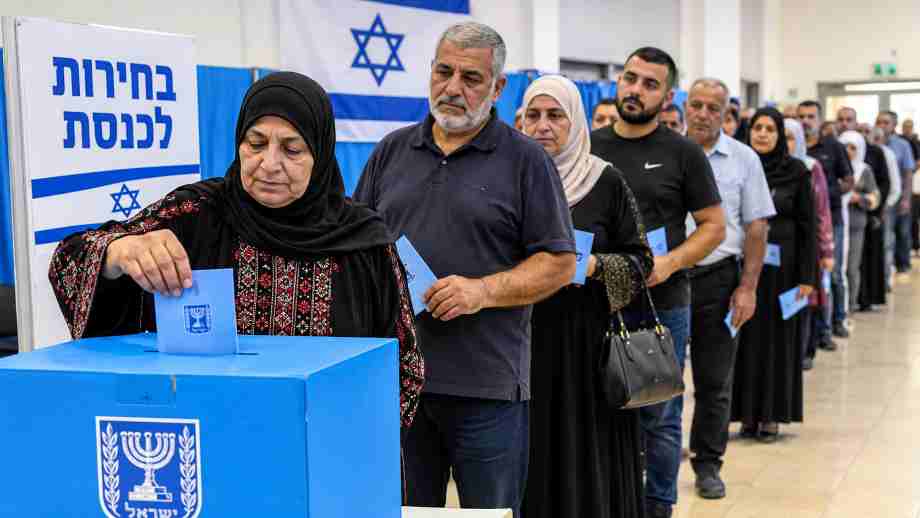 Click Image to Enlarge. Image created via AI.
The participation of the anti-Zionist Arab parties in Israel’s parliamentary elections is a multiple travesty of law, of reason, and of basic common sense.
The recent elections have highlighted the precarious condition of Israel, its security and its ability to preserve its Jewish character.
Astonishing anomalies
Its hyper-socio-political tolerance and ultra-liberal judiciary have created a situation that gravely imperils the country’s ability to sustain itself as a sovereign entity founded on the principles enshrined in the Declaration of Independence—see here.
Moreover, the voting procedure itself and the events that preceded it exposed astonishing anomalies in Israeli societal structure, anomalies unlikely to be sustainable in the long run.
The alleged ballot box fraud in favor of the predominantly Arab anti-Zionist parties has only served to throw this contorted paradox into even sharper relief.
The current turmoil and apparent political deadlock, resolvable only if opposition parties renege on their electoral pledges not to include the predominantly Arab anti-Zionist parties in any future coalition, were precipitated—or at least facilitated—largely by unlawful rulings of Israel’s Supreme Court.
Indeed, the participation of the anti-Zionist Arab parties in Israel’s parliamentary elections is a multiple travesty. It is a travesty of law, a travesty of reason, and a travesty of basic common sense.
Of course, this does not imply that Arabs citizens of Israel should be barred from voting.
There is a sharp distinction between hostile Arab parties on the one hand and individual Arab voters on the other. Prohibiting participation of the one does not imply prohibiting the other—as I shall explain later.
Overarching anti-Zionist sentiment
The overarching sentiment in all the dominantly Arab parties is reflected in the words of the previous head of the Hadash party, Ayman Odeh, who asserted “…there is something very basic in the theory of zionism that I can’t accept, and there is something very basic in the practice of zionism that I can’t accept.”
This is a perspective echoed by numerous other leading figures in the predominantly Arab factions.
For example, Yosef Jabareen Odeh’s successor, who leads the newly (re)formed Joint List, penned an op-ed in the LA Times in which he disavowed Israel’s status as a Jewish state and rejected Israel’s Basic Law proclaiming it to be the nation-state of the Jewish people. He claimed “the nation-state bill …marginalizes my community and entrenches Israel’s regime of racial discrimination and deterioration into apartheid”.
The veteran parliamentarian, Ahmed Tibi of the Ta’al faction, espoused similar sentiments
“I certainly oppose Zionism and the Jewish character of the state.” Elsewhere, he proclaimed: “I’m a member of the Israeli parliament and I don’t recognize Israel as Jewish.”
Even Mansour Abbas, head of the Islamic Ra’am party, who is often bandied about as an Arab politician accepting Israel as a Jewish state, declared: “I have not become a Zionist, and I will not become a Zionist.”
However, should any lingering doubt remain as to the anti-Zionist nature of the Ra’am faction, they will be swiftly dispelled by the briefest perusal of the party platform, which calls for the expunging of any hint of Jewish governance and of any Jewish symbolism in the public sphere.
Unlawful Supreme Court Rulings
It should therefore be underscored that the very participation of these Arab dominated anti-Zionist parties in the elections is a contravention of existing Israeli law, and is only sustained by the scandalously distorted and cravenly cowardly ruling of the Supreme Court justices, who time and time again impose torturously contorted interpretations of existing legislation that negate any common-sense reading or understanding of the written letter of the law.
Indeed, the conduct of the Supreme Court jurists seems to be motivated by a deep-seated desire to prevent the disqualification of the dominantly Arab anti-Zionist factions by any means—fair or foul—an impulse perhaps generated by a wish to avoid tension or conflict with their judicial peers abroad. Indeed, it is difficult to conceive of any other motivation.
After all, the Basic Law: The Knesset permits the disqualification of candidates or party lists whose goals, actions, or statements expressly or implicitly deny Israel’s existence as a Jewish and democratic state, incite racism, or support an armed struggle against Israel by an enemy state or terrorist organization. (Article 7A(a).) Yet despite the copious and unequivocal evidence that the anti-Zionist parties do not comply with the provisions of the law, the Supreme Court repeatedly fails to disqualify their participation.
Perturbing past precedents
The (thankfully) short-lived Bennett-Lapid government (2021-2022) underscored the problematics of including anti-Zionist Arab elements—the Ra’am faction—in a ruling coalition in Israel. This entailed the need for approval of its policy initiatives by the Islamic Shura Council, to which Ra’am was affiliated, and which is historically related to the Muslim Brotherhood.
Even Avigdor Liberman, then Finance Minister, has acknowledged that the Bennett-Lapid coalition found itself unable to act decisively, particularly regarding security. Thus, not only was the government unable to engage in the imposition of law and the adequate demolition of illegal housing in the Negev, but it was even forced to curtail forestation activities in the South because of Arab pressures.
Liberman grumbled that because Ra’am repeatedly threatened to freeze its membership or collapse the coalition over security actions in Gaza or Jerusalem, the government’s ability to maintain deterrence was significantly compromised.
Affirming this viewpoint is the fact that the only large-scale military operation, carried out under Bennett-Lapid—Operation Breaking Dawn—was launched in August 2022. only after the Knesset had voted to disperse itself, and the resulting interim government was no longer dependent on Ra’am support.
Perturbing precedent (cont.)
Moreover, the historical precedents bode ill regarding the conduct of Arab Knesset members in the recent past. For example, veteran politician Azmi Bashara, a Christian representative of the Balad party, was forced to flee the country, having been found aiding Hezbollah in time of war.
Likewise, Basel Gattas, another Christian Arab and a representative of the Balad party, was convicted for abusing his parliamentary privilege (which exempted him from security checks) to smuggle cell phones and SIM cards to incarcerated terrorists.
Haneen Zoabi, yet another Balad MK, participated in the May 2010 attempt to break Israel’s naval quarantine of the Hamas-ruled Gaza Strip aboard the Turkish ship Mavi Marmara. As a result, the Knesset voted to strip her of several parliamentary privileges, such as her diplomatic passport and the right to state-funded legal representation, a measure which, not unexpectedly, the Supreme Court annulled.
Bearing the past in mind, the future ramifications of anti-Zionist Arab parties comprising a significant element in a prospective coalition – either as part of such a coalition or as an outside prop supporting it—appear ominous.
Nullifying the Jewishness of the Jewish state?
Indeed, quite apart from the troubling question of whether Donald Trump would embark on an assault against Iran with Eisenkot, rather than Netanyahu, at the helm (an unlikely prospect), it is difficult to see how a coalition dependent on Arabs partners could/would mount a military campaign against Iran.
Moreover, how would inclusion of anti-Zionist Arab parties impact:
- Anti-terror operations in Judea/Samaria;
- the ability to combat illegal seizure of land and unlawful building in the Negev and Galilee;
- forceful measures against Arab crime syndicates;
- settlement construction in Judea/Samaria—even in areas of broad consensus in Israel;
- the use of Jewish symbolism and characteristics in the public sphere.
Clearly, all of this increasingly threatens the ability of the coalition to conduct Jewish-oriented governance of the country and imperils the very nature of Israel as a sovereign nation established on the precepts of the Declaration of Independence.
Israpundit is entirely dependent on readers support. Please help me continue educating people with the truth about what is going on in Israel and around the world.


Leave a Reply
You must be logged in to post a comment.