
Ambassador (ret.) Yoram Ettinger | “Second Thought: a US-Israel Initiative” | June 28, 2026
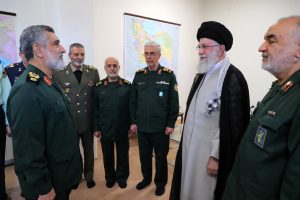 Iran’s then Supreme Leader, the late Ayatollah Ali Khamenei, prepares to award a medal to the late General Amir Ali Hajizadeh (L), then commander of the Aerospace Force of the Islamic Revolutionary Guard Corps (IRGC), in the presence of the senior IRGC leadership, in Tehran on October 6, 2024. (Image source: Office of the Iranian Supreme Leader)
*A regime that merely changes tactics under pressure – and is not forced into foundational restructuring – is not reformed, but temporarily constrained. A durable reform away from the Ayatollah’s Islamic Republic requires more than a leadership turnover.
*47 years of the Ayatollah regime’s rogue track record determines that expecting this regime to be potentially reformed – while its core architecture is not overhauled – is speculative and unrealistic.
*The Ayatollah’s Islamic Republic is not merely a government that can be reformed, deconflicted or voted out; rather, it is an ideological ecosystem. Thus, the prerequisite for an effective reform to occur, the core pillars (the DNA) that sustain this ecosystem must be entirely dismantled and uprooted. An effective reform cannot just be a shift in leadership at the top, but must preclude a potential renewal of the Ayatollah ideology. Furthermore, dismantling the core pillars distinguishes between a deceptive (a tactical retreat utilizing taqiyya-dissimulation) and a genuine transformation.
The Following Prerequisites Are Required:
*Disavowing and discarding completely the 1979 Constitution, which is not merely a legal charter, but the roadmap of the Ayatollah’s domestic and external rogue strategy. It reflects the Ayatollah regime’s 1,400-year-old apocalyptic, megalomaniacal vision, which pursues the establishment of a universal society under the supremacy of Shiite Islam, mandating the toppling of all “apostate” Sunni regimes and bringing the Western “infidel” – and especially “The Great American Satan” – to submission. The Ayatollah’s Constitution enshrines the battle of the oppressed “mustadafun” (e.g., Iran, Syria, Lebanon, Venezuela, Cuba, Nicaragua) over the oppressive and arrogant “mustakbirun” (e.g., “The Great American Satan,” Saudi Arabia, the UAE and Israel). It codifies the concept of Velayat-e Faqih (Guardianship of the Islamic Jurist), subordinating the entire population to a, supposedly, divinely-ordained authority, religiously (as the sole interpreter of Islam), militarily and civically, domestically and externally, educationally and economically.
*Abolish the Ayatollah (Supreme Leader) position, the Guardian Council (the unelected body that vetoes legislation and disqualifies candidates) and the Islamic Revolutionary Guard Corps (IRGC), which is not merely a military force, but an economic empire and ideological enforcer that exists independently of any government. The dismantling of the IRGC should include the Basij, which is a paramilitary volunteer militia within the IRGC.
*Another prerequisite for a reformed regime in Iran is the uprooting of the school curriculum and the Friday mosque sermons, which have been the most authentic reflection of the Ayatollah’s vision and policy, highlighting Jihad, martyrdom, vengeance and the vilification of the Western “infidel” and the neighboring Sunni “apostates,” who must be subjugated. The education and religious systems have become the most effective machines of ideological reproduction, and the manufacturing lines of Ayatollah loyalists. They are committed to the Ayatollah Constitution, willing to sacrifice their lives on the altar of the Ayatollah’s apocalyptic and imperialistic vision. They are consistent with the Constitution, domestic repression of ethnic and religious minorities, the subjugation of women, and the proliferation of anti-US terrorism in the Middle East, Africa, Latin America and on US soil, providing a roadmap for an apocalyptic commitment to a global, anti-US Islamic revolution.
*Rejecting the exportation of the Islamic revolution, which is articulated by Article 154 of the Ayatollah Constitution, mandating support for the “just struggles of the oppressed [Iran and additional 3rd World members of “the axis of resistance”] against the arrogant [the USA and its allies] in every corner of the globe.” This doctrine justifies global sedition and subversion, cooperation with terror proxies, as well as framing domestic dissent as treason.
*Renouncing – explicitly and constitutionally – the toppling of Sunni (“apostate”) regimes, subjugation of the “infidel” West, bringing “The Great American Satan” to submission, and the destruction of Israel as national objectives.
*Ending – explicitly and constitutionally – discrimination, repression and oppression of women, as well as religious and ethnic minorities, while releasing all political prisoners, and recognizing the legitimacy of the 2009 Green Movement, the 2019 protests, and the 2022 Zan, Zendegi, Azadi (Woman, Life, Freedom) uprising.
*Abolishing the 1979-conceived name/identity “The Islamic Republic,” and restoring the original name/identity “Iran” or “Persia.” This prerequisite refers to the predominance of historical, pre-Islamic, and civic nationalism over fanatical Ayatollah theocracy, which has been dedicated to the subordination of Iran’s thousands of years-old-cultural heritage to a fanatical, supremacist, apocalyptic 7th-century-identity. It would shift the national ethos away from martyrdom toward a unified historical linguistic and cultural heritage, such as the legacy of Cyrus the Great and, possibly, the 1905 secular Constitutional Revolution, which transformed Iran from an absolute monarchy into a constitutional system, underscoring parliamentary sovereignty, individual rights and written law to curb despotic authority.
The Bottom Line
*Differentiating between tactical accommodation by Iranian negotiators and systemic reform, one should remember that scorpions cannot change stings, neither can leopards change spots.
*Changing the spots of the Ayatollah regime mandates the dismantling of the Ayatollah’s DNA, ideological ecosystem and the aforementioned core pillars.


WOW. Someone – something or somebody has got their work cut out for them. Could you reprogram an entire culture and people back 100 years in their political and religious thinking, and do it in the next 5 to 10 years? I would think not.
“America as a new ‘light unto the nations,” or I hate to say I told you so…” New English
Review
https://share.google/nkCgoW3xTiR2BSN5U
Good analysis, and one of several of my own earlier ones as well:
“Unconditional Surrender & Total Victory”New English Review
https://share.google/eb6JoNxSiEGndXoww
Short answer: No.