
‘You close it and you won’t have a country’ – Trump threatens to strike Iran if IRGC closes Hormuz
| Published: June 21, 202
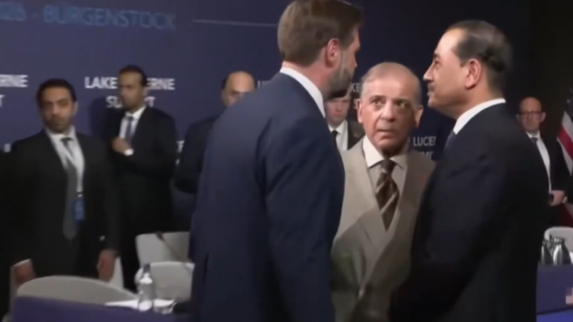 Preliminary meetings before talks begin in Switzerland. Screengrab via X
The Israel-Hezbollah conflict is reportedly at the head of the agenda as representatives from the United States, the Islamic Republic of Iran, Qatar, and Pakistan meet for the first of several rounds of negotiations in Switzerland. aimed at ending the conflict.
“The Zionist regime continues to violate its commitment in Lebanon; this issue will be the main topic of discussion in today’s talks,” Iranian Foreign Ministry Spokesman Esmaeil Baghaei said in a statement cited by IRNA news media.
The Iranian regime claimed on Saturday that it had closed the Strait of Hormuz in response to what it described as Israeli ceasefire violations, an apparent reference to Israeli retaliatory strikes following multiple drone and rocket attacks on IDF troops and Israeli territory in recent days.
Audio, reportedly recorded earlier today, of Iranian forces warning ships that the Strait of Hormuz is closed. pic.twitter.com/C3imi6w44c
— OSINTtechnical (@Osinttechnical) June 20, 2026
“Due to the blatant breach and violation by the United States of the first clause of the ceasefire agreement, and in response to the continuous and relentless violations of the ceasefire by the Zionist regime in southern Lebanon, the merciless killing and displacement of hundreds of thousands of oppressed people of this land, and also considering the failure of the Zionist occupying forces to withdraw from southern Lebanon, it is declared that the Strait of Hormuz will be closed to vessel traffic,” read one statement published on the Islamic Republic of Iran Broadcasting (IRIB) website.
U.S. Central Command reported shortly after that commercial traffic through the strait had increased, and that “U.S. forces continued operating in the general area to support freedom of navigation.”
“Safe passage through the international waterway remained intact today as 55 merchant ships transited, moving large amounts of cargo and more than 17 million barrels of oil to global markets,” CENTCOM said.
However, ship-tracking websites reported that only one non-Iranian ship passed through the strait during Sunday morning.
U.S. President Donald Trump weighed in on the Israel-Hezbollah conflict on Sunday, rejecting the Islamic Republic’s attempt to blame Israel for the conflict. The president also said that if Iran cannot control its proxy in Lebanon, the U.S. might “hit Iran very hard again.”
“Iran must immediately stop their highly paid PROXIES in Lebanon from causing trouble,” Trump wrote on Truth Social. “If they don’t, we’ll hit Iran very hard again, just like we did last week, only harder!!!”
The initial meeting between the United States, Iran, Qatar, and Pakistan is set to begin with a special session on the situation in Lebanon, according to CBS News.
Reports on social media claim that the Iranian delegation refused to participate in a photo opportunity at the beginning of the talks, and also refused to shake hands with members of the U.S. delegation.
This was humiliation. No one in modern history has made America wait and beg for negotiations. This was the moment JD Vance should have returned to Washington. The Islamic regime did this on purpose. Trump, if you don't understand politics, you should at least understand… pic.twitter.com/NVWAxr8NMH
— Amjad Taha ???? ?? (@amjadt25) June 21, 2026
Some residents displaced from southern Lebanon began returning to their homes following the pause in hostilities between the IDF and Hezbollah, according to Lebanese media.
However, the Lebanese military urged civilians not to return to areas evacuated during the fighting, citing the risk of renewed flare-ups.
Israeli Defense Minister Israel Katz denied Hebrew media reports saying Israeli soldiers had been instructed to hold their fire, even when faced by Hezbollah threats, in order not to disrupt the talks.
“There was and is no restriction on IDF soldiers in Lebanon from operating to remove threats,” Katz said in a statement.
He also denied reports that Israeli troops would have to leave the security zone in southern Lebanon.
“The ceasefire announced yesterday leaves the IDF in all positions within the security zone that protects the northern communities,” Katz added, stating that the IDF “will not withdraw from the security zone in Lebanon.”
Iran’s Tasnim news agency reported on Saturday that the Strait of Hormuz, which Tehran said it had closed earlier in the day, would remain closed until the ceasefire in Lebanon is fully observed. Citing a source close to Iran’s negotiating team, Tasnim said the reopening of the strategic waterway would also depend on sanctions waivers allowing the sale of Iranian oil.
Under the terms of the Memorandum of Understanding, the Strait of Hormuz was to reopen immediately after the agreement was signed and remain open throughout the 60-day negotiation period.
President Trump also responded to reports that Iran is planning to charge tolls for vessels transiting the strait.
“There will be NO TOLLS in the Hormuz Strait for 60 days during the Cease Fire Period, and there will be NO TOLLS after the 60 day period has expired, unless they are imposed by and for the United States of America, should the deal not be completed, for services rendered as the Guardian Angel to the countries of the Middle East for purposes of both past, present, and future reimbursement of costs,” Trump wrote on Saturday. “Thank you for your attention to this matter!!!”
On Sunday, Trump threatened to destroy Iran if the Islamic Revolutionary Guard Corps (IRGC) closes the Strait of Hormuz.
“You close it and you won’t have a country,” Trump told Trey Yingst of Fox News. “You won’t even make it back to your f—king country.”
Trump issued several other threats before the start of the negotiations.
“We may take over the Strait, if we have to,” Trump said, regarding the reported closure. “I’ll blow the s— out of them.”
When asked about Iranian President Masoud Pezeshkian’s assertion that Iran would maintain its right to enrich uranium, Trump directly rejected the claim.
“He better watch his mouth,” Trump replied. “He better shape up or we’ll take over the rest of the country.”


The US must give free hands to IL to destroy Hezbollahs! This will considerably weaken Iran.