
Peloni: David Brody makes some very important reflections while considering recent events with Trump’s Iran deal. First, it is important to note that it is Trump’s deal, and that no matter how well or how poor Vance applies himself, the current negotiations are entirely Trump’s undertaking. That is why he has repeatedly made unexpected pronouncements regarding the negotiations. Beyond this, Vance is placing his entire political credibility on the line base on how he proceeds in this negotiation, even beyond whether the negotiations are successful or not. Notably, Vance has played his cards thus far in hosting this gambit in a manner which might be argued to diminish his political hopes. Also Brody indicates below, I have never forgotten Trump’s dead pan jest about blaming this entire fiasco on Vance, as I too did not interpret that Trump’s ironic statement was actually intended to garner any laughs. Regardless of the earnest efforts by Trump and Vance to gain Iran’s support for any deal, I still remain convinced that these attempts will ultimately prove fruitless as the Iranians are predictably who they are.
So in two months time, this will likely leave Trump with the unenviable choice of either punting further with a further extension on the farcical negotiations, surrendering entirely to Iran while claiming a faux victory, or resuming the war while still in need of some ground force to bring about any victory, and this choice will come just shortly before the looming midterms. Only one of these options would leave Vance in a better light, and that would require the Iranians offering him a clear political victory just before the crucial US midterms.
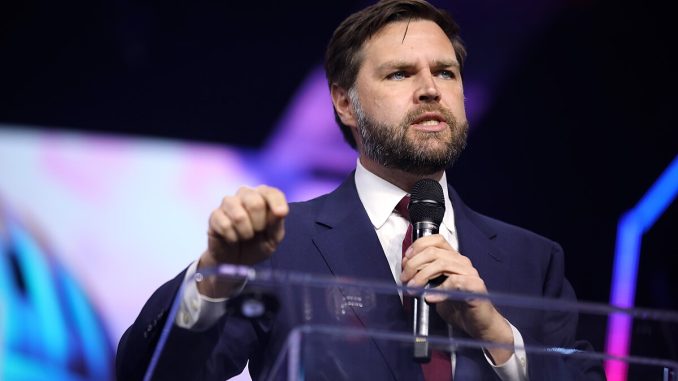 By Gage Skidmore from Surprise, AZ, United States of America – J. D. Vance, CC BY-SA 2.0, Wikipedia
JD Vance is now front and center in the Iran negotiations, but let’s be clear about something: this is not really about JD Vance freelancing foreign policy. This is about Donald Trump.
Vance may be the face of the negotiations and the one sitting across from the Iranians. He may be the one doing the public explaining. However, at the end of the day, he is carrying out Trump’s orders.
And Trump’s order is pretty simple: get America out of this war, stop the bleeding, reopen the Strait of Hormuz and find a way to call it peace.
That is why Vance makes sense for this role. He didn’t want this war in the first place. He has never been the guy beating the drums for another long, messy Middle East conflict.
He is much more comfortable making the argument that America has already spent too much blood, treasure, and credibility chasing “perfect” outcomes in a region where perfect outcomes rarely exist.
That puts him right in line with Trump’s gut instinct.
Trump may talk tough, but he has always had a strong aversion to getting America stuck in another endless war. He wants leverage and the optics of strength. He wants the headline that says he ended the conflict, and he does not want a forever war with Iran.
He never did.
When Iran played its ultimate “Trump Card” in the form of the Strait of Hormuz, Iran had Trump over a barrel.
So, enter JD Vance. From Trump’s perspective, Vance is the perfect messenger because he can sell restraint to the MAGA base in a way Marco Rubio probably can’t. Rubio has long been seen as more hawkish, especially on Iran.
Vance, on the other hand, has built much of his national identity around skepticism toward foreign interventions. So if the goal is to make a deal with Iran and then convince conservatives that this is strength, not surrender, Vance is the guy.
Now, let’s also be honest about something else: JD Vance is not exactly popular with the pro-Israel crowd right now.
His recent critical comments regarding Israel have many Vance critics steaming. A lot of pro-Israel conservatives look at his comments and see a man who is too willing to put daylight between the United States and Israel.
They have heard him criticize Israeli concerns about the deal and wonder whether he really understands the stakes. They might be worried that this administration is so eager to get out of the war that it may give Iran too much, too soon, with too few guarantees.
Those concerns are real. After all, Midterm Elections are right around the corner and gas prices need to come down.
However, let’s step back for a moment and begin with this simple fact: Vance is not stupid. In fact, this may be where his political instincts are sharper than some people realize.
You have to wonder whether some of his tough talk toward Israel before heading into these final negotiations was intentional. Was he trying to signal to Iran that he wasn’t walking into the room as Israel’s lawyer? Was he trying to show Tehran that he had enough distance from the pro-Israel camp to actually deliver a deal? Was he trying to create the appearance of being an honest broker so the Iranians couldn’t simply dismiss him as another American negotiator doing Jerusalem’s bidding?
To be clear, that does not mean Vance doesn’t believe what he said. He may very well believe that Israel has been too critical of the deal or too willing to keep the conflict going, but there is also a negotiating tactic here. If you are trying to strike what Trump likes to call “the art of the deal,” you don’t walk into the room looking completely controlled by one side.
The risk, of course, is that he may be too clever by half. Because in trying to gain leverage with Iran, he risks losing credibility with pro-Israel conservatives who already suspect this deal is headed in a dangerous direction. That is a very delicate line to walk and Vance is walking it with a political future hanging over every step.
That brings us to the biggest point here, at least politically for Vance: he has a lot riding on this. Recently, Trump joked that if the deal doesn’t work out, he’ll blame JD Vance. People laughed. They thought it was just Trump being Trump.
I didn’t think it was funny at all. I thought it sounded like the truth wrapped in a punchline. If this deal goes south, Vance is going to own a big piece of it.
Yes, technically, the responsibility belongs to Trump. He is the president. He sets the policy. He makes the final call. If Iran cheats, if Israel feels betrayed, if Hezbollah regroups, if the nuclear inspections turn into another game of hide-and-seek, Trump will get the blame. But Vance will take the hit, too, and that wouldn’t be good for his chances in 2028 (presidential elections).
This is now front and center on his VP resume. It is a major foreign policy test and with a probable presidential run lurking in the background, people are watching. Republican voters are watching. Pro-Israel evangelicals are surely watching. The America First crowd is watching. The foreign policy establishment is watching. And Iran is watching too. All eyes are on JD Vance.
If this works, Vance will say he helped end a war, kept America out of another quagmire, helped spur the economy and forced Iran back into some level of nuclear oversight.
That would be a huge feather in his cap.
But if it fails, the story changes fast. Vance becomes the politician who trusted Iran, helped sell a bad deal, and distanced himself from Israel at the very moment Jerusalem needed clarity from Washington. He becomes the man who thought he could outsmart Tehran, only to discover that the Iranian regime plays a much longer – and darker – game.
That is the gamble and let’s be honest – with Iran’s track record, the odds aren’t in his favor.


We saw this with GW Bush in his second term, practically every Israeli military and political leader at some point in their careers. Something unknown that made them suddenly do a 180.
If Vance is counting on the the mullahs, his lack of acumen in this part of the world will be out there for all the world to see.