
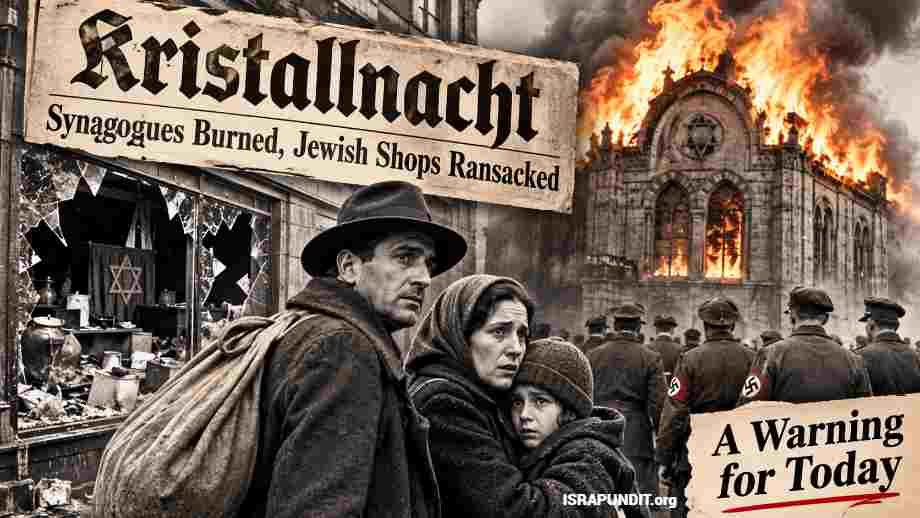
Between the late evening hours of Nov. 9 and the early morning of Nov. 10, 1938, gangs of German brownshirts and the SS publicly destroyed and firebombed 267 synagogues throughout Germany, Austria and the Sudetenland. Historian Richard Evans noted that Reinhard Heydrich, chief of the Reich Security Main Office—the SS and police agency most responsible for implementing the Final Solution—instructed the police and the SS not to stop the destruction of Jewish property or restrain those committing violent acts against German Jews.
In addition to burning down synagogues, Evans noted that stormtroopers shattered the shop windows of an estimated 7,500 Jewish-owned commercial businesses, leaving their wares looted or strewn across the broken-glass-coated pavements outside. Before Heydrich directed the security police to thwart the looting, widespread robberies took place; furthermore, ledgers recording mortgages and unsettled debts owed to Jews were systematically destroyed, as documented by historian David Cesarani. Extortion burgeoned under the pretext of implementing “Aryanization” and creating areas free of Jews. In Garmisch-Partenkirchen in Bavaria, Jews were forced to sign a “declaration of their intent to leave the district immediately and never to return.”
Evans adds that Jewish homes and apartments were ransacked, and their contents were stolen. Furniture was smashed, books and valuables were tossed everywhere, and the residents were terrorized and beaten. In many towns, gravestones in Jewish cemeteries were completely trashed.
The ‘Degradation Ritual’
Systematic public humiliation became a harrowing component of this uncontrolled, disorganized and anarchic pogrom, according to Cesarani. In dozens of cities and towns, this “degradation ritual” assumed different forms: As their synagogues burned, Jews were forced to watch them go up in flames; others were compelled to dance around the fires or kneel in front of them. Torah scrolls and prayer books were widely vandalized, frequently by German youth. In Vienna, numerous rabbis had their beards publicly cut. Other Jews were paraded through their cities in their pajamas. Old-age homes and orphanages were similarly ransacked. In the Jewish hospital in Nuremberg, patients were removed from the premises with such viciousness that several died from the ordeal.
Exodus of the Jews
Germans forcibly seized Jewish men between the ages of 16 and 60, sending them directly to the Dachau, Sachsenhausen and Buchenwald concentration camps. Severe overcrowding and malnutrition rapidly led to disease, causing a high number of deaths.
Cesarani adds that on Nov. 16, 1938, in response to public “disquiet” about the nationwide pogrom and his own strategic “cynicism,” Heydrich ordered several groups of Jews to be discharged. Those holding active emigration papers, individuals prepared to sell their businesses and the lawyers required to assist them were among this initial release group. The subsequent groups included combat veterans and elderly men, followed by those over 50 years old and teenagers. Though their incarceration did not last long, Cesarani emphasizes that many Jews never recovered from the severe physical and psychological trauma they endured.
Beginning the Process
The overarching objective of Kristallnacht was to coerce Jews to emigrate. The psychological devastation wrought by these horrors convinced many victims and their families to flee Germany as quickly as they could locate a country willing to admit them. However, as a direct result of malicious Nazi decrees, punitive taxes and severe financial restrictions, even those who had once been affluent were now entirely destitute.
Gaining admission to the United States proved formidable. Each American consul general held total autonomy in establishing the eligibility of those seeking entry. Applying the strict financial requirements provided by the “Likely to become a Public Charge” (LPC) clause of the 1917 Immigration Act, consuls could arbitrarily reject a candidate’s entry by deciding they might become dependent on the U.S. government for subsistence.
Antisemitism, Nativism and
‘America First’
Widespread antisemitism, nativism and a rigid policy of “America First” served as the primary justification behind the campaign to exclude Jewish refugees from America, asserted historian David Wyman. Throughout the war, he noted, hundreds of bills were introduced in Congress specifically designed to decrease immigration.
Fear of the Fifth Column
The very word “refugee”—which implied an undesirable “alien” to bureaucrats and a potential “secret agent” to the military—was used to justify excluding Jews. Compounding the problem, many Americans, including prominent members of Congress, believed Jews from Eastern Europe were political radicals, or even Communists, who would form a dangerous “fifth column” inside the United States. This deeply entrenched fear of an internal fifth column played a significant, yet frequently underrated, role in determining American immigration restrictions.
A Final Note
Kristallnacht ultimately became a wake-up call for German Jews. Historian Christian Gerlach pointed out that out of a Jewish population of 500,000 living in Germany at the beginning of 1933, only 214,000 remained by 1939. By 1941, two-thirds of all German and Austrian Jews had successfully emigrated.
The enduring message of Kristallnacht is that mass violence does not begin with destruction; it ends with it. The November Pogrom was not an isolated outburst, but rather the logical culmination of years of unchecked hate speech, systematic dehumanization and the gradual erosion of the civil rights of German Jews. For modern society, the event serves as a stark warning about the danger of bystander apathy; while many ordinary Germans felt private discomfort over the violence, their public silence signaled to the Nazi regime that it possessed a mandate to proceed.
This historical collapse demonstrates the extreme fragility of democratic institutions, proving that even a highly educated, legally bound society can rapidly descend into state-sponsored brutality when authoritarian impulses replace constitutional norms. Furthermore, the pogrom demonstrated how quickly hatred against Jews expands beyond its original scope, as evidenced by the rioters who targeted Catholic churches and symbols when no Jewish properties could be found. Ultimately, Kristallnacht serves as a universal wake-up call for the present day, reminding us that fighting rising antisemitism and radical political extremism requires active moral courage and early intervention before casual prejudice escalates into irreversible tragedy.
“The Jews are a peculiar people…” observed Eric Hoffer, the noted non-Jewish American social philosopher. He asserted that “Jews are consistently in the forefront of the war to preserve our liberal democracy, our freedoms, and our way of life.” He argued that a failure to respond to these targeted assaults only encourages further attempts to destroy Western culture and civilization. Hoffer understood this profound intersection deeply: “I have a premonition,” he stated, “that will not leave me: as it goes with Israel, so will it go with all of us. Should Israel perish, the Holocaust will be upon us.”
Dr. Alex Grobman is the senior resident scholar at the John C. Danforth Society, a member of the Council of Scholars for Peace in the Middle East, and serves on the advisory board of the National Christian Leadership Conference of Israel.
Israpundit is entirely dependent on readers support. Please help me continue educating people with the truth about what is going on in Israel and around the world.


Leave a Reply
You must be logged in to post a comment.