
Yossi Baum | X | Aug 27, 2026
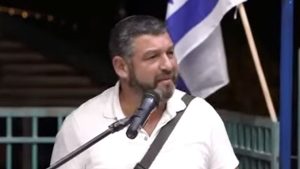 Brig. Gen. (Res.) Ofer Winter’s Speech at Jerusalem Day Ceremony, March 10, 2025. Screengrab via Youtube.
After we have seen that Winter has countless Lieberman people around him (details below), after Kaplan has been “lifting” him up, and after he established his party despite the risk of Smotrich falling below the threshold, the burden of proof is on him that he will not go into a bloc with Lieberman and Bennett. And here is why:
A. The degree of closeness between Winter and Lieberman
First, pay attention to the closeness between Winter and Lieberman. Much more than you thought:
1. While in 2018 Eisenkot prevented Winter from becoming the Prime Minister’s Military Secretary, the person who stood by his side was Lieberman, then Defense Minister, who appointed him as his personal military secretary.
2. The closeness between Winter and Lieberman is not limited to the previous decade. In 2024 as well, when the Left persecuted Winter, Lieberman publicly stood by his side.
3. Sharon Shalom, one of Lieberman’s closest associates, is in Winter’s inner circle.
4. Kobi Eliraz, who joined Lieberman, is an adviser to Winter.
5. Aviv Ezra, chairman of ‘Victory Generation,’ who is on Winter’s list, is also considered close to Yisrael Beiteinu. The chairmen of the ‘Victory Generation’ caucus established in the Knesset are MK Sharon Nir of Yisrael Beiteinu, and MK Dan Illouz, who also defected to Lieberman.
6. Davidi Ben Zion, also on Winter’s list, and someone considered close to Bennett and Shaked, explicitly said in recent months that he is willing to join ‘Yisrael Beiteinu.’
It is important to mention here the considerable closeness between Winter and Bennett, which goes back more than 30 years(!), since they served together in Sayeret Matkal (see in the response to the post), and places Winter in the same political area code, with the formation of a third bloc of Lieberman-Bennett-Winter being almost self-evident.
B. The conscription law
Now pay attention: two very prominent figures in the public struggle against the conscription law are with Winter – Lali Deri and Davidi Ben Zion (links in the response to the post). Yosef Haddad wrote that there needs to be a conscription law with severe sanctions against the Haredim. Aviv Ezra also represented reservists (although with a somewhat different position regarding the conscription law).
Winter’s own people briefed N12 the day before yesterday that “Winter wants a broad government headed by Netanyahu but not a narrow government, among other things because he does not want them to be dependent on the Haredim because of the conscription issue.”
Now let us think about the political meaning that follows from this: the Haredim have already declared that even before the establishment of a new right-wing government they will demand the passage of a conscription law. Without a doubt – this demand will constitute a non-negotiable condition on their part for entering the coalition.
What are Winter’s red lines on the conscription issue? And what is the likelihood that they will correspond with the Haredi demands?
It must be said that Winter himself has spoken out against forcibly conscripting Haredim. But these are only statements. It can already be assumed that Lali Deri and Davidi Ben Zion (and perhaps others as well) will ‘stand on their hind legs’ to make sure that Winter does not agree to a conscription law according to the Haredim’s wishes. What will happen then? What will the other party members do?
The positions on the list are also unclear. Who is in positions 3-4? Who is in the positions after them? This has real significance for our purposes – if Lali Deri and Davidi Ben Zion are in the top positions, they have a real card in their hands: the threat of breaking up the party, and the ability to lead Winter as they wish on the issue.
If such a scenario happens – and it is much more than ‘reasonable’ – Winter can roll his eyes to the heavens, and his commitment this evening will not be worth even a potsherd. Winter will turn to Netanyahu, say that he wants to join, and there will even be broad smiles and joint photographs. But then the issue of the conscription law will come up, and it will be very convenient for Winter to bring down the negotiations over an issue on which there is no unified opinion even within the Right.
And then, what will happen is one of two things: either Netanyahu will tell Winter that he is not suitable for the coalition, because, what can you do, the Haredim are worth more numerically. Or Netanyahu will declare that he is more interested in Winter, but then he will not have a coalition because the Haredim will abandon him.
Either way, Winter will have the full case to stand before the public and say, ‘I did everything so that Netanyahu would be Prime Minister, but there are things that do not depend on me.’ And we will not even be able to claim against him that he is violating his commitment to the voters.
C. Is Lieberman right-wing?
From Winter’s perspective, it is unclear whether Lieberman is not considered a right-wing person, as quite a few in Religious Zionism see him. If my memory does not deceive me, we have never heard Winter make any statement against Lieberman, even when he sat in a government with Ra’am.
One additional point: according to a poll by @filbers this evening Winter receives 4 mandates. That is, he is on the threshold of the electoral threshold. But Winter did not come in order to join, and the presentation of 11 candidates on his behalf is clear evidence of that, as is the narrative about ‘those who were not on October 7’ and so on. And what will happen if in the end he does not pass? And what will happen if Smotrich does not pass and thereby brings down the Right? These concerns, it seems, are of no concern to Winter and beyond.
Therefore, before the trumpet fanfare as though Winter is on the Right, and when he seeks to reassure the Right about the fact that the Left has ‘lifted’ him up in this way, clear statements from him are called for on at least 3 issues:
- Is Lieberman considered ‘Right’ in his eyes;
- What are his boundaries regarding the conscription issue, and whether and to what extent he sees the possibility of cooperation with the Haredim;
- If two weeks before the election his party is not passing in Filber’s polls, will he withdraw or not.
These are the basic tests. If, on the conscription issue, he begins to stammer or speak in slogans, my advice – keep your distance (and it makes absolutely no difference what your own opinion is on the substance of the conscription issue. In the current situation it is either Haredi conscription or Iran, Gaza and Hezbollah. There is no ‘both and’).
It should be said in conclusion that a good word must be said about the many good people who are with Winter, including Winter himself. Among them are people of values with an impressive record. But politics is not a matter for good people, but for those who have proven that they are capable of standing up to the atomic pressure of the Left and the media. And in this area – almost none of them has a record. If anything – the opposite (past statements, see in the response to the post). And hence the great concern.
Israpundit is entirely dependent on readers support. Please help me continue educating people with the truth about what is going on in Israel and around the world.


https://youtu.be/xAJPk1Xx8_U?is=aH2zOvDW28yBO5v6
https://www.israelnationalnews.com/news/432559
7
That last assertion cites TOI not Faber, AI is being slick with a bait and switch here.
“Why students need to be able to identify logical fallacies.”
https://resilienteducator.com/classroom-resources/logical-fallacies/
August 28, 2026 16:42
“When Winter announced his new party, the prime minister quickly expressed concern that a proliferation of small right-wing parties could dilute his bloc’s share of the vote, and even reportedly attempted to give Winter a reserved spot on the Likud list to prevent him from launching the fledgling right-wing party.”
The polls are split on whether he will pass the threshold, barely.
https://www.thejc.com/news/israel/ofer-winter-only-back-netanyahu-election-ekvs3ttf
I saw it in C14 news but close enough. It’s Bibi or bust if you care about restoring Yesha and Gush Katif.
The elephant in the room:
https://www.timesofisrael.com/eisenkot-says-two-state-solution-delusional-post-oct-7-but-e1-settlement-plan-a-mistake/
My prediction: Either Bibi will heal the rift with UTJ and Shas and win or the present government will remain in office by default as a caretaker government since nobody can form a coalition.
“can a caretaker government in Israel continue with all the same policies ”
” No, a caretaker government in Israel cannot continue with all the same policies, as it faces strict legal and judicial limitations designed to prevent it from binding the hands of future administrations.While Israel’s Basic Law: The Government mandates that an outgoing administration must continue to function until a new coalition is sworn in, its practical scope of authority is significantly narrowed.The Standard of RestraintUnder long-standing Israeli judicial precedent, a caretaker (or interim) government is legally expected to act with extreme caution and restraint. It is restricted from initiating major new long-term initiatives, restructuring public policy, or implementing sweeping ideological agendas. Instead, its primary duty is limited to maintaining the status quo and running day-to-day administrative affairs.Specific Policy and Legal RestrictionsNo “Election Economics”: Caretaker governments face strict constraints on their fiscal policies. They are legally prohibited from transferring irregular state funds, approving sudden public subsidies, or making financial promises that could be construed as bribing the electorate ahead of an election.Frozen Senior Appointments: Long-term, permanent appointments to critical state roles—such as police commissioners, corporate regulators, or director-generals—are heavily restricted. Temporary placeholders are typically appointed instead to ensure the future government can select its own leadership.The “Essential and Urgent Need” Exception: A caretaker government can only deviate from the status quo if it can prove an essential, immediate, and urgent public need. For instance, handling unexpected wartime operations, navigating active defense escalations, or resolving sudden diplomatic crises (such as urgent border or resource disputes) can justify major executive actions.Judicial and Attorney General Oversight: The Supreme Court of Israel and the Attorney General play an active role in vetting interim policies. If a caretaker administration attempts to push through a highly controversial policy, the court can freeze it on the grounds that an unelected interim cabinet lacks a public mandate to reshape the country’s trajectory.Even though prolonged political stalemates have historically left Israeli caretaker governments in power for months or even over a year, they must legally govern as a custodial authority rather than a fully empowered political body.”
Google misunderstood my question here but the answer is clear: It’s down to another battle between the government and the Supreme Court or electoral defeat to the latter, in any case. Time for another Judicial Reform crisis, but a post Oct. 7 one this time, so maybe the ever-thuggish left won’t be able to paralyze the country with their shock troops.
@Sebastian: we’re back to the same old, same old. The supreme court thinks that it has the authority to change policies on the fly or obstruct new policies. If the Israeli electorate can’t get a 2/3 majority in place, the situation will never change unless a rebellion takes place. Since the electorate seem to be unable to choose a government, even a rebellion will fail.
Is the only solution to give up or let the opposition take over with all that will immediately follow, since the supreme court and the AG are part of the opposition?
We can prophesy what would then happen:
Surrender to Hamas, Hezbollah and Iran.
Let the Iranians build their nuke and test it on us.
Let the Houthis block Bab al-Mandeb.
Forget obstructing the two (three, or even four) state solution and building in J&S.
Deny building permits anywhere until the [2-4]state situation is clarified to international satisfaction?
Pay retribution to everybody that claims to have been harshly dealt with?
An so on…
I’m sure you can add a few items to my list.
I would play the game till the elections and then see who got how many votes before selecting partners for a coalition. We all know that the real fighting begins then.
This think is so long and boring.
I miss Peloni’s summary…