
MEMRI | March 4, 2026
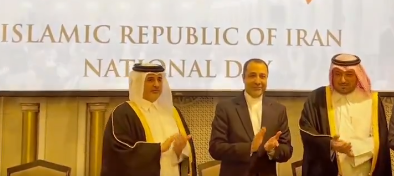 Iran’s Ambassador to Qatar Ali Saleh Abadi (center) with Qatari Foreign Ministry official Ibrahim Yousef Fakhro (right) and Qatari Minister of Environment and Climate Change Abdullah Al-Subaie. Screengrab via X, February 5, 2026
In the weeks before the launch of the U.S. and Israeli attacks on Iran, Qatar conspicuously sided with Tehran – politically, diplomatically, and in the media – despite its ostensible role as a strategic ally of Washington and as a mediator between the U.S. and Iran. The warming between Doha and Tehran was evident first and foremost in the increasing diplomatic contacts between them in that period, alongside Qatar’s blatant disregard for the popular protests in Iran and their violent suppression by the Iranian regime.[1] Thus, on January 31, 2026, Qatar’s Prime Minister and Minister of Foreign Affairs, Mohammed Bin Abdulrahman Aal Thani, met in Tehran with the secretary of Iran’s Supreme National Security Council, Ali Larijani.
On February 7, Aal Thani hosted Iran’s Foreign Minister, Abbas Araghchi, [2] and on February 11 Larijani visited Doha for a meeting with the Qatari Emir, Sheikh Tamim bin Hamad Aal Thani, which focused on “strengthening the cooperation between the countries,” regional developments, and “efforts to reduce tensions.”[3] In addition, there were telephone conversations between the Qatari Emir and the Iranian President, Saud Pezeshkian,[4] and Qatar’s Prime Minister and Foreign Minister Aal Thani held numerous discussions with his Iranian counterpart Araghchi and with Supreme National Security Council head Larijani.[5] Although these contacts were presumably part of Qatar’s mediation efforts between Tehran and Washington, the scope of Qatar’s direct engagement with Washington were limited compared to the intensity of its ties with Tehran in that period.
These diplomatic contacts were accompanied by public statements of support for the Iranian regime by senior figures close to the Qatari leadership. These figures adopted the Iranian narrative and leveled sharp criticism at the Trump administration’s policy toward Iran. For example, in a February 23, 2026 X post, Azmi Bishara, a close adviser of the Qatari Emir, described the U.S. policy toward Iran as “pure aggression” and argued that there was no justification whatsoever for an attack on Iran. He also launched a personal attack on President Trump, calling him “an uncultured man of limited intelligence, afflicted with obsessive narcissism.” At an event held by the Iranian embassy in Doha marking the 47th anniversary of the Islamic Revolution and the rise of the ayatollah regime, the head of protocol at Qatar’s Ministry of Foreign Affairs praised the achievements of the Iranian regime and its “peace-seeking” policy, while criticizing the U.S. pressure campaign against Iran. Implicit criticism of the U.S. and support for the Iranian regime was also conveyed by Qatar’s ambassador to the United Nations, Alya Ahmed bin Saif Aal Thani, who warned during a Security Council debate of the “growing threats” to the international rule of law and called to respect the principles of “the sovereignty and territorial integrity of states, non-interference in their internal affairs, and refraining from the use of force or the threat of its use.”
This series of statements – by the Emir’s adviser, by a Foreign Ministry official, and by Qatar’s ambassador to the UN – indicates that the pro-Iran stance was the official Qatari position, not the personal position of the speakers.
Qatar’s alignment with Iran was also evident in the media: articles published in the Qatari press adopted the Iranian narrative, opposed a U.S. strike, emphasized that Iran is a powerful state that cannot accept external dictates, and warned that the entire region would be adversely affected by an attack on this country. Qatar’s Al-Jazeera network served as a major platform for conveying Iranian propaganda and conducted numerous interviews with senior Iranian officials, including Foreign Minister Araghchi, Supreme National Security Council Secretary Larijani, and Ali Shamkhani, a senior adviser to Iran’s Supreme Leader Khamenei.[6]
It should be noted that Qatar’s pro-Iran position in the weeks before the outbreak of the war – its adoption of the Iranian narrative, its disregard for the popular protests in Iran and their brutal suppression by the regime, and the repeated emphasis on the need to avoid interference in Iran’s internal affairs – stood in stark contrast to this country’s positions in past crises. During the Arab Spring, Qatar openly supported the uprisings against the Arab regimes in Tunisia, Egypt, Libya, and Syria. It portrayed itself as promoting the will of the peoples to overthrow dictatorial governments and mobilized its Al-Jazeera network to advance the revolutionary narrative. Conversely, in the case of Iran, Qatar aligned itself with the dictatorial regime, adopting a discourse of sovereignty and non-interference and ignoring the regime’s ongoing violent repression of its own people.[7]
Qatari Emir Sheikh Tamim and Iranian Supreme National Security Council Secretary Larijani in Doha (Qna.org.qa, February 11, 2026)
This report presents the Qatari expressions of support for Iran and the criticism in Qatar against the U.S. in the weeks prior to the outbreak of the current war with Iran.
Senior Qatari Officials Justified Iran, Criticized U.S.
As stated, Qatari officials and individuals close to the Qatari regime made statements of support for Iran, while adopting its narrative and harshly criticizing the American threats to use force against it.
Senior Adviser To Qatari Emir: U.S. Is Committing Unjustified Aggression Against Iran; Trump Is An Uncultured Man Of Limited Intelligence And A Narcissist
In a February 23 X post, Azmi Bishara, a senior adviser to the Qatari Emir (and a former member of the Israeli Knesset), stated that there was absolutely no justification for an American attack on this country and also lashed out at President Trump personally, writing: “There are futile debates about the intentions of that uncultured man of limited intelligence, afflicted with obsessive narcissism [meaning Trump]: Will he dare to attack [Iran] during the negotiations, or will he embark on a full-scale war in the service of Israel? And will he agree to a settlement with terms better than those of Obama’s deal [in 2015], including commercial and financial advantages, or will he insist on [Iran’s] complete surrender? Completely absent [from these discussions] is what ought to be the main issue: the fact that there is not a single legal justification for attacking Iran, and that what the U.S. has been doing so far is pure aggression.”[8]
Cartoon in Qatari daily presents Trump as a savage who negotiates with Iran while threatening it with military force (Al-Arabi Al-Jadid, Qatar, January 29, February 20, 2026)
Qatari Foreign Ministry Official Praised, Justified Iran’s Conduct Toward U.S.
The close relations between Qatar and Iran were also evident in an event held by the Iranian embassy in Qatar at the beginning of February to mark the 47th anniversary of the Islamic Revolution. During the event, which was attended by senior Qatari officials and ministers, the Iranian ambassador in Doha, Ali Saleh Abadi, praised the relations between the two countries and emphasized that “the development of active relations between Doha and Tehran reflects the shared political will of the two countries to consolidate and expand them.”
Conspicuous at the event was a speech by the Director of the Protocol Department at Qatar’s Ministry of Foreign Affairs, Ibrahim Yousef Fakhro, which at times could have been mistaken for a speech by an Iranian spokesperson. Fakhro lavished praise on the Iranian regime and its achievements since the revolution, on its “balanced foreign policy,” and on its “promotion of dialogue, pluralism, and cooperation in order to consolidate peace and stability and achieve sustainable development.”
Fakhro also praised and justified Iran’s conduct in the negotiations with the U.S., while implicitly criticizing America’s pressure and threats against Iran, saying: “Iran initiated the resumption of nuclear negotiations as a gesture of goodwill. [It did so] despite the policy of maximum pressure exercised against it by the U.S., and despite the fact that, after five rounds of negotiations and a sixth round agreed upon, we witnessed military aggression against it by the Zionist entity [i.e., Israel], which caused loss of life and significant economic damage.” Fakhro added: “Today, too, the Islamic Republic of Iran is facing simultaneous military, political, and media attacks. Just as it stands up, firmly and earnestly, to defend its sovereignty and national security, it is also determined to harness diplomacy to protect the interests of the Iranian people and to safeguard the peace and security of the region. The main principle underlying diplomacy is respect for national sovereignty and mutual interests. Therefore, any negotiation based on mutual respect and on refraining from pressure and threats, and conducted within a just and balanced framework, can constitute an effective path to realizing shared interests and strengthening peace and stability.”[9]
The event at the Iranian embassy (X.com/IRANinQATAR, February 5, 2026)
Qatar’s Ambassador To UN In Implicit Criticism Against U.S.: Interference In States’ Internal Affairs Is Illegitimate; Their Sovereignty Must Be Respected
Remarks by Qatar’s Ambassador to the UN, Alya Ahmed bin Saif Aal Thani, during a Security Council debate on January 28, 2026, likewise included implicit criticism of President Donald Trump’s threats to attack Iran. She said: “The principle of commitment to the international rule of law is facing growing threats. This requires rebuilding trust in the international rule of law and respecting the principles of the [UN] Charter, particularly respect for the sovereignty and territorial integrity of states, non-interference in their internal affairs, refraining from the use of force or the threat of its use, and respect for human rights and the right to self-determination.” She also called for “preventing emerging threats and addressing them at an early stage…”[10]
Qatari State Press Opposed Overthrow Of Iranian Regime, Adopted Its Narrative
As stated, the support for the Iranian regime and the adoption of its narrative were also evident in articles published in the Qatari state press. These articles not only ignored the violent suppression of the protests in Iran and the killing of many protesters, but even claimed that the videos showing these events were fabricated. They also warned against a potential U.S. attack on Iran, emphasizing that Iran is a strong country that cannot be forced to accept external agendas and that any attack on it would ignite the entire region.
Article In Qatari Daily Al-Sharq: The Suppression Of Protests In Iran – Fabricated Or Old Footage; Iran Is Not Fragile And Will Reject External Agendas
In a January 18 article in the Qatari daily Al-Sharq, Kuwaiti academic Abdullah Khalifa Al-Shaiji adopted the narrative of the Iranian regime regarding the protests, claiming that Israel and other parties had “fabricated videos and used old archival materials and AI-generated materials to exaggerate the Iranian authorities’ suppression of the demonstrations and protests. They also spread [the claim] that the Iranian regime is on its last legs in order to encourage and incite an escalation of the protests…”
Alluding to the demands presented by the U.S. to Iran on the eve of the war regarding its nuclear program and ballistic missiles, Al-Shaiji argued that “Iran is not a fragile entity or state that can easily be compelled to make such concessions…” Finally, he concluded that the “decrease in tension” between the parties and the resumption of the talks between them with the assistance of regional countries, as well as “Iran’s success in controlling the situation, prove—at least temporarily—that Iran is not an entity that can be forced to comply with external agendas for the benefit of forces that constitute the greatest threat to the region’s security [i.e., Israel].” [11]
Reporter On Qatari Channel: The Iranian Regime Is Pragmatic And Change Will Occur Without War
Hazem Kallas, director of the Tehran bureau of the Qatari channel Al-Araby – a channel that operates under the supervision of Azmi Bishara, a senior adviser to the Qatari Emir – argued in a February 1 article in Al-Sharq that Iran was no longer a threat to the region and that the pragmatism of its regime would eventually lead to change in the country. He wrote: “…Iran is a neighbor, geographically and historically. If decades ago the source of concern was [Iran’s] ‘export of the revolution,’ and years ago the source of concern was its ‘influence’ [in the Arab countries] – which, according to some Iranian leaders at the time had reached the point of [Iranian] control over four Arab capitals – today the situation is completely different…
“Talk of a paradigm shift has begun to spread among circles of the Iranian elite. Therefore, if change in Iran is inevitable, what Iran and its neighbors want… is for this change to take place as quietly and as naturally as possible, in light of the evident pragmatism of the Iranian regime, not in a rigid manner that would set the region’s ball of fire rolling.”[12]
Editor Of Qatari Daily: External Intervention In Iran Is Harmful And Will Exact A Heavy Price From The Entire Region
In a post on his X account, Jaber Al-Harmi, editor of the daily Al-Sharq, likewise expressed opposition to U.S. intervention aimed at changing the regime in Iran. He wrote: “We have had disagreements with the Iranian regime regarding many positions and policy approaches, but placing it in the crosshairs today and toppling it through external intervention will not be for the sake of the Iranian people and their rights, or for the benefit of the states and peoples that have been harmed by Iranian interference in their affairs. The efforts [to overthrow the Iranian regime] are wrapped in such pretexts. But, while outwardly they appear as a kindness [to the Iranian people and the region], in practice this is impending evil. An attack [on Iran] and regime change from the outside, if they occur, are first and foremost an Israeli interest…
“The goal is to deprive this vital region of stability and sustainable development, prevent it from utilizing its resources to build up [its] societies and ensure their prosperity, [cause it] to continue exhausting resources in wars and conflicts, and generate crises and civil wars everywhere… Regime change through external intervention will exact a very high price, both in the present and in the future. These costs will not be borne only by the state and people directly concerned [i.e., the Iranians]; everyone will pay this price and be burned by the fire of this change, if it occurs. We have experienced nearly half a century of instability, manufactured crises, and conflagrations across this region. Enough. The time has come for the peoples of the region to rest, and for their states to devote their time to further development for the sake of their peoples…”[13]
[2] Mofa.gov.qa, January 31, 2026; Al-Watan (Qatar), February 8, 2026.
[3] Qna.org.qa, February 11, 2026.
[4] Al-Sharq (Qatar), January 29, 2026.
[5] Tasnim (Iran), January 13, 27, 28, February 3, 2026; mofa.gov.qa, February 21, 2026.
[6] Tasnim (Iran), January 12, February 15, 2026; khabaronline.ir, February 12, 2026; IRNA (Iran), February 13, 2026.
[8] X.com/AzmiBishara, February 23, 2026.
[9] Al-Arab (Qatar), February 5, 2026.
[10] Al-Watan (Qatar), January 29, 2026.
[11] Al-Sharq (Qatar), January 18, 2026.
[12] Al-Sharq (Qatar), February 1, 2026.
[13] X.com/jaberharmi, January 14, 2026.


Well that means, that the US and Israel needs to cripple Qatar and put them out of the oil business. Which vicariously, takes out Hamas and Hezebola leadership.
What value with the Sand dwellerds be to anyone if they loose their oil sales.
And imagine all those EU countries who have been buying oil through the back door from these guys while boasting of 85% renewable energy. Wha Wha Wha
Meanwhile the, US is energy self sufficient!