
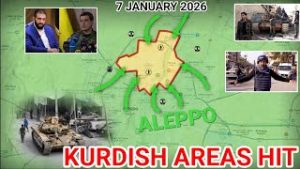
Syrian Army Moves on Kurdish Areas | Aleppo Fighting Resumes [7 January 2026]

Peloni:  As the US is pressuring Israel to come to terms with the Jihadist regime under Jolani, Jolani reaffirms his Jihadist goals of subjugating all opposition with an open assault on the Kurds as the American remain supportively and shamefully silent.  The Kurds recently offered terms under which they would merge with the Syrian army, but these terms were soundly rejected by Jolani.  Is the assault on Aleppo the counter offer?
Video Loads Below

January 8, 2026 | 7 Comments »

Leave a Reply

7 Comments / 7 Comments

  1. Divide Syria,
    Give a part to Alavites, a part to Kurds, a part to Christians and a part do Druzes, and I suppose leave the rest to Sunnies, unless I forgot someone.
    Sadat can return to the Alavites and be Russian Ally.
    Kurds can be allies with US and Israel.
    Druzes can be an Israeli protectorate, retaining independence, but have a close cooperation with Israel.

    • I agree

      AI Overview:

      9
      Demographics – Heritage for Peace
      Syria’s minorities include significant ethnic groups like Kurds, Turkomans, Armenians, and Circassians, alongside religious minorities such as Alawites, Druze, and various Christian denominations (Assyrian, Greek, etc.), plus smaller groups like Yazidis, all facing diverse challenges and uncertainties within the country’s evolving political landscape, with historical roots and varying degrees of integration and distinct identity.
      Major Ethnic & Religious Minorities
      Kurds: The largest non-Arab group, predominantly Sunni, but also including Yezidis and Christians; concentrated in the northeast, facing expulsions and displacement.
      Alawites: A Shia Muslim sect, forming a significant minority (around 12%), historically influential but vulnerable.
      Christians: Comprising about 10% (Armenians, Assyrians, Greek Orthodox, etc.), concentrated in cities like Damascus and Aleppo, facing emigration and violence.
      Druze: A distinct religious community, mainly in southern Syria, with beliefs blending Shia Islam, Christianity, and paganism.
      Turkomans: Turkic-speaking Muslims, descendants of Mamluk and Ottoman settlers.
      Assyrians: Indigenous, multi-denominational Christian groups, particularly in northeastern Syria.
      Yazidis: A small religious minority often associated with Kurdish areas, facing extremist violence.
      Key Dynamics
      Security Concerns: Years of conflict have heightened fears among minorities about representation, safety, and belonging.
      Political Representation: Recent shifts in governance have included minority figures, but deep-seated issues of inclusion remain.
      Displacement & Emigration: Many minorities, including Armenians and Christians, have left Syria due to the civil war.
      Syria’s complex tapestry of ethnic and religious minorities plays a crucial role in its internal power dynamics, with their future dependent on stable, inclusive governance.

      2m
      Minorities in the New Syria: Threats, Opportunities, and Future Prospects

      YouTube·Foreign Policy Research Institute
