
Peloni: This is a very important article. It delineates the importance and potentially disruptive power of the Kurds in any deal struck with Iran, not withstanding the fact that any deal struck with Iran will fail.
Hence, it is critical to reflect upon the possibility of a Kurdish-US alliance which might emerge in the wake of the MOU negotiating period should this period come to rendering little to recommend the deal as actually supporting Trump’s designs for the region, which seems likely.
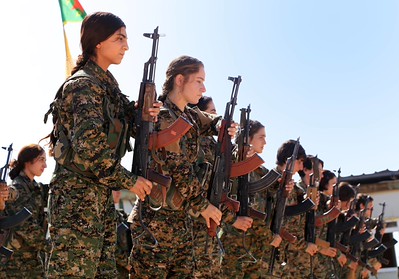 “Kurdish YPG Fighters” by Kurdishstruggle, CC BY 2.0
JAFAJ STRATEGIC BRIEFING | 2026-06-14
THE KURDISTAN WILD CARD: WHY AMERICA’S MOST RELIABLE NON-STATE PARTNER WILL DETERMINE THE SUCCESS OR FAILURE OF ANY U.S.–IRAN AGREEMENT
IN A NUTSHELL
The Kurds are not a secondary issue in Middle Eastern geopolitics. They are a structural force embedded across Iraq, Syria, Turkey, and Iran that directly influences regional stability, U.S. military operations, and the strategic balance with Iran.
The Kurdish population is estimated at 30–40 million people, making them the largest stateless ethnic group in the world. Their territory spans approximately 190,000–230,000 square miles, covering critical energy corridors, border regions, and conflict zones.
They maintain one of the most consistently pro-American orientations in the region, particularly when compared to surrounding populations where U.S. favorability is often below 30 percent in polling across the Middle East.
At the same time, they remain politically fragmented, institutionally divided, and structurally under-recognized.
This creates a high-impact strategic reality:
- If the Kurds are stabilized, supported, and integrated into U.S. regional strategy, then they function as a forward-operating stabilizer, a buffer against Iran, and a reliable security partner.
- If the Kurds are ignored, fragmented, or sidelined, then they become a destabilizing force capable of undermining any U.S.–Iran agreement through indirect pressure, insurgency risk, and regional spillover.
Bottom Line: The Kurds are not simply part of the system. They are the variable that determines whether the system stabilizes or fractures.
CORE THESIS: THE KURDS AS A STRUCTURAL WILD CARD IN THE U.S.–IRAN SYSTEM
The Kurdish issue is not merely a background constraint or “shadow file.” It is a structurally embedded geopolitical force that directly affects the durability of any U.S.–Iran agreement.
Unlike traditional allies such as Israel, which operate as centralized, sovereign states with institutional continuity, the Kurds operate as a distributed, cross-border network. This makes them both less predictable and, in specific contexts, more strategically disruptive.
Israel represents a high-capability, stable, formal ally with deep military, technological, and intelligence integration with the United States.
The Kurds represent a high-loyalty, high-exposure, and under-institutionalized partner whose alignment can shift regional dynamics from within contested territories.
Former U.S. diplomat Peter Galbraith summarized this distinction directly:
“The Kurds are America’s only friends in Iraq.”
This statement is not rhetorical. It reflects battlefield alignment, intelligence cooperation, and sustained operational partnership over decades.
Forced Conclusion:
Any U.S.–Iran agreement that ignores the Kurdish factor will not fail immediately. It will degrade over time as Kurdish instability introduces indirect pressure into the system, ultimately undermining the agreement’s durability.
SECTION I — THE STRATEGIC PARADOX: RELIABLE PARTNER VS STRUCTURAL WEAKNESS
The Kurds are among the most operationally reliable partners the United States has had in the Middle East.
- Kurdish Peshmerga forces played a decisive role in the defeat of ISIS by holding territory that Iraqi and Syrian state forces could not secure, which allowed U.S. airpower and intelligence operations to translate into sustained battlefield gains rather than temporary tactical victories.
- Kurdish intelligence networks provided actionable, ground-level intelligence in areas inaccessible to U.S. forces, which directly improved targeting accuracy and reduced operational risk in counterterrorism missions.
- Kurdish leadership consistently aligned with U.S. strategic objectives even when doing so increased their exposure to retaliation from Iran and regional militias, demonstrating a level of political risk tolerance that most state actors in the region have avoided.
However, unlike Israel:
- Israel operates as a unified state with a GDP exceeding $500 billion, advanced defense industries, and formalized military integration with the United States.
- The Kurdish regions operate with fragmented governance, limited international recognition, and economic dependency on external actors such as Baghdad and Ankara.
This creates a structural imbalance:
- Israel is a fully institutionalized ally with global integration.
- The Kurds are a highly reliable but structurally constrained partner without state-level protections.
Hard Truth: The Kurds may be among the most loyal partners the United States has in conflict environments, but they are also among the least structurally supported.
SECTION II — GEOGRAPHY AS STRATEGIC POWER (WITH DATA)
Kurdish-populated regions span a critical geographic corridor:
- Approximately 40 percent of Iraq’s northern oil reserves are located within or adjacent to Kurdish-controlled territory.
- The Kurdistan Region of Iraq alone produces between 400,000 and 500,000 barrels of oil per day, representing a significant share of Iraq’s export capacity.
- The region borders Iran, Turkey, and Syria, placing it at the intersection of three major security theaters.
This geography provides:
- Direct access to Iran’s western border, which stretches over 300 miles adjacent to Kurdish regions.
- Proximity to key trade and energy routes, including pipelines connecting Iraq to Turkey.
- Strategic oversight of conflict corridors used by militias, insurgent groups, and state actors.
Quotation (CSIS analysis):
“Northern Iraq remains one of the most strategically significant regions in the Middle East due to its geography, energy resources, and proximity to Iran.”
Forced Conclusion:
Control or influence over Kurdish geography is equivalent to influence over a major portion of the region’s security and energy architecture.
SECTION III — IRAN AND THE KURDS: A HISTORY OF CONFLICT AND CONTAINMENT
The tension between Iran and Kurdish populations is not recent. It is structural and historical.
- Kurdish uprisings in Iran date back to the early 20th century, including the short-lived Republic of Mahabad (1946), which Iran quickly suppressed.
- Since the 1979 Iranian Revolution, Kurdish groups have periodically challenged Tehran’s authority, leading to sustained military and intelligence operations against them.
- Iran has consistently viewed Kurdish political organization as a threat to territorial integrity due to its own Kurdish population of 8–10 million people.
This explains Iran’s current strategy:
- Iran conducts periodic missile and drone strikes into Iraqi Kurdistan targeting opposition groups.
- Iran supports proxy militias to exert pressure on Kurdish regions.
- Iran leverages political fragmentation to prevent Kurdish unity.
Strategic Logic:
A unified Kurdish entity creates a cross-border identity movement that Iran cannot fully contain.
Hard Truth:
The Kurdish issue is not a peripheral security concern for Iran. It is a persistent internal vulnerability.
SECTION IV — THE UNITED STATES AND THE KURDS: HISTORY, ALIGNMENT, AND STRATEGIC VALUE
The U.S.–Kurdish relationship has evolved over decades, shaped by both cooperation and inconsistency.
Historical Alignment
- The United States supported Kurdish groups indirectly during the Cold War as part of broader regional strategy.
- After 2003, Kurdish forces became one of the most reliable partners during the Iraq War.
- During the fight against ISIS, Kurdish forces were widely regarded by U.S. commanders as the most effective ground force partner.
Former U.S. officials repeatedly emphasized this:
“The Peshmerga were indispensable in the campaign against ISIS.” — U.S. Department of Defense assessment
Why the U.S. Supports the Kurds
The U.S. supports Kurdish actors for three primary reasons:
- The Kurds provide reliable ground forces in regions where U.S. troop deployment is politically and strategically constrained.
- The Kurds offer intelligence access in areas that are otherwise inaccessible or hostile to U.S. operations.
- The Kurds maintain a pro-U.S. orientation in a region where alliances are often transactional or adversarial.
Strategic Importance
- Kurdish regions serve as forward-operating environments near Iran.
- Kurdish cooperation reduces the need for large-scale U.S. troop deployments.
- Kurdish stability directly affects Iraq’s political and economic stability.
Hard Truth:
The United States does not support the Kurds out of preference. It supports them because they are operationally necessary.
SECTION V — ECONOMIC AND REGIONAL IMPACT OF KURDISH STABILITY
Kurdish stability has direct economic implications:
- Northern Iraq’s oil production contributes billions of dollars annually to regional markets.
- Instability in Kurdish-controlled regions can remove between 400,000 and 500,000 barrels per day from global supply, which is sufficient to trigger short-term oil price spikes in the range of 5 to 15 percent depending on broader market conditions.
- Trade routes through Kurdish areas connect Iraq to Turkey and Europe, making them critical for regional commerce.
- Because Kurdish-controlled regions sit along critical energy and trade corridors connecting Iraq to Turkey and Europe, sustained instability introduces friction into regional supply chains, which can propagate into higher transportation costs and downstream consumer price increases in global markets
Broader Economic Effects
- Increased instability in Kurdish and northern Iraqi regions raises insurance premiums for energy infrastructure and regional transport corridors, which directly increases operational costs for multinational firms and reduces project viability.
- Political instability in Kurdish regions increases sovereign risk premiums across Iraq, which can reduce foreign direct investment inflows by billions of dollars annually and delay major energy and infrastructure projects.
- Security risks increase operational costs for multinational corporations.
Bottom Line:
Kurdish instability is not a localized issue. It has direct consequences for global energy markets and regional economic stability.
SECTION VI — U.S. POLICY PATHWAY: THE KURDS, TRUMP, AND THE ABRAHAM ACCORDS SYSTEM
The expansion of the Abraham Accords represents a structural shift in Middle Eastern geopolitics from fragmented bilateral relationships to a coordinated regional alignment system. As efforts intensify to bring additional states into this framework, the Kurdish question emerges as a critical unresolved variable.
Former President Donald Trump has urged regional actors to expand participation in the Abraham Accords, emphasizing normalization, economic integration, and collective security alignment. However, current expansion efforts focus almost exclusively on recognized states, leaving non-state but strategically consequential actors—such as the Kurds—outside the framework.
This exclusion creates a structural gap.
THE STRATEGIC QUESTION
The United States faces a direct policy choice:
- Should the Kurds remain an informal partner outside the regional system?
- Or should they be integrated into the emerging Abraham Accords architecture as a structured strategic actor?
Forced Conclusion:
Maintaining the Kurds outside the system preserves instability. Integrating them reduces it.
POLICY OPTION ANALYSIS
- FORMAL RECOGNITION OF A KURDISH STATE
Formal recognition of an independent Kurdish state would represent the most decisive shift in U.S. policy.
- Recognition would immediately increase Kurdish political cohesion and international legitimacy.
- Recognition would create a permanent strategic partner positioned along Iran’s western flank.
- Recognition would, however, trigger immediate opposition from Turkey, Iran, and Baghdad, creating short-term regional instability.
Conclusion:
Full recognition is strategically powerful but operationally destabilizing in the near term.
- SECURITY SUPPORT AND CONTROLLED ARMING
Providing expanded military support to Kurdish forces represents the most immediate and scalable policy tool.
- Controlled arming strengthens Kurdish defensive capability without requiring formal state recognition.
- Security support enhances deterrence against Iranian pressure and proxy activity.
- Expanded coordination reduces the need for direct U.S. troop deployment.
Constraint:
Unstructured arming risks escalation with Turkey and increases intra-Kurdish fragmentation if not centrally coordinated.
Conclusion:
Arming the Kurds is necessary, but it must be tied to political unification and command integration.
- ECONOMIC FINANCING AND STRUCTURAL STABILIZATION
Economic instability is the primary driver of Kurdish fragmentation.
- Direct investment, energy coordination, and revenue stabilization mechanisms increase internal cohesion.
- Economic normalization reduces vulnerability to Iranian and regional pressure.
- Financial support strengthens governance capacity and reduces dependency on external actors.
Conclusion:
Financing Kurdish stability is not optional; it is the foundation of any sustainable security relationship.
- INTEGRATION INTO THE ABRAHAM ACCORDS FRAMEWORK
This is the most strategically underutilized option.
- Integrating Kurdish leadership into the Abraham Accords system—formally or informally—would align them with regional normalization and economic cooperation structures.
- Kurdish participation would extend the Accords’ influence into Iraq and Syria, expanding the system beyond traditional state actors.
- Inclusion would reinforce pro-U.S. alignment and reduce the likelihood of Kurdish drift toward alternative power structures.
Constraint:
Because the Kurds are not a recognized state, integration would require a modified participation model (observer status, security coordination framework, or economic partnership tier).
Conclusion:
Excluding the Kurds from the Abraham Accords preserves a structural vulnerability within the system.
RECOMMENDED U.S. STRATEGY (INTEGRATED APPROACH)
The United States should pursue a phased strategy combining political, security, and economic integration:
- The United States should avoid immediate formal recognition while creating a pathway toward conditional political legitimacy tied to Kurdish unification.
- The United States should expand security support through controlled arming, intelligence integration, and command coordination.
- The United States should finance Kurdish economic stabilization through energy alignment, investment facilitation, and revenue normalization.
- The United States should integrate Kurdish actors into the Abraham Accords framework through a modified participation model that reflects their non-state status but strategic importance.
FINAL POLICY DETERMINATION
The Kurdish question cannot be separated from the future of the Abraham Accords system.
- A regional architecture that excludes the Kurds remains incomplete and structurally vulnerable.
- A regional architecture that integrates the Kurds gains depth, resilience, and strategic reach into contested zones.
Hard Truth:
If the United States expands the Abraham Accords without incorporating the Kurdish variable, it will replicate the same structural weakness that has undermined previous regional frameworks.
FINAL DETERMINATION
The Kurds are not simply a partner. They are a structural force embedded in the Middle Eastern system.
- Israel represents stability, capability, and institutional strength.
- The Kurds represent flexibility, geographic leverage, and internal system influence.
Non-Negotiable Reality:
- If the Kurds are supported and integrated, they function as a stabilizing partner aligned with U.S. interests.
- If the Kurds are ignored or fragmented, they become a destabilizing wild card that amplifies regional instability.
There is no neutral outcome.
FINAL TAKEAWAYS
- The Kurds are the largest stateless population in the Middle East with significant geographic and strategic influence.
- The United States has relied on Kurdish forces as one of its most consistent operational partners.
- Israel remains the United States’ strongest formal ally, but the Kurds provide unique in-theater leverage that Israel cannot replicate.
- Iranian strategy is built around preventing Kurdish unity due to internal vulnerability.
- Kurdish stability directly impacts energy markets, trade routes, and regional security.
- Supporting the Kurds is not optional. It is a strategic requirement for any durable U.S.–Iran framework.
Hard Truth:
Any U.S.–Iran framework that does not integrate Kurdish political stability and security alignment will fail under predictable regional pressure. Kurdish fragmentation will not remain contained; it will translate into increased Iranian leverage, expanded proxy activity, and measurable economic disruption across energy and trade systems. The Kurdish variable is not optional within the regional architecture—it is determinative. Ignoring it does not remove it from the equation; it guarantees that it will re-enter under conditions that are more volatile, less controllable, and more costly to manage.
REFERENCES AND FOOTNOTES
REFERENCES
- U.S. Department of Defense, Operation Inherent Resolve Reports, 2017–2024.
- International Crisis Group, Iran’s Cross-Border Operations in Iraqi Kurdistan, 2025.
- Al Jazeera, Reuters, and regional reporting on U.S. weapons allegations, 2026.
- Chatham House, Political Deadlock in Iraq’s Kurdistan Region, 2026.
- Washington Institute for Near East Policy, Kurdish Fragmentation and Regional Power Dynamics, 2025.
FOOTNOTES
- U.S. Department of Defense, Operation Inherent Resolve Reports, 2017–2024.
- International Crisis Group, Iran’s Cross-Border Operations in Iraqi Kurdistan, 2025.
- “Trump Says U.S. Armed Iranian Dissidents via Kurds; Kurdish Groups Deny Claim,” Al Jazeera, April 6, 2026.
- Chatham House, Political Deadlock in Iraq’s Kurdistan Region, 2026.
Washington Institute, Kurdish Fragmentation and Regional Power Dynamics, 2025.


Leave a Reply
You must be logged in to post a comment.