
Peloni: After fifty years of betrayal and being used as the chit by which the West gained bargained their future away, the Iranian people deserve the support of the West. The list of those Iranians slaughtered this past January, when tens of thousands of Iranians were murdered, is still being extended today with continued executions.
By Amil Imani |
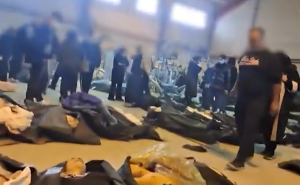 Families search for missing loved ones among the bodies of Iranian protestors following Iranian crackdown in mid January 2026. Screengrab via Youtube
As a constitutional lawyer, bestselling author, and influential broadcaster, Mark Levin has long used his platform to advocate for a robust, peace-through-strength approach to global affairs. His commentary often reflects a deeply rooted distrust of authoritarian regimes coupled with a fierce commitment to Western democratic values. Recently, Levin distilled his complex, hawkish, yet distinctly modern foreign policy philosophy into a succinct and powerful statement regarding one of America’s most enduring adversaries: the Islamic Republic of Iran.
Writing on his official social media platform, Levin declared:
“We must help liberate the Iranian people, and we can do it. We can do it without our troops on the ground. Without a forever war. We can do it. Train them. Arm them. Support them. And we will never have to worry about nuclear arms from the Iranian regime ever again. Not only that, but the Middle East will also change for the better in ways that we cannot even imagine. The regime must be destroyed. The time is now.”
This statement is not merely a rhetorical broadside; it represents a nuanced and strategic synthesis of traditional Reaganite interventionism and post-9/11 American war-weariness. To understand Levin’s stance on Iran and its citizens, one must analyze how this Levin Doctrine seeks to navigate the fine line between standing against tyranny and avoiding the pitfalls of protracted, costly military occupations.
At the core of Levin’s argument is a vital geopolitical distinction that is frequently lost in mainstream diplomatic discourse: the separation of the Iranian government from the Iranian people. For decades, the Islamic Republic – established during the 1979 revolution – has projected an image of unified, anti-Western fundamentalism. However, Levin recognizes what millions of Iranians have risked their lives to demonstrate in recent years through widespread protests: the domestic populace is largely a captive audience, subjugated by a brutal, corrupt theocracy.
By framing his argument around the imperative to “liberate the Iranian people,” Levin positions his foreign policy stance not as an act of aggression against a nation, but as an act of solidarity with an oppressed population. He views the citizens of Iran not as enemies of the West, but as potential allies in the fight against their own oppressors. This distinction allows Levin to advocate for the total destruction of the Islamic Republic while simultaneously projecting a message of hope and empowerment to the ordinary citizens of Iran, acknowledging their agency and desire for freedom.
Perhaps the most significant aspect of Levin’s statement is his explicit rejection of traditional American military intervention. The phrase “without our troops on the ground” and the rejection of a “forever war” signal a profound alignment with the shifting tides of American public opinion. Having witnessed the staggering human and financial costs of the conflicts in Iraq and Afghanistan, both the American public and conservative strategists have grown deeply skeptical of nation-building and direct military occupations.
Levin’s solution is a proxy-driven, indigenous-focused strategy: Train them. Arm them. Support them. This model seeks to replicate successful historical precedents where the United States provided logistical, financial, and material support to resistance movements without directly embroiling American soldiers in a foreign quagmire. In Levin’s view, the desire for revolution already exists within Iran; what is lacking is the capability. By supplying the Iranian opposition with the tools, intelligence, and weaponry necessary to mount an effective resistance, the United States could facilitate the collapse of the regime from within, minimizing American casualties and shifting the burden of liberation to those who stand to benefit from it most.
Levin’s urgency is underscored by the existential threat of a nuclear-armed Iran. For years, international efforts – ranging from the Joint Comprehensive Plan of Action (JCPOA) to various rounds of economic sanctions – have failed to permanently dismantle Iran’s nuclear ambitions. Levin argues that as long as the current regime stands, the threat of nuclear proliferation remains a ticking time bomb.
According to his logic, the only permanent solution to the nuclear threat is regime change. By neutralizing the head of the snake, the threat of a nuclear holocaust in the Middle East evaporates. Levin posits that the fall of the mullahs would trigger a geopolitical domino effect, changing the Middle East “for the better in ways that we cannot even imagine.” Without Tehran funding terror proxies like Hezbollah, Hamas, and the Houthis, the region could witness an unprecedented era of stability, normalization, and economic integration, building upon the foundations of initiatives like the Abraham Accords.
Mark Levin’s blueprint for Iran represents a bold reimagining of conservative foreign policy for the modern era. It rejects the passivity of pure isolationism as well as the exhausting burdens of direct military interventionism. By placing the destiny of Iran squarely in the hands of its own people – backed by the immense material and strategic might of the United States – Levin offers a roadmap that seeks victory over tyranny without the cost of American lives. Whether this strategy can be successfully implemented remains a subject of intense debate, but Levin’s message is clear: the status quo is untenable, the regime must fall, and the liberation of the Iranian people is the key to unlocking a peaceful Middle East.


Leave a Reply
You must be logged in to post a comment.