
Harry Liberman
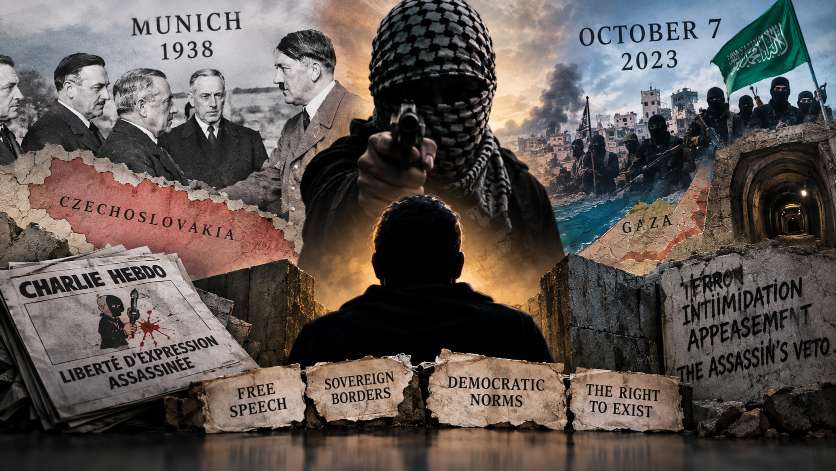 Click Image to Enlarge. Image created via AI.
The concept of the “assassin’s veto” has long served as a dark boundary marker for Western liberal democracies.
Coined to describe how the threat of lethal violence can force free societies into self-censorship, the term found its most visceral modern validation in the 2015 Charlie Hebdo massacre [cato]. There, the intent was clear: use the bullet to enforce ideological boundaries, forcing media outlets and governments to capitulate to fear [cato].
But a profound and terrifying evolution of this doctrine occurred on October 7, 2023. On that day, the logic of the assassin’s veto was elevated from a tool used to silence speech into a geopolitical weapon designed to veto sovereign borders, democratic norms, and the very right of an ethno-religious people to exist.
“The logic of the assassin’s veto was elevated from a tool used to silence speech into a geopolitical weapon designed to veto the very right of an ethno-religious people to exist.”
The Historical Anatomy of Appeasement
Historically, this pattern of appeasement mirrors the early aggression of totalitarian regimes. In the lead-up to World War II, European powers—most notably the UK and France—consistently chose a path of capitulation and diplomatic rationalization.
This culminated in the 1938 Munich Agreement, where Western democracies sacrificed Czechoslovakian territory to Adolf Hitler under the delusion that satisfying a radical expansionist’s immediate demands would secure “peace for our time.”
The Munich crisis demonstrated a fatal flaw in the Western liberal framework: the belief that eliminationist ideologies can be pacified through territorial compromise or diplomatic integration. Hitler understood this weakness completely. He used the threat of immediate, catastrophic war as a geopolitical assassin’s veto, forcing the international community to ratify his lawlessness out of fear. The Soviet Union under Joseph Stalin played a similar game of cynical accommodation, signing the Molotov-Ribbentrop Pact to temporarily deflect the threat.
In 1938, delaying conflict by “conceding territory” did not prevent war; it arguably gave Nazi Germany more time to build its military and secure strategic advantages, making World War II far worse when it finally broke out.
By “conceding territory” to the Muslim Brotherhood / Hamas did not prevent war; it arguably gave the Muslim Brotherhood / Hamas more time to build its under ground tunnels and secure strategic advantages, making the Arab Israeli conflict far worse when it finally broke full out on October 07 2023.
The 2005 Israeli disengagement from Gaza conceding territory to a terrorist regime led to the October 7, 2023, attacks.
Journalist Tom Gross argued that evacuating Israeli settlements and military forces from the Gaza Strip led to a heavily fortified staging ground for conflict rather than the intended path toward peace.
http://www.tomgrossmedia.com/ExodusFromGaza.html
In both cases, Western nations, alongside Canada and America, rationalized their inaction, hoping to contain the radical threat within distant borders—until the boundaries of that aggression, in the case of Nazism , expanded, and they themselves inevitably became the targets of that very same violence.
History repeating itself again and the Jews are the proverbial Canaries !
Unmasking the Foundational Ideology
To understand the scale of October 7, one must look beyond modern territorial disputes and confront foundational ideology. Mainstream media “analysts” parse the words of geopolitical actors for nuance, but Hamas’s foundational blueprints leave no room for ambiguity. The 1988 Hamas Covenant operates not as a political manifesto, but as an eliminationist directive.
Article 7 of the charter frames the conflict in stark, immutable theological terms, explicitly calling for the killing of Jews.
Article 22 builds an identical scaffolding of hatred, leaning heavily on classic, conspiratorial anti-Semitism reminiscent of the Protocols of the Elders of Zion by accusing a global Jewish conspiracy of controlling wealth, media, and international revolutions.
The tactical brutality and deliberate sadism witnessed on October 7 demonstrated that the genocidal intent of the original 1988 charter was never discarded; it was merely waiting for its execution.
Just as the remilitarization of the Rhineland and the annexation of the Sudetenland were not isolated border disputes but stepping stones to total destruction, October 7 was an ideological mandate put into physical action.
“Just as the annexation of the Sudetenland was not an isolated border dispute but a stepping stone to total destruction, October 7 was an ideological mandate put into physical action.”
Why Anti-Semitism Defies Ideological Categories
This reality forces a critical distinction in how modern societies categorize hatred and critique. It is a common rhetorical shield to argue that opposing an ideology is distinct from racial animus—a parallel often drawn when comparing critiques of religious or political frameworks, like Marxism, to immutable characteristics.
But anti-Semitism defies this simple categorization because Jews are an ethno-religious group. Jewish identity is bound by both faith and an unbroken lineage of shared ancestry. When anti-Semitism manifests, it targets bloodlines just as viciously as it targets beliefs, a reality codified by the International Holocaust Remembrance Alliance (IHRA) and proven by centuries of racial persecution.
Nazi racial laws did not spare individuals who converted away from Judaism, because the hatred was directed at their ancestry.
When the assassin’s veto is applied to an ethno-religious population like the Jews, the stakes change entirely. It is no longer just an assault on a satirical cartoon or an uncomfortable piece of prose; it is a violent rejection of human coexistence. By launching a mass casualty assault rooted in the eliminationist text of Articles 7 and 22, the perpetrators sought to establish a permanent veto over regional stability, democratic sovereignty, and Jewish safety.
The Insatiable Demand
Civil liberties institutions, including the Cato Institute, have warned for decades that ratifying the assassin’s veto—by succumbing to fear or rationalizing the violence—subverts the rule of law [cato]. When free societies excuse, compromise with, or offer diplomatic carve-outs to groups that utilize slaughter as The lesson of October 7 is as clear as it is grim: the assassin’s veto is an insatiable demand.
Unless it is resolutely confronted and denied, its boundaries will continue to expand from silencing the pen to erasing the person.
An expansive, graphic repository aggregating authenticated raw footage, photographs, and bodycam – via Go Pro – streams extracted from the locations of the assault.
This visual evidence library is accessible via Hamas-Massacre.net.
The Cato Institute’s legal and policy frameworks directly underpin this analysis of institutional failure [cato]:
Direct source links from the Cato Institute
“The Threat of Self-Censorship: Yielding to violence causes widespread self-censorship, effectively “ratifying” the veto when institutions suppress ideas to appease violent actors.
Direct Source: Cato Institute Working Paper: To Confront the Assassin’s Veto, or to Ratify It?
“The Catalyst of Charlie Hebdo: The murder of 12 people over satirical cartoons was a textbook enforcement of mandatory blasphemy boundaries through slaughter.
Direct Source: Cato Institute Briefing: The Aftermath of Charlie Hebdo and the Assassin’s Veto
“Historical Continuity: This strategy connects directly back to the 1989 fatwa against Salman Rushdie, the 2004 murder of Theo van Gogh, and the 2005 Danish cartoon protests.
Direct Source: Cato Institute Analysis: From Rushdie to Charlie Hebdo
“Hate Speech Laws as Facilitators: Western legal structures and speech restrictions often inadvertently codify the exact censorship demanded by violent actors, legalizing the goals of the assassin’s veto.
Direct Source: Cato Institute Policy Analysis: Hate Speech Laws: Ratifying the Assassin’s Veto


Leave a Reply
You must be logged in to post a comment.