
Harry Liberman
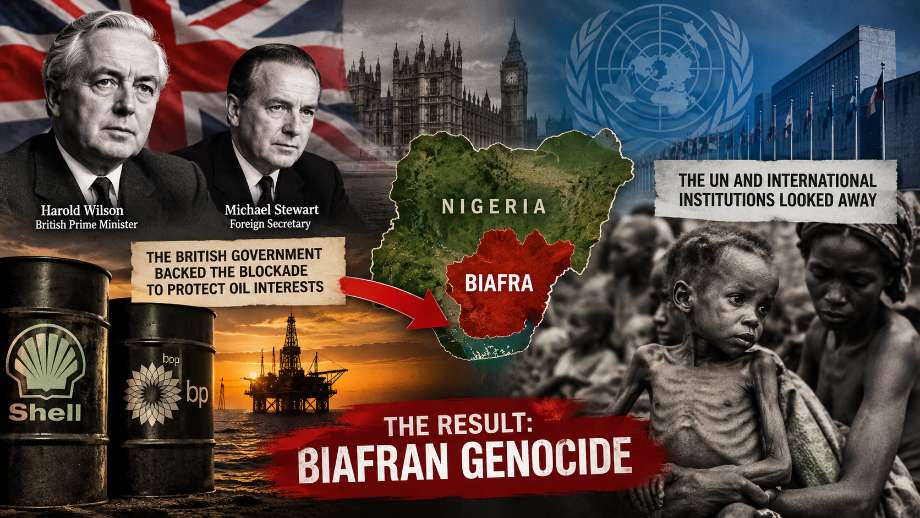 Click Image to Enlarge. Image created via AI.
BRITAIN AND THE ARCHITECTURE OF COMPLICITY:
One of the most significant and documented flaws in the international legal order: asymmetric justice, where powerful nations use geopolitical leverage and media dominance to insulate themselves from accountability. Historically, global powers have effectively exempted themselves from the consequences of international law, and the media has frequently played a role in minimizing or burying state-sponsored atrocities.
THE UN, COOPERATIVE SILENCE, AND THE NEED FOR AN OPEN INVESTIGATION INTO THE GENOCIDE IN BIAFRA
The passage of time does not dilute the gravity of state-sanctioned atrocity.
In a contemporary global landscape that rightly views targeted actions against children as the most severe of all international crimes, the structural destruction of a generation during the Nigerian Civil War (1967–1970) demands an immediate, unrestricted international tribunal. Declassified state papers strip away decades of diplomatic obfuscation to reveal a chilling reality: the starvation of over one million Biafran children was a calculated geopolitical outcome, overseen by British Prime Minister Harold Wilson and Foreign Secretary Michael Stewart, explicitly designed to preserve corporate oil monopolies.
Crucially, this catastrophe did not occur in a vacuum.
While the British state provided the physical and diplomatic machinery for this famine, international institutions—specifically the United Nations—and various established human rights apparatuses maintained a complicit silence. They were fully aware of the genocidal nature of the blockade but chose to prioritize institutional access and post-colonial geopolitical alignments over the lives of infants.
The Whitehall Directive: Subsidizing Famine for Sterling
The historical record demonstrates that the starvation within the blockaded Biafran enclave was not a tragic, accidental byproduct of war; it was an intentional counter-insurgency strategy funded by the British state. In August 1967, Commonwealth Minister George Thomas explicitly detailed the administration’s core motivation in a declassified memo: “The sole immediate British interest in Nigeria is… so we can regain access to important oil installations.” A joint venture between Shell and British Petroleum (BP), heavily tied to British state finances, controlled 84% of Nigeria’s oil production—two-thirds of which sat directly inside the blockaded Biafran territory.
To protect this investment from a secret French counter-maneuver to back Biafra for its own state oil interests (SAFRAP/Total), Foreign Secretary Michael Stewart championed the “quick kill” strategy. This policy involved accelerating the supply of millions of rounds of ammunition, heavy artillery, and armored personnel carriers to the Nigerian military to enforce the blockade. Stewart privately noted that a rapid military victory was the most effective means to secure the oil fields, deliberately accepting the systemic starvation of civilian populations as a necessary operational cost.
The UN’s Indifference and Humanitarian Bureaucracy
While images of skeletal children with advanced kwashiorkor saturated global media, the United Nations Security Council and its member states deliberately looked the other way. Declassified accounts confirm that UN leadership was fully briefed on the genocidal implications of the total land, sea, and air blockade.
Yet, the UN chose to shelter behind the diplomatic shield constructed by Britain and the United States. Adhering strictly to a rigid interpretation of “territorial integrity,” the UN treated the systematically engineered extermination of children as an internal policing matter, effectively validating starvation as a legitimate instrument of statecraft.
Simultaneously, a profound ethical compromise manifested within the broader humanitarian ecosystem. While relief agencies publicly launched fundraising campaigns utilizing the visceral imagery of starving Biafran children to solicit global donations, their leadership bodies possessed precise intelligence regarding the source of the famine. They knew that the starvation was actively sustained by British weapon shipments and protected by Whitehall’s diplomatic maneuvers. Instead of universally exposing the geopolitical state actors driving the genocide, many organizations institutionalized the crisis—treating the symptoms of a state-sponsored slaughter as a fundraising opportunity while carefully avoiding a direct confrontation with the Western powers funding the conflict.
The Mandate for an Independent Investigation
The argument that these actions are relegated to unalterable history is legally and morally bankrupt. While the International Criminal Court conveniently lacks retroactive jurisdiction for crimes committed prior to July 2002, the absolute prohibition against genocide and the weaponization of famine exists as a peremptory norm (jus cogens) under universal international law.
Under universal public international law, a peremptory norm (jus cogens) represents a fundamental, non-negotiable rule accepted by the global community from which absolutely no derogation or exception is permitted. If an act violates a jus cogens norm, no domestic law, sovereign immunity, or statute of limitations can legally erase the crime. [1, 2, 3] Holding Britain, Nigeria, and the United Nations accountable for the Biafran Genocide (1967–1970).
The scale of this atrocity demands an immediate, open parliamentary and international investigation tasked with:
Unrestricted Archival Disclosure: Forcing the complete, unredacted release of all remaining Foreign Office, Ministry of Defence, and intelligence logs concerning British military advisement to the Nigerian Air Force and blockade operations.
Corporate Auditing: Initiating an independent inquiry into the corporate records of Shell-BP during the 1967–1970 period to map the direct coordination between corporate executives and the Wilson administration in financing military advances.
Institutional Accountability: Investigating the deliberate inaction of the UN Security Council and its failure to trigger intervention mechanisms despite possessing clear evidence of mass civilian destruction.
The calculated starvation of over one million children for corporate balance sheets is the absolute antithesis of a rules-based international order.
True accountability cannot be achieved through passive historical reflection; it requires a formal, transparent investigation to expose the state and corporate actors who commodified the lives of a generation of children for oil.
By flooding the region with unregulated NGO money, humanitarian organizations inadvertently subsidized the secessionist state’s infrastructure. It is estimated that these fundraising-driven relief efforts prolonged the war by up to two years.By late 1968, these images migrated from evening news broadcasts into dedicated television and print fundraising campaigns across the United States and Europe. [1]
The Organizations:
Campaigns were aggressively pushed by organizations like the Joint Church Aid, the International Committee of the Red Cross (ICRC), and newly formed American coalitions like the Committee to Save the Children of Biafra (which operated out of Fifth Avenue in New York City). [1, 2, 3]
The Visual Template:
The television commercials utilized extreme close-ups of silent, naked infants with bloated bellies and stick-like limbs, often wreathed in flies, while a solemn American or British narrator pleaded for immediate financial donations to “save a dying child”. [1, 2]
The Psychological Hook:
This campaign transformed the word “Biafra” from a geographical location into a global synonym for a starving child. It successfully commercialized Western guilt, prompting major public figures—ranging from Joan Baez to John Lennon—to donate or use their platforms to drive the financial windfall. [1, 2, 3]
As documented by humanitarian researcher Hugo Slim (University of Oxford/former ICRC head of policy), the international aid sector quickly realized that portraying children with distended bellies was a profound form of visual manipulation. They knew it stripped the children of their human dignity and reduced an entire population to helpless props, but it was an industry “scam” that brought in millions of dollars, so the template was institutionalized.[1]
The Cover-Up of British Complicity:
By framing the crisis on television as a generic, apolitical tragedy requiring loose change from Americans, the advertisements actively shielded the true perpetrators. The commercials never informed viewers that the British government was actively shipping the heavy weaponry necessary to sustain the very blockade causing the distended stomachs in the first place.
The Biafra campaigns proved to the global elite that shocking images of dying children could generate massive financial capital while keeping the public entirely blind to the corporate resource extraction driving the genocide. [1]
Comparative Overview of Child Atrocities
To provide a scannable historical perspective on how different genocides and state-enforced mass killings impacted child populations by scale and speed:
| Event / Regime | Estimated Child Fatalities | Primary Timeframe | Principal Mechanism of Child Death |
| The Holocaust (Nazi Germany) | ~1,500,000 | 1941–1945 (4 Years) | Systematic gassing, mass shootings, and institutional execution. |
| Biafra (Nigerian Civil War) | 1,000,000 – 2,000,000 | 1967–1970 (3 Years) | Deliberate military blockade leading to mass starvation (Kwashiorkor). |
| Democratic Kampuchea(Khmer Rouge) | Hundreds of thousands (Exact numbers undefined) | 1975–1979 (4 Years) | Forced labor, starvation, and execution of entire families to prevent “revenge.” |
| Rwandan Genocide | ~300,000 | 1994 (100 Days) | High-velocity machete slaughters and localized community massacres. |
Historically, the worst atrocities against children :
International bodies like the United Nations historically refused to intervene until the demographic damage was already absolute. [1, 2]
The International Court of Justice (ICJ) and the UN International Law Commission explicitly recognize the prohibition of genocide as an absolute jus cogens norm. Because this status existed well before 1967 (codified in the 1948 Genocide Convention), the legal obligation to prevent and punish genocide applied to all state actors during the Biafran War. [1, 2, 3]
Triggering the Genocide Convention via the ICJ:
Because the obligation to prevent genocide is erga omnes(owed to the international community as a whole), any current country that is a signatory to the 1948 Convention has the legal standing to sue Nigeria or the UK in the International Court of Justice. This mechanism mirrors how The Gambia sued Myanmar over the Rohingya crisis.


Leave a Reply
You must be logged in to post a comment.