
Peloni: What goes unmentioned in this article is the poignant silence which awkwardly followed Trump’s proposal for the Sunni nations to join the Abraham Accords on the phone call discussed below. That pregnant pause demonstrated the taboo nature of Trump’s proposal, and notably, Trump’s own lack of clarity on what might make peace in the region possible. Frozen lines of battle between Israel and its warring enemies in Gaza, Lebanon, Yemen and Iran do not support the potential of widening of peace between Israel and its neighbors, but instead it makes such peace arrangements impossible to navigate for the Sunni nations. Notably, in Trump’s Riyadh speech of 2017, Trump called for the Sunni nations to “drive out” the very radicals from their nations and the region which are being left in place in Iran and its regional holdings due to Trump’s current preference of adopting frozen wars rather than seeing them thru to victory. Furthermore, seeking such victory over the Iranian Islamists and their subsidiaries would be the only means by which to extricate these radicals from power in their strongholds of terror in these nations. Failing to secure such a victory does not make peace more possible for the Sunni nations, because the preservation of radicalism in the region at large only serves to strengthen the radicals on the streets of the very nations Trump is mandating to join the Abraham Accords. Stated differently, by refusing to do what is needed to demonstrate the intolerance for radicalism in Iran and its Proxy states only serves to weaken the resolve of the Sunnis to stand firm against the radicals in their own nations, and that does not support the development of peace with Israel.
Even if we were to ignore the radical nature on which nations such as Turkey and Qatar are based, which Trump does seem to consistently ignore, forcing even the moderate Sunni states to join the Abraham Accords would not support the notion of peace in the region, but would more likely destabilize the govts of the nations who would concede to do so under the current political environment. While Trump seems oblivious to this fact, the relative Sunni leaders are clearly well aware of it. Indeed, their grasping this reality is what brought about the pregnant pause which followed Trump’s suggestion that “it should be mandatory that all of these Countries, at a minimum, simultaneously [should] sign onto the Abraham Accords.” I would argue that the silence which met Trump’s call for peace in the region states pretty clearly that the consequence of failing to drive out the radicals in the region does not support the development of peace in the region, but rather, it makes it impossible.
This is also why nations with radical leadership such as Turkey and Qatar have been consistently maneuvering Trump to keep the rump of the IRGC in power in Iran, because doing so serves the purposes of the Muslim Brotherhood adherents, Erdogan and al-Thani, which is contrary to the development of peace in the region. Trump seemed to understand this in 2017 when he called for such Islamists to be driven out. The principles espoused by Trump in 2017 that could bring peace to the region, but this is not the policy being secured by maintaining Hamas, Hezbollah, Houthis and the IRGC in power. Even as they are weakened, their survival is what gives them strength, raises their regional credibility, and makes peace in the region impossible.
US president uses social media to make formal request of countries to sign historic agreement
| Published: May 25, 2026
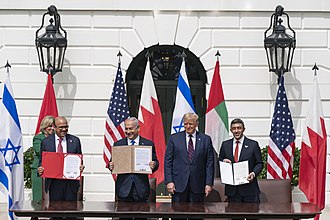 President Donald J. Trump, Minister of Foreign Affairs of Bahrain Dr. Abdullatif bin Rashid Al-Zayani, Israeli Prime Minister Benjamin Netanyahu and Minister of Foreign Affairs for the United Arab Emirates Abdullah bin Zayed Al Nahyan signs the Abraham Accords Tuesday, Sept. 15, 2020, on the South Lawn of the White House. Photo by The White House from Washington, DC – President Trump and The First Lady Participate in an Abraham Accords Signing Ceremony, Public Domain, Wikipedia
U.S. President Donald Trump told leaders of Arab and Muslim states that, following a peace deal with Iran, he would like their countries to join the Abraham Accords.
The news was first shared by Axios, and was later confirmed by Trump in a post on Truth Social.
President Trump wrote that negotiations with Iran “are proceeding nicely.” He also renewed threats of possible military action, writing, “It will only be a Great Deal for all or, no Deal at all – Back to the Battlefront and shooting, but bigger and stronger than ever before – And nobody wants that!”
During his phone call with the leaders of Saudi Arabia, the United Arab Emirates, Bahrain, Qatar, Pakistan, Egypt, Jordan, and Turkey, Trump said he believes that those countries should join the Abraham Accords.
“After all the work done by the United States to try and pull this very complex puzzle together, it should be mandatory that all of these Countries, at a minimum, simultaneously sign onto the Abraham Accords,” he wrote.
President Trump said that the countries that have joined the Abraham Accords, the UAE, Bahrain, Morocco, Sudan, and Kazakhstan, have seen “a Financial, Economic, and Social BOOM, even during this time of Conflict and War.”
He even expressed his hope that the Islamic Republic of Iran would eventually sign the Abraham Accords.
The president wrote that he considers his Truth Social post to be a formal invitation for the listed countries “to begin, and successfully complete, the process of signing these Countries into the already Historic Abraham Accords.”
Trump’s social media post was shared by former Israeli government spokesman Eylon Levy, who wrote, “If President Trump can get Qatar and Pakistan to sign the Abraham Accords, he shouldn’t get a Nobel Prize – the prize should be renamed after him.”
If President Trump can get Qatar and Pakistan to sign the Abraham Accords, he shouldn’t get a Nobel Prize—the prize should be renamed after him. pic.twitter.com/UXvFmqMM5r
— Eylon Levy (@EylonALevy) May 25, 2026
However, Eyal Ofer, an Israeli writer and open-source intelligence analyst, argued that America’s failure to stand by its Gulf allies – especially after the ceasefire was declared and Iran continued launching attacks against the UAE, Kuwait, and Saudi Arabia – could lead to the formation of a “Shia-Sunni alliance,” which he referred to as “The Muhammad Accords.
Ofer noted that, more than most Gulf states, the UAE’s economy is based on “being a business hub for Western companies” rather than oil. He argued that the Iranian regime recognized the UAE’s alignment with the West, including Israel, and launched more ballistic missiles and drone attacks against it than against any other country, including Israel.
**Instead of the Abraham Accords: The Muhammad Accords**
One small detail in the lost details of the 2.0 Iran nuclear deal carries far deeper significance: the United Arab Emirates has joined the Saudi-Pakistani axis — which is now also Iranian. For the first time, a Shia-Sunni…
— Eyal Ofer ???? ???? (@Eyalo365) May 24, 2026
The Iranian regime reportedly targeted UAE power stations and oil facilities, even after Trump backed away from threats to strike similar facilities in Iran. When the same UAE facilities were reportedly hit again following the ceasefire, Trump did not publicly characterize the attacks as ceasefire violations. Critics argued this signaled to the UAE that the United States would not intervene directly on behalf of its partner, despite the UAE reportedly participating in several strikes against Iran during the conflict and risking further retaliation as a result.
Ofer expressed concern that if Trump’s peace plan does not place limits on Iran’s military capabilities, Tehran could rebuild its armed forces and eventually align with a broader Shia-Sunni axis involving Turkey, Pakistan, Egypt, and Saudi Arabia – which he warned would “make life in the State of Israel extremely difficult.”


Leave a Reply
You must be logged in to post a comment.