
Ambassador (ret.) Yoram Ettinger | “Second Thought: a US-Israel Initiative” | July 8, 2026
inFOCUS Magazine, Summer 2026
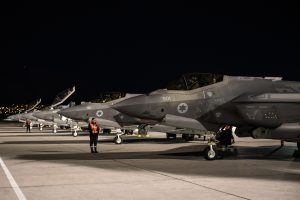 Israeli Air Force members wait for F-35I Adirs to launch for a Red Flag-Nellis 23-2 mission at Nellis Air Force Base, Nevada, March 16, 2023. Photo by Airman 1st Class Trevor Bell – Dvidshub.net, Public Domain, Wikipedia
In the arena of US alliances, no relationship delivers the outsized return for the American taxpayer as does the US-Israel partnership.
Conventional wisdom often frames the annual $3.8BN US credit to Israel (spent on the acquisition of military systems only in the US) as “foreign aid” – a one-way handout, supposedly at the expense of American taxpayers. Formally, it is “foreign aid.” However, due-diligence reveals that this is not aid, but a low/no-risk, high-return investment for the US.
Since 1967, Israel has functioned as Washington’s premier dollar and defense multiplier, the most effective battle-tested laboratory, the most sophisticated commercial and defense research and development center (for over 250 US high tech giants, in addition to the US defense and aerospace industries), a unique source of intelligence for the US, and a geopolitical force-amplifier with no American military bases on its soil.
The Mutually Beneficial Two-Way-Street
In fact, US-Israel cooperation has been mutually beneficial, generating an annual Return-on-Investment (R-o-I) of well over 1,000% on Washington’s “foreign aid” to Israel. This has yielded the US billions of dollars in research and development savings, bolstered economic output and export, expanded employment, increased tax revenues, boosted technological edge, and enhanced US national and homeland security. No other ally can deliver such benefits.
At the heart of this multiplier effect lies Israel’s role as a real-time, combat-proven showroom and innovation hub for the US defense and aerospace industries. For example, in 2018, Israel was the first country to receive the F-35 combat aircraft for operational use. At that time, leading US experts considered it a failed program.
However, by 2019, the combat-experienced Israeli Air Force, together with Lockheed-Martin, had solved most/all of the software/technical and hardware/mechanical glitches. This transformed the F-35 into the flagship of the US Air Force’s future fighter fleet and the premier program of the US aerospace industry. The Israeli experience and resulting upgrades have been shared on a daily basis with the US manufacturer, saving 10-20 years of research and development, which amounts to tens of billions of dollars (the F-35’s total development cost amounts to $55BN).
These battle-tested refinements have dramatically enhanced the aircraft’s reliability, maintainability, electronic warfare capabilities, weapons integration, and survivability. As a result, since 2019, the uniquely intense use of the F-35 by the Israeli “showroom” has yielded a surge in global demand. Since 2019, more than 1,200 F-35s have been exported to US allies, including Britain, Canada, Australia, Japan, South Korea, Germany, Italy, and others. By late 2025, Lockheed-Martin reported a staggering $173BN–179BN backlog as well and a $72BN in annual US economic output, including $40BN in exports.
Currently, the F-35 project supports 290,000 jobs (a 35% expansion since 2019). It contributes about $3BN in annual corporate and personal income tax revenues to the US Treasury. This almost completely offsets the $3.8BN annual investment in Israel from this single platform alone.
This role of Israel as a unique dollar and defense multiplier for the US applies to dozens of advanced US military systems, enhancing the fortunes of US defense and aerospace industries, which employ 2.5 million people. For instance, Boeing’s Apache attack helicopter and Lockheed-Martin’s Black Hawk utility helicopter have benefitted from Israel’s intense operational tempo since the 1990s. Israel’s combat use has resulted in upgraded avionics, survivability features (including advanced missile warning, electronic warfare, and countermeasures), and combat networking for the helicopters.
These improvements, validated in real-world conditions rather than simulations, have slashed research and development timelines and costs. For the Apache the figure is $16BN; for the Black Hawk $21BN in today’s dollars.
Moreover, Israel’s track record has propelled American exports, such as recent Apache deals with Poland, South Korea, Britain, and others, in excess of $20BN. Black Hawk sales to Greece, Australia, Sweden, Brazil, and others totalled $8BN–10BN for 2023–2026 alone. Similar dividends flow from the upgrading of the F-16 and F-15 combat aircraft, as well as US-made precision munitions, drones, air defenses, etc..
Israel-Driven US Innovations
Beyond hardware, Israel serves as the US Armed Forces’ premier innovation center for battle tactics and training. Israeli operational lessons—drawn from thousands of hours in high-intensity, do-or-die environments—have reshaped US doctrines in air-to-air combat, radar suppression, urban warfare, counter-IED (Improvised Explosive Devices) operations, special forces raids, and hostage rescue. In addition, some US Special Operation battalions on their way to Iraq and other countries spend a few weeks in Israel, trained by Israeli experts in facing car bombs, suicide bombers and the deadly IEDs. US urban warfare units have adopted a training program, based on the Israeli daily experience in facing Islamic terrorism in Lebanon, Syria, Judea, Samaria and Gaza. Furthermore, the 1976 Jonathan (Entebbe) Operation directly inspired US counter-terrorism, in general, and the creation of Delta Force, in particular. The 1982 Israeli “Operation Mole Cricket 19” destroyed 20 advanced Soviet surface-to-air missile batteries (which were perceived by the US to be impregnable) and downed 82 Syrian (Soviet) MiGs without Israeli losses, remains a cornerstone of US Air Force training programs and battle tactics.
More recently, Israel’s systematic sharing of maintenance, repair, and performance data on the performance of the F-35, F-16, F-15 in the war against Iran has provided the Pentagon with priceless insights on the vulnerabilities of Chinese and Russian air defenses, aircraft and ballistic missiles, which are deployed throughout the globe. These insights have impacted the global balance of power, by eroding China’s and Russia’s posture of deterrence, while bolstering the US own deterrence. No other ally provides the US with such intensive, high-quality volume of national and homeland security support.
Intelligence Cooperation
Intelligence cooperation delivers a most staggering R-o-I due to Israel’s demography, which includes many people, who could easily blend into every Muslim country, as well as Israel’s daring, innovative, can-do, defiance of odds and out-of-the-box state-of-mind. Former US Air Force Intelligence Chief, General George Keegan, stated in an interview with the New York Times that if the US were to procure on its own the scope of intelligence provided by Israel, then the US would have to establish “5 CIAs.” The annual budget of one CIA is around $15BN, which amounts to a 400% annual R-o-I on the $3.8BN investment, and probably twice or three-to-five times as much. Senator Daniel Inouye, who served as the Chairman of the Senate Intelligence Committee, assessed that Israel shares with the US more critical intelligence on enemy and rival military systems and counterterrorism than all NATO countries combined.
For example, in 2017, Israeli human and signal intelligence exposed a Syrian ISIS unit, which developed the means to insert explosives into laptops, bypassing US civic airport security. Upon receiving the information from Israel, the US upgraded its airport security systems, which spared the US a catastrophic loss of human lives, severe cost to US airliners, and a grave blow to public morale and the US’ global posture of deterrence. Israeli tracking aided the elimination of chief Shiite and Sunni Islamic terrorists. Moreover, Israel has delivered to the US Soviet-era advanced military hardware, such as the MiG-21 and MiG-23, the T-72 tank, the SA-6 missile, the P-12 radar, etc. These were leveraged for reverse-engineering, radar-jamming techniques, and battle-tactic refinements that tilted the Cold War balance of power. Recent Israeli contributions include detailed profiles of Iranian drones, North Korean ballistic missiles, and Hezbollah networks in the Middle East, Africa, Latin America and on US soil. This directly enhances US homeland security, the safety of US installations in the Middle East and worldwide, and the stability of all pro-US Latin American and Arab regimes.
Israel’s Strategic Value for the US
Strategically, Israel functions as the largest US military beachhead with no US boots on the ground. This is equivalent to a fleet of unsinkable aircraft carriers and multiple ground divisions in the Mediterranean-Red Sea-Indian Ocean-Persian Gulf theater. During the 1970s and the 1980s, Admiral Elmo Zumwalt, who served as Chief of Naval Operations and General Alexander Haig, who served as NATO Supreme Commander and US Secretary of State, contended that the Israeli track record and potential replaces the need to manufacture and deploy to the Indian Ocean and the Mediterranean a few more aircraft carriers and deploy additional ground divisions to the Middle East. The manufacturing cost of one advanced aircraft carrier is $10-$13 billion (more than 300 percent R-o-I), and the cost of deploying one ground division to the Middle East is $1 billion.
This region serves as the platform of 48% of global oil reserves, the intersection of critical shipping lanes between the Far East and the West, and the epicenter of anti-US Islamic terrorism. Israel’s deterrent posture has minimized the instability of pro-US Arab regimes (especially Jordan), facilitated six Israel-Arab peace treaties and constrained the maneuverability of Russia, China and anti-US Sunni and Shiite Islamic terrorism. Contrast this with the $35BN annual cost of US military bases in West Europe, in addition to 80,000 US servicemen stationed there….
Historical Precedents
Since 1967, Israel has been a leading national security-multiplier for the US as demonstrated by the following examples:
Israel’s 1967 victory aborted Soviet-backed Egyptian military/terror offensive to assume pan-Arab leadership, while toppling all pro-US Arab oil producing regimes. That would have dealt the United States a historic economic and national security setback, while boosting the global strategic stature of the USSR.
In 1970, pro-Soviet Syria invaded Jordan, aiming to topple the pro-US Hashemite regime, and trigger ripple effects, toppling the pro-US Arab Gulf regimes. This was averted by Israel’s deployment of military forces to the Golan Heights (the tri-border area of Israel-Syria-Jordan) at a time when the US was bogged down in Southeast Asia. The 1973 Yom Kippur War Israeli victory convinced Egypt to realign itself from pro-Soviet to pro-US.
The 1981 Israeli destruction of Iraq’s nuclear reactor snatched all pro-US Arab oil producers from the jaws of the pro-Soviet Saddam Hussein, and spared the US a potential nuclear confrontation during the 1991 First Gulf War. Israel’s 2007 destruction of Syria’s nuclear reactor averted the first ever nuclearized civil war (in Syria).
The 2024 Israeli offensives against Hezbollah sparked the toppling of Syria’s Assad regime. That in turn opened the door for the US to replace Russia as Syria’s major influencer. The June 2025 Israeli air offensive against Iran’s Ayatollah regime, devastated Iran’s air defenses and air force, enabling the US air force to bomb the three leading Iranian nuclear sites unimpeded. This exposed the vulnerabilities of Chinese and Russian air defenses, which has tilted global balance of power in favor of the US.
Israel’s Reliability
Israel presents zero “zig-zag” risk unlike other allies of the US, like regimes in Iran, Libya, Egypt, Iraq, and Yemen, which have flipped from pro-US to anti-US overnight due to coups, revolutions, or ideological shifts. Qatar hosts the massive Al Udeid US military base, but it bankrolls Hamas and the Muslim Brotherhood anti-US Sunni terrorists, while on-again off-again cozying up to the anti-US Ayatollah regime. European allies’ support of US action is often conditioned upon domestic politics or multilateral approval, earning the quip “NATO = No Action Talk Only.” Realistically, West Europe is not willing to flex a muscle against Islamic terrorism and additional threats, if – given shrunken military establishments – there is a substantial muscle left… Israel, by contrast, maintains a rock-solid, cross-spectrum pro-US domestic consensus (Left and Right, secular and religious, hawks and doves). It does not wish US bases on its soil; almost-fully-funds and fully mans its own military forces, and acts proactively against mutual threats. Since joining CENTCOM (the US military Central Command, overseeing the Middle East) in 2021, operational integration has surged dramatically, enhancing CENTCOM’s preparedness and battle tactics.
Israel’s multiplier-effect extends beyond defense into commercial high-tech. More than 250 US giants, such as Google, Intel, Nvidia, Microsoft, Apple, John Deere, Johnson & Johnson, General Electric maintain R&D centers in Israel, leveraging its brainpower, defiance-of-odds culture, and frontier mentality to pioneer dual-use breakthroughs in AI, cyber, communications, medicine, agriculture, irrigation and financial technology. These innovations sustain US global technological supremacy, boost US exports, and create high-value jobs in the US.
The Bottom Line
*Israel is to the US what Michael Jordan was to Nike – a transformative global ambassador and performance enhancer – but on a vastly larger, strategic scale. It is a self-funded, battle-hardened, democratic partner whose contributions to the US economy, national and homeland security, and power projection dwarf the annual investment of $3.8BN.
*The $3.8BN investment is erroneously defined as foreign aid. In fact, the US supplies Israel with US-made advanced military systems, which are stress-tested, upgraded, and showcased globally by the Israeli battle-tested laboratory, generating an annual Return-on-Investment (R-o-I) of more than a 1,000%. This outsized R-o-I is generated through research and development saving, export increase, employment expansion, corporate and personal income tax revenues, intelligence windfalls, and reduced US military footprints. Israel is not a passive recipient of US military hardware, but an active co-developer and multiplier of its value.
*In an era of peer competition and persistent threats, the US-Israel mutually-beneficial two-way-street remains indispensable. Policymakers and citizens alike would do well to recognize Israel as one of the US’ most astute investments. It delivers to the American people unmatched financial and defense returns that secure freedom, prosperity, and deterrence for generations to come.
*In a world of costly uncertainty, a compact, capable ally that translates battlefield lessons into market-ready solutions is not merely valuable — it is indispensable.


Leave a Reply
You must be logged in to post a comment.