
Peloni: Prof. Eyal Zisser is quite correct. Israel has been forced to accept a serious restriction of its freedom of action in Lebanon while leaving the IDF exposed and vulnerable to FDV drone attacks, to which it can only respond while not moving northwards. This advantage of holding the IDF hostage to US demands give Hezbollah a significant boon which it lacked prior to this untenable ceasefire. Where things stand today is intolerable state of appeasement to Iran, and the forced pretense of the fake ‘peace’ negotiation with Lebanon is ruse which has born fruit for Iran and its proxy while bearing no potential benefit for either Israel or Lebanon.
The latest round of fighting ended with dangerous concessions: Iran proved that it decides when the fire stops, the IDF lost its freedom of action in Beirut, and we were drawn into a limited guerrilla war in the buffer zone. While Israel clings to illusions that the Lebanese government will dismantle the terrorist organization, it is time to wake up and prepare for a real victory in the next round.
Prof. Eyal Zisser | May 4, 2026
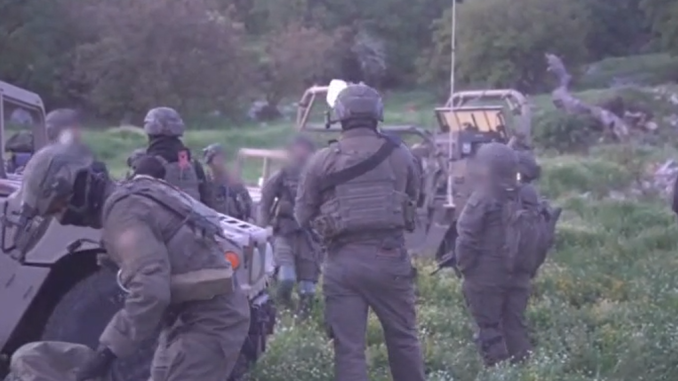 IDF forces in Lebanon. Screengrab via X
Unfortunately, the latest round of confrontation between Israel and Hezbollah, which began after the terrorist organization rallied to Iran’s side in its war against the US and Israel, ended with three important achievements that we handed, with our own two hands, to Hezbollah and to Iran, which stands behind it.
The first: It was Iran that forced President Donald Trump to impose a ceasefire on us in Lebanon before the job was done. In doing so, it established its status not only as Hezbollah’s patron, but also as the party in whose hands, not Israel’s or the Lebanese government’s, lies the decision on when to open a war in Lebanon and when to end it.
The second: The ceasefire did not return us to the reality of the past year, in which the Israel Defense Forces enjoyed broad freedom of action in Lebanon. On the contrary, Israel is now restricted to operating only in southern Lebanon and is barred from acting north of it, for example in Dahiyeh in Beirut, where Hezbollah’s leaders and commanders sit and from where the campaign against us is run.
Finally: Israel played into Hezbollah’s hands when it agreed to a reality of limited conflict between us and the organization in the buffer zone we established in southern Lebanon. This allows Hezbollah to wage guerrilla warfare against us, while the IDF limits itself to trying to thwart terrorist cells launching explosive drones at our soldiers, but refrains from attacking the commanders and headquarters in Beirut from which the orders to attack us were issued, or where the terrorist cells are trained and equipped. It is clear that such a war of attrition, in which our forces suffer casualties almost every day, plays into Hezbollah’s hands, not ours.
All this is taking place against the backdrop of growing US pressure to hold fire in Lebanon, which would give Hezbollah breathing space and time to rehabilitate itself and prepare for the next round.
The false picture from Lebanon
It turns out that in the US, but also in Israel, there are those who are indulging in illusions that the ceasefire, and perhaps even an IDF withdrawal from southern Lebanon, will allow the Lebanese government to act to disarm Hezbollah. The Israeli media pounces on every statement heard from Lebanon against Hezbollah and creates a false impression that Lebanon is about to act against the organization.
But anyone who knows Lebanon and follows the Lebanese media understands that no one in Lebanon has any intention or desire, nor the ability, to act against Hezbollah. Rather, everyone hopes things will somehow work themselves out. This is despite the fact that Hezbollah repeatedly stresses that it will not give up its weapons, nor abandon the principle of the struggle against Israel.
But what is done is done, and it is important to focus on the future, even though doing so requires a deep examination of the reasons for our missed opportunity during the latest round of confrontation with the organization. That is necessary so that in the next round, which is only a matter of time, we will know how to defeat Hezbollah and restore quiet and security to the communities of the north.
Contrary to the working assumption on which our activity in Lebanon is based, Hezbollah can and must be defeated, not only in boastful declarations that have nothing to do with reality, but also in practice on the ground. True, it is impossible to reach every last Hezbollah terrorist and every last missile in the organization’s possession, but it is possible to hit it hard, something we have not done to date.
First: We must strike not only the organization’s military power, but also its organizational, political, social and economic envelope. Second: In its areas of activity, we must also target the infrastructure of the Lebanese state that surrounds it, shields it and, in practice, enables its activity.
Finally: Extracting a price from Hezbollah by pushing it and its supporters northward has proved itself. After all, this is not the security zone of the previous century, but a new kind of security zone, one that has stirred panic within the organization and among its supporters. The problem is that Israel settled for a zone that is the bare minimum of the bare minimum, and that does not provide protection and security for the communities of the north.
Hezbollah’s willpower can and must be broken. If we do not do so, we will reach the next round against it, which is inevitable, from a position of inferiority, facing an enemy that we ourselves are allowing to recover and build itself up for the next confrontation with us.


Professor Zisser is promoting the faiytales of the media. Hezbollah is the government of Lebanon and any suggestion that Hezbollah will disband itself is based on those fairytales.
As far as Israel is concerned, the US must be holding a mighty hammer over our heads to get us to postpone any retaliation indefinitely.
The title of this article is very misleading and tells the reader that it is in Israel’s hands to accept or decline the imposed cease fire. As just mentioned, the hammer must be mighty.
So what, in your opinion, would happen with respect to the US, if Israel now took matters into its own capable hands?
@Keelie: I just finished watching the video on this site about the China – Iran Bridge. While some aspects of this situation have not been mentioned, the video describes that China is trying to work around the oil supply discrepancy they are now experiencing without success so far. This is likely the reason why Israel is currently inactive.
If China were to decide to retaliate one way or the other, we could have any imaginable situation on our hands from the capture of Taiwan to the capture of Australia to bombing US cities. As far as China is concerned, Israel is a minor irritation – so far. They may allow themselves to be sucked in by the Iranians…
I think the message of the day is to widen the scope of your observations and review more of the world-wide situation. Right now, even Russia is keeping a low profile and confining themselves to activities in Ukraine. The Europeans are blasting hot air but nothing else so far. Macron and Merz may decide that the time is ripe to show that they can influence the rest of the world too. The UK is sitting on their hands, but of course we know that they can’t do much else anymore.