
Peloni: As you read this, consider the relevant context which Hassan’s story holds for those Muslim leaders who are now faced with the dilemma of accepting Trump’s demands of joining the Abraham Accords or having to face the consequences of being left outside of any influence on the coming new world order. A society built upon 1400 years of rigid training to subjugate, slaughter and conquer the infidel is being required by the infidels to itself submit infidel demands of change, moderation and modernization. Is this doable? Some societies are already moving towards this outcome, but the pace of change has been tepid and cautious, and even now such things are never referenced in the same conversation as peace with Israel. More on this later.
By Jalal Tagreeb
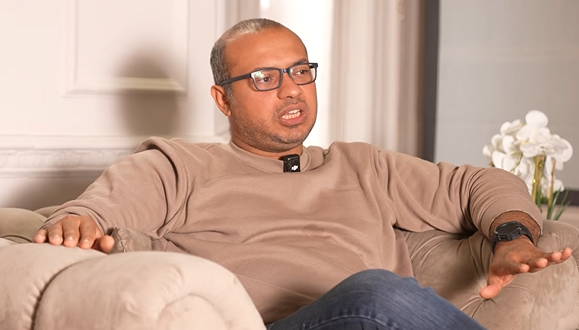 Khaled Hassan. Screengrab via Youtube.
There is a particular kind of testimony that cuts through the noise of geopolitical debate — not the testimony of politicians or diplomats, but of those who were raised inside a culture of hatred and chose, at personal cost, to walk away from it. Khaled Hassan is one such person. Born in Cairo in 1990, raised in what he describes as a thoroughly ordinary, middle-class Egyptian family, and educated at an American school, Hassan has emerged as a lucid and courageous voice warning the West about the ideological forces arrayed against it — and against Israel in particular.
A recent video interview with Hassan, is essential viewing for anyone who wants to understand the roots of anti-Israel sentiment, not as a political abstraction, but as a deeply embedded cultural reality transmitted from parent to child across the Muslim world. What Hassan describes is not the radicalization of a fringe. It is the radicalization of the mainstream — and that distinction matters enormously for those who care about Israel’s survival and legitimacy.
The Banality of Jew-Hatred
One of the most strong — and disturbing — revelations in Hassan’s account is how casually, how unremarkably, Jew-hatred was transmitted in his upbringing. His father was not a militant. He did not attend a mosque regularly. He was a teacher of German, a man of some education. And yet he was, by Hassan’s description, an admirer of Adolf Hitler. The reason? Simple and chilling: Hitler killed Jews.
Hassan recalls asking his father as a child about a Volkswagen key ring the man kept. The answer he received was matter-of-fact — it was Hitler’s car company, and his father liked Hitler because he killed Jews and because the engineering was reliable. There was no ideology lecture, no theological justification. It was delivered with the same casual register one might use to explain a preference in football teams. That is the point. The elimination of Jews was not, in Hassan’s household or in his broader social world, a controversial opinion. It was the water in which everyone swam.
“I don’t even recall anyone saying the Nazis were bad,” Hassan tells his interviewer. Growing up, he himself drew swastikas — not out of malice but out of cultural absorption, the way children absorb whatever surrounds them. This is not the story of a household in the grip of extremism. This is the story of normalcy in a society where antisemitism is the default setting.
For those who follow the conflict over Israel’s existence, this matters enormously. The claim that the Arab world’s hostility to Israel is essentially a political dispute — a reaction to settlements, to borders, to this or that military operation — is simply not supported by what men like Khaled Hassan describe. The hatred pre-dates the policies. It is theological, cultural, and generational. Israel could withdraw to the 1948 partition lines tomorrow and the children being raised on these values would still be taught that Jews are enemies deserving of death.
Moderate Islam Is Not Moderate on Jews
Hassan is careful to address a popular misconception head-on. Many in the West comfort themselves with the distinction between “radical” and “moderate” Islam, assuming that Muslims who do not pray regularly, who listen to music, who attend mixed-gender schools, must also be free of antisemitic ideology. Hassan dismantles this assumption with the authority of personal experience.
His parents were not devout. They did not pray. They watched television, went on holidays, and lived in many ways like secular people. Yet the antisemitism was there, as present as the furniture. “Antisemitism was still the norm,” he says flatly. The American school he attended — with its mixed classrooms and English-language curriculum — did not insulate him from it either. There was still a religion class. The Quran was still taught. The hadiths describing a final battle in which trees would call out the hiding places of Jews so they could be killed — this was part of the curriculum even in an institution designed to give Egyptian children access to Western opportunity.
This is a point that deserves more attention in Western policy circles than it receives. The distinction between “radical” and “moderate” Islam, as it is typically drawn in European and American discourse, maps onto observable practice — does a person pray five times a day? Does a woman wear the niqab? — rather than onto the content of beliefs. What Hassan reveals is that the relevant beliefs, including lethal antisemitism and the theological mandate for the eventual elimination of Jews, are transmitted even in homes and schools that appear, by Western standards, to be moderate. The observable markers of religiosity are simply not reliable proxies for the presence or absence of this specific ideology.
The “Muslim Vote” and the War Against Israel in the West
Hassan’s account does not stay in Cairo. It follows the ideology westward, into the streets and council chambers of Britain, and by extension into the broader landscape of Western democracies. What he describes in the United Kingdom is a political project, partly intentional and partly emergent, that threatens not only Jewish communities but the liberal democratic fabric itself.
He describes the “Muslim Vote” campaign in the UK — an organized effort to mobilize Muslim voters around explicitly anti-Israel positions — as a form of what he calls “intellectual jihad.” The concept of jihad, he explains, is not confined in Islamic theology to armed struggle. It encompasses the struggle of the word, the pen, the political campaign. When Western commentators dismiss the term as relevant only to terrorism, they miss the broader project that Hassan identifies clearly: the deliberate use of democratic mechanisms to advance an agenda that is, at its core, hostile to Israel’s existence and to the values of the societies hosting these communities.
The alliance between the political left and Islamist-aligned political movements in Britain is, in Hassan’s analysis, not a misunderstanding or a case of the left being naive. At the leadership level, it is a transactional arrangement: politicians signal hostility to Israel, and Muslim bloc votes follow. The left, he argues, has chosen not to confront Muslim antisemitism — which polling data consistently shows is far more prevalent among British Muslims than among the general population — because doing so would cost them votes. Instead, they amplify warnings about “far-right” antisemitism while remaining silent about the more statistically significant threat emanating from within communities they depend upon electorally.
This dynamic has direct consequences for Jewish life in Britain and across Europe. Jewish communities find themselves trapped in a political landscape where one major party flirted openly with antisemitism at the leadership level, and the other has formed alliances with political forces animated by precisely the ideology Hassan describes growing up with in Egypt. Israel, in this environment, is not merely a foreign policy question — it is a symbol around which a broad coalition of anti-Western, anti-liberal forces has organized itself.
The Suppression of Reform
One of the most sobering sections of Hassan’s interview concerns the structural impossibility of reform within Islam as currently constituted. He contrasts Judaism and Christianity — both of which have traditions of internal criticism, of questioning whether ancient texts remain valid in modern contexts, of reforming practice in light of changed circumstances — with Islam, which he describes as built on three interlocking pillars that make such reform nearly impossible.
The first is submission: the very meaning of the word “Islam.” The prophet’s actions and the Quran’s content are, within orthodox Islamic theology, beyond question. The second is perpetual validity: the belief that Quranic injunctions are not time-bound but eternally applicable. The third is cultural enforcement: the reality that in most Muslim-majority societies, those who question these premises face not debate but violence.
“Anyone who wants serious reform is basically going to end up paying for it in blood,” Hassan says. This is not hyperbole. He points to the case of a man who burned a Quran in Sweden as part of an asylum claim — whatever one thinks of the act — who was subsequently shot dead in his home by two individuals who then fled to Syria, with the Swedish authorities apparently accepting this outcome with remarkable passivity. The lesson drawn by would-be reformers is obvious.
Why does this matter for Israel? Because it forecloses the most optimistic scenario available to those who believe that peace is achievable through Palestinian moderation and Islamic reform. If the theology that drives eliminationist antisemitism cannot be questioned without mortal risk to the questioner, then the realistic timeframe for ideological change is not years or decades but generations — and perhaps never, without a fundamental political transformation in the societies that enforce these norms. Israel, meanwhile, must exist in the present, surrounded by populations among which these beliefs are, as Hassan testifies, essentially universal.
The Courage to Name What Others Will Not
What makes Khaled Hassan’s testimony especially valuable is not merely its content but its context. He is not an Israeli speaking about Arab culture. He is not a conservative Western pundit speculating about societies he has never lived in. He is an Egyptian-born man who absorbed the ideology he critiques, who lived inside it, and who chose at significant personal and social cost to reject it and speak publicly about what he saw.
He is aware of what this costs him. He understands that by speaking in the terms he uses — naming antisemitism as normative rather than extreme, linking Islamic theology to political violence, refusing to confine his critique to a “radical fringe” — he forfeits the goodwill of a great many people and exposes himself to accusations that range from the tiresome to the genuinely threatening. He speaks anyway.
This is the kind of testimony that Israel’s defenders in the West need to amplify. Not because it is convenient propaganda — Hassan is no propagandist, and he is careful to distinguish between people and ideologies, between Egyptians as individuals and the culture that shapes them — but because it is true, and because the truth is what is most consistently suppressed in mainstream Western discourse about Israel and its neighbors.
The BBC will not broadcast this conversation. The major broadsheet opinion pages will not commission pieces drawing on it. The academic departments that produce endless papers on Israeli policy will not assign it to their students. This suppression is itself part of the story Hassan tells: a West so afraid of offending, so captured by an ideological framework that treats criticism of Islam as inherently racist, that it cannot bring itself to hear the testimony of Muslim-born dissidents who are trying, at personal risk, to tell it the truth.
Conclusion: What Israel Represents
Khaled Hassan did not grow up loving Israel. He grew up in a culture where Israel was a symbol of everything to be destroyed. His journey away from that culture was not primarily about Israel — it was about his own intellectual honesty, his love of Western liberal values, his refusal to live inside a framework of fear and hate. But the implications of his journey for Israel’s legitimacy are profound.
What Israel represents, in the landscape Hassan describes, is the refusal of one people to submit to exactly the ideology he grew up with. Israel exists as a rebuke to the claim that Jews are a people without a homeland, without the right to self-determination, without the right to defend themselves. It exists as proof that the tide of history — however often it has run against the Jewish people — can be turned. For those like Hassan who have broken free of the ideology that demands Israel’s elimination, Israel’s existence is not a provocation. It is, quietly, a kind of hope.
The West would do well to listen to him.
Source: https://youtu.be/eMEbuV0Elvo?si=fht1Gi_Fu7B0-R1w
Jalal Tagreeb is an East Jordanian freelance researcher and translator who works in the United Kingdom and abroad, specializing in Islamic Studies and History. Formerly rooted in conservative Sunni Islam, he was once an active Muslim apologist who frequently debated secularists. Following a series of decisive intellectual defeats, he undertook a profound re-evaluation of his beliefs, ultimately culminating in his public renunciation of Islam.
He now focuses on analyzing cultural and ideological contrasts between the West and the Middle East. Through his writings and translations, he aims to foster meaningful dialogue, encourage critical engagement with Islamic tradition, and promote intellectual honesty. His writings, debates, and a selection of his previously refuted Islamic arguments can be found here: Jalal Tagreeb, Author at The Freethinker.
He can be contacted at servantjiff@gmail.com.


I think Khaled and Jalal are good examples showing that this is perfectly doable.