
Peloni: About a week ago, I wrote that we were on the edge of a precipice. Today, we are venturing onto the other side. As J.E. Dyer captures so well in this article, we are limited from anticipating exactly what will come to be on the other side, as the existence of the Iranian regime and its tentacles of slaughter and mayhem have been a guiding constant over the past half century, and its malicious impact has shaped the world in many significant ways during that period. Yet we can be certain that what comes next will be a very different reality than we have known, as many geopolitical givens are destined to be undone or at least re-envisioned when the Islamic regime refused to alter its malicious undertakings. As its last breaths come to be drawn in the coming days, we will be facing the birth of a new reality in which Trump will leave a very important mark on the world as we come to realize the nature and character of this coming undiscover country of tomorrow, much as Bismarck had in the 19th Century as Dyer notes below. This fact places a great onus as well as an important impact on the decisions which guide Trump in choosing this path. With a greater interest in establishing stability than on expanding liberal convictions, which marked his choices in Venezuela, the new world order in this tomorrow-land may come to be quite foreign and somewhat bizarre from what we might otherwise expect. What is certain is that the US influence will be integral to what is and is not included in the changes to come, and yet, as powerful as the US is, and as impactful as the persona of Trump can be, many other factors and voices will come to cement the parameters which will create this world. I am emboldened by the fact that Trump has recently announced his demand of Unconditional Surrender of the Iranian Islamic regime, as they should have no input into anything which comes next. Yet the diabolical Iranian Islamist regime is not the only malicious influence potentially in play in deciding this new reality, nor is it the only diabolical influence likely to be involved, nor even perhaps the only Islamist influence either.
Expect change, and manage it.
J.E. Dyer, a retired Naval Intelligence officer, blogs as The Optimistic Conservative, Mar 5, 2026
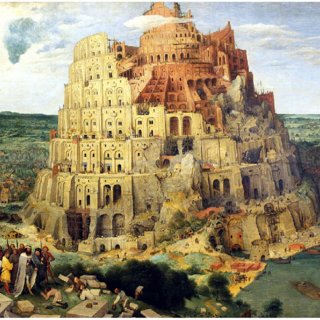 The Tower of Babel (detail), Pieter Bruegel the Elder, 1563. (Via Wikipedia)
Most coverage of Operation Epic Fury and Operation Roaring Lion is so rapidly emerging and quickly ephemeral that it’s best suited to a post on X. Not that much is worth thrashing out at greater length. We’re in such unfamiliar territory that most of people’s guiding experiences don’t really fit the current situation very well.
But I do want to address a couple of topics very briefly. They’re quite simple and fundamental. The intention here is not to address them comprehensively. That would take considerable time, and be of limited value, in my view.
Instead, I want to introduce them: to put down a marker for future discussion. Both of them will remain with us beyond the duration of this conflict. They’re very “big picture” concepts, and therefore as simple and applicable in a given time as a concept can be.
The first is an essential thing to understand about the U.S. role in the Iran operation. It’s this: the key value of the United States doesn’t lie in our military prowess, distinctive as it is. There’s a great deal in Iran that Israel can get done on its own, and in fact is getting done.
It’s better to have the U.S. military there as well, because two high-performing and extremely-capable forces are inherently better than one, when well-coordinated.
Ping One
But the unique value of the United States is our global stature and ability to get regional buy-in for the consequences of the operations in progress.
Below, see how I put it in that other forum I’m always referring to. The set-up is reactions to this summary of comments by Speaker Mike Johnson and Secretary Rubio, whom the legacy media were trying to depict as blaming Israel for dragging the U.S. into the conflict: “Israel saw an existential threat, Johnson said, and was ready to move alone. ‘If we had waited to respond before acting first, then those losses would have been far greater than if we had done what we did,’ he said.
“The speaker’s remarks echoed those of Secretary of State Marco Rubio, who alluded during his own words to the press on Monday that the U.S. knew Israel was primed to attack Iran. Johnson, too, added that intelligence presented during the classified briefing indicated Iranian retaliation against U.S. personnel and assets was likely if Israel launched a unilateral strike. ‘I am convinced that they did the right thing,’ Johnson said. ‘If the president, the commander-in-chief, had not acted as he did, those same officials would have been hauled in here by members of Congress and asked them why in the world they waited.’”
My response:
Neither Johnson nor Rubio was complaining about Israel’s timing or determination, or their effect on us. They were simply noting the sequence of events.
I think Johnson is right, FWIW. I also think the Trump administration understood a separate and actually very important principle. It’s because the US joined the fight that there’s a prospect of Iran’s regime being changed, out of this operation, and the region accepting the outcome without a feeding frenzy in the unstable aftermath that’s already started.
ONLY the US can shepherd through a regime change, or even lesser consequences, with regional buy-in. If we’re not there, China and Russia will get involved, KSA and others will find reasons to be at loggerheads, Turkey will weigh in to ill effect, and jihadis of all stripes will try to make an impact.
Forcing the settlement we want on Iran (no nuc weapons program or long-range missiles, vitiating of proxy threat, regime left with no ability to project power or even torment its own people) requires the US to be in the fight. Israel can largely inflict the conditions, but it takes our power to make everyone else accept the outcome.
Containing and shaping an aftermath in which the Iranian people have overthrown the Islamic regime is something only the U.S. can do. Moreover, achieving the American objectives Trump laid out (last paragraph in the quote) requires the same level of destructive attack that would create conditions for a regime-change. It was always inherently likely that regime-change would follow.
And since the U.S. can have no conceivable preference for keeping the Iranian regime in place, the correct course of action is to prepare to shape regional forces for buy-in, and for mutually beneficial participation in fostering the new outcome – the “better peace.”
Ping Two
The second point is that everything is going to change. It’s as simple as that. In 47 years, a whole geopolitical atmosphere and set of dynamics has been established due to the brooding, dysfunctional presence of the endlessly erupting Islamic Revolutionary regime in Iran. As with the 75 years of the old Soviet Union, people can hardly imagine global life without it.*
But that’s what we are going to have. Without the mullahs of Qom, their proxies – Hezbollah, Hamas, and the Houthis – can’t simply continue as they are. The Iran-backed militias in Iraq can’t remain what they are. The outreaches of the radical regime through “cultural centers” around the globe will quickly wither, untended and hollow.
We saw in Venezuela how very much was affected globally through a single operation to squash the cartels and remove Nicolas Maduro from power. (See earlier discussions at TOC here and here.) Zeroing out the Iranian regime will have an impact that reverberates even further.
This second point is far too big to treat in a short think-piece. A place to start getting the juices flowing is Lee Smith’s excellent treatment of the China problem at Tablet, and its closely intertwined relationship with U.S. interests and policy in the Middle East. I have to give it shamefully short shrift here, but would call attention to Smith’s discussion of the “Concert of Europe” idea Henry Kissinger was fond of (a guiding principle from the Congress of Vienna after Napoleon was regime-changed). U.S. overtures to China under Nixon and Kissinger, Smith observes, were an attempt to establish what Obama later called “geopolitical equilibrium,” the Holy Grail of the Concert of Europe framework.
Long-time readers know I’ve written about the Concert of Europe idea a number of times before. A very notable aspect of its regulatory effect was favoring things like the consolidations of Germany and Italy as an equilibrium-seeking solution to “small wars” and inconvenient revolutions in the 19th century. The “Concert” notion was deemed to be a tamer of armed eruptions, but plenty of conquered provinces were unhappy having their fate decided by it.
China today, under the Communist Party, is nothing if not an aspiring hegemon seeking to turn neighbors and overseas connections into conquered provinces. China is what Kissinger would call a dissatisfied power, in need of balance and containment from the status quo powers.
I would propose that Trump, rather than seeking to gratify what Smith delightfully calls the “effete and clammy-pawed Davos set” with their idea of a geopolitical good time, should work from the larger perspective that fundamental change is needed, and is often a solution and not a problem. The UN Charter has largely stood the test of time, but that makes it a useful starting place, not an excuse for sticking with “done deals” in international organization and protocols that could stand a good rollback.
This brings us back to the idea that only the U.S. can protect transformative geopolitical developments that are preferred by peoples and result in a better peace.
A key codicil to that point is that letting old-consensus Davosites set boundaries for new developments is a wrong direction. The U.S. can shake that off – and should. Trump’s project should not be to organize us all into paralysis, but to preside with a loosely protective presence, firm but of limited scope, over voluntary, peaceable, largely transactional activity.
Only the U.S. can do that. (It’s a whole other discussion what is required to remain capable of doing it in good faith and well.)
There’s no other nation that even wants to do it, and no other entity that could.
I will put down this one marker. There’s also just one direction to move for best effect, and that’s toward decentralization of power among the nations. Less centralizing organization; more results from transaction, as opposed to hiding behind unenforceable appeals to “international laws and norms” that are always manipulated one-sidedly in their application.
Looking down the road a bit, it is well to remember that the end of the Concert of Europe was World War I. Europe congratulated itself for about a century on the spirit of Vienna and its domestication of war. Then August 1914 hit, and it turned out the prize of “limited” wars was a chimera, when the limited wars kept requiring moral losses, greater and more sclerotic concentration of power, and political resentments. Sooner or later the steam has to blow. That is a lesson to take seriously.
Feature image: The Tower of Babel (detail), Pieter Bruegel the Elder, 1563. (Via Wikipedia)
* A think-piece on a fundamentally changing world, from 2015, is here. The scope of what I see happening is significantly larger than even the impending collapse of the Iranian regime. I wrote “A World without a Hegemon” just before Trump came on the scene in 2015, and in his 45 term he began to rescue the world from the untethering effect of Obama’s abandonment of responsibility in American hegemony. Trump’s rescue has resumed in T47. So the 2015 predictions about the future have been tempered by the Trump presidencies.
But the review of the past stands, and the assessment that the model of hegemony is undergoing change in a way not envisioned or foreseen. We’re on a one-way trajectory here. The trends of today are not sending us into the repetition of a 400- or 500-year cycle, or developing according to any other popular theory about how history behaves.
That isn’t necessarily a bad thing, as I said in 2015. There’s unique opportunity in such a juncture of history. This applies to the more limited problem of the aftermath in Iran, and I believe Trump sees that. I think his tendency to focus on fostering trade, enterprise, prosperity, and partnerships may well be much more of a godsend than a grand ideological view would be.


Leave a Reply
You must be logged in to post a comment.