
Harry Liberman
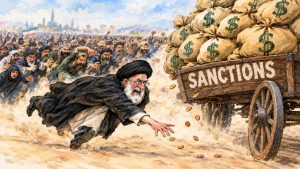 Image via AI
To those complaining that the economic and geopolitical war against the Iranian regime is taking too long: Your impatience betrays a fundamental ignorance of history.
America is a nation currently trapped in the cadence of a TikTok video, conditioned to demand instant-gratification accomplishments that can be neatly packaged into a 15-second clip or a triumphant 100-day press cycle. But history is not a social media feed. This rapid-fire, short-sighted mindset is precisely why the West has spent decades losing ground to adversaries who operate not in fiscal quarters, but in centuries.
In times of civilizational crisis, nations rarely get the polished, diplomatic heroes they want; they get the ones they need.
Donald Trump is the modern iteration of General George S. Patton or Dirty Harry—brash, uncompromising, and deeply unliked by the polite consensus of the global elite.
Yet, like Patton sweeping through Europe or Harry Callahan ignoring bureaucratic red tape to stop a predator, he understands a brutal truth that elites refuse to admit: raw power and economic leverage are the only currencies recognized by ancient, patient adversaries. He is the figure no one wants to invite to a dinner party, but everyone secretly relies on to get the job done.
Consider the historical scale of the threat that Washington has ignored for sixty years.
It took over 1,400 years of systemic, patient expansion to transform more than 50 once-diverse, non-Islamic regions into uniform, Muslim-majority states—leaving them effectively emptied of ancient Jewish communities and deeply hostile to their Christian roots.
Today, that same long-term ideological patience exploits Western democratic systems to establish deep demographic and cultural footholds across Western Europe and North America.
Historic capitals like London and cultural hubs like New York have morphed into heavily altered landscapes, straining under localized demands for institutional assimilation. Twenty-five years after 9/11, the victims of the Twin Towers still metaphorically scream from the New York skyline—a permanent, harrowing reminder of what happens when a free society falls asleep to a patient, generational assault.
This civilizational erosion has been actively accelerated by what political scientists and intelligence agencies describe as an emerging “Red-Green Alliance”. This dangerous axis pairs radical Western Marxist movements with fundamentalist Islamist factions.
On the surface, the partnership is paradoxical:
Marxist frameworks seek a totalitarian, secular socialist order, while Islamist groups pursue total submission to religious law. Yet they have formed a toxic, operational partnership driven by a singular, shared obsession: the destruction of Western civilization, capitalism, and American sovereignty. This is not the first time this unholy alliance has struck; historical precedents like the 1979 Iranian Revolution demonstrate how radical Marxists willingly aligned with Islamist zealots to overthrow a pro-Western regime, only to be consumed by the monster they helped create.
Today, this alliance utilizes the mechanisms of Western democracy to erode borders, campus stability, and national identity from within.
President Donald Trump’s administration is finally executing the harsh, unsentimental corrections required to undo over 60 years of naive American benevolence.
This grand, miscalculated global charity began with the Marshall Plan—a noble initiative that mutated into a permanent welfare state for a complacent Europe, allowing foreign governments to take immense financial and military advantage of the American taxpayer while neglecting their own defensive responsibilities.
For decades, Washington subsidized the security of the world while its own domestic industrial base was systematically hollowed out.
President Donald Trump’s aggressive new energy strategies represent a total, un-apologetic rejection of that failed status quo, deploying a high-speed American shock doctrine designed to reclaim raw global leverage. He does not care about the approval of European technocrats or corporate globalists; he cares about winning.
On paper, the Trump administration’s recent chess moves look devastating.
In Venezuela, the sudden ouster of Nicolás Maduro allowed Washington to execute a swift, crushing economic coup against Beijing’s regional ambitions. By partnering with North American Blue Energy Partners (NABEP), the United States successfully seized control over 17 vital oil fields, commanding an estimated 65 billion barrels of crude reserves. In a single, decisive stroke, the U.S. locked down China’s heavily discounted “teapot” refinery supply, froze out aggressive state firms like Sinopec and the China National Petroleum Corporation (CNPC), and effectively nullified billions of dollars in Venezuelan sovereign debt owed to Beijing.
It was a classic “Dirty Harry” move—fast, legally unassailable, and devastating to the opponent.
Meanwhile, in the Middle East, Trump is deploying what strategist frame as the “American Python”—a geopolitical strategy designed to completely reroute global oil flows away from the vulnerable, Iran-choked Strait of Hormuz and into alternative, U.S.-secured pipelines. The ultimate goal is a slow, agonizing, and total economic squeeze on Tehran.
By choking off the Islamic regime’s primary black-market revenue streams, the administration is systematically starving the Islamic Revolutionary Guard Corps (IRGC) of the cash required to fund its regional terrorist proxies, from Hezbollah to the Houthis. This strategy is engineered to dismantle what has been a decades-long domestic occupation of the Iranian people by a radical clerical elite.
It is a slow, crushing death, and for the radical regime in Iran, the board is being cleared. It is game over.
Critics who whine about the timeline or the lack of immediate, explosive fireworks fail to see the fundamental paradox of the modern era. While domestic detractors fret over short-term shifts and worry that aggressive resource extraction might disrupt traditional green industrial transitions, they miss the larger, civilizational picture: energy is not just a commodity; it is the ultimate weapon of survival.
President Donald Trump’s Python strategy assumes the target will suffocate, but it requires the American public to shed its short-term, instant-gratification attention span.
China’s Belt and Road Initiative and Iran’s regional proxy networks were explicitly engineered to absorb economic pain, adapt to temporary blockades, and outlast Western political patience. They bank entirely on the structural vulnerability of democracies—specifically, the belief that American political winds will shift every four to eight years, allowing adversaries to simply hide in the tall grass and outwait us until a more compliant, benevolent leader takes the Oval Office.
Silencing the critics means understanding that a generational, multi-century conflict cannot be won with a superficial 100-day plan.
Weaponizing domestic oil fields, seizing hostile reserves, and choking off rogue shipping lanes are not temporary political stunts; they are the foundational bricks of a long-overdue wall built against civilizational expansion.
You cannot defeat an adversary thinking in centuries when you are only planning for the next cable news cycle. Washington is finally learning to play the long game, guided by President Donald Trump , a leader who—like Patton—is built for the mud and the blood of real victory, rather than the clean optics of a diplomatic surrender.
Footnotes
[1] For a comprehensive analysis of the historical, century-long demographic changes and territorial shifts across North Africa and the Middle East, see Ephraim Karsh, Islamic Imperialism: A History (Yale University Press, 2007).
[2] Documentation regarding the tactical coordination between Western radical left organizations and Islamist political groups is detailed in the symposium series The Red-Green Alliance: Radical Islam and the Marxist Left (Center for Security Policy, 2023).
[3] For an analysis of how Marxist factions originally allied with Ayatollah Khomeini’s Islamist movement during the 1979 revolution before being systematically purged, see Ervand Abrahamian, A History of Modern Iran (Cambridge University Press, 2008).
[4] Details regarding the asset reorganization of Venezuelan crude reserves, Western state interests, and the restructuring of state-backed entities like Sinopec and CNPC are outlined in the global energy security report Reclaiming the Margin: Geopolitical Realignments in Latin American Energy Markets (Energy Policy Research Foundation, 2026).
Israpundit is entirely dependent on readers support. Please help me continue educating people with the truth about what is going on in Israel and around the world.


I’m locked out since the identification information I thought was correct isn’t being accepted to post a response to the Jared Kushner article about the “D” rated Gaza “Peace (of the grave) plan he’s come up with for Israel.
So, I’m posting my response here, I hope;
https://www.newenglishreview.org/as-a-dedicated-fisherman-i-can-smell-the-naivete-and-stench-of-a-rotten-fish-and-the-latest-gaza-peace-plan-stinks-to-high-heaven/
On the same Kushner “peace plan,” while I shared this earlier, it’s relevance is as potentially important today as much earlier:
https://www.newenglishreview.org/is-munich-1938-and-neville-chamberlains-peace-for-our-time-about-to-be-duplicated-in-president-trumps-new-gaza-peace-plan/
Excellent analysis, but Trump is not Patton…
Patton’s armored tank brigades! led American ground
forces to hunt down and seek and destroy the Nazi regime ànd its military support system as effectively as possible.
More than economic strangulation ànd air bombardment were required to complete this task, and it cost America dearly.
Had the Russians not reversed their original decision and decided to fight the Nazis instead of allying with them, American and other Allied efforts would probably not have succeeded.
The massive amount of military might Hitler had to divert to the Russian front was key to our own success.
President Truman had to agree to the invasion of Europe, making way via France to the heart of the Nazi regime.
He wasn’t confused or conflicted because of family and fellow billionaire friends’ business interests, in collaboration with black African slaver Arab oil potentates like The Donald has been.
Trump has all but given up on freeing the oppressed Iranian masses and bringing democracy to them as
Truman did for Japan ànd Germany after WWII…
https://www.newenglishreview.org/the-difference-two-letters-in-an-american-leader-make/
Patton commanded Divisions, in WWII, not smaller brigades…
Long overdue and about time.
Pairing radical Western Marxist movements with fundamentalist Islamist factions is the new death of our world.
Well stated!